

America Says They Can Win
I was in a bar in Austin, Texas, on a November afternoon in 2022, watching the United States play England in the World Cup. The place was packed -- not with the expatriate English crowd you might find in New York or Boston, but with Americans, young
Published: June 6, 2026
Comic content and match statistics are for entertainment purposes only and may contain inaccuracies. For Accurate Data, please refer to the reference's official website.
# Stars, Stripes, and Expectations: The USMNT's Date with Destiny
I was in a bar in Austin, Texas, on a November afternoon in 2022, watching the United States play England in the World Cup. The place was packed -- not with the expatriate English crowd you might find in New York or Boston, but with Americans, young Americans, wearing Pulisic jerseys and McKennie jerseys and the kind of face paint usually reserved for college football Saturdays. They sang. They chanted. They knew the words to songs that did not exist when I first started covering American soccer twenty years ago. When the final whistle blew on a goalless draw -- a result that, in the cold arithmetic of the group stage, suited both teams just fine -- the bar erupted as though a victory had been secured. And in a sense, it had.
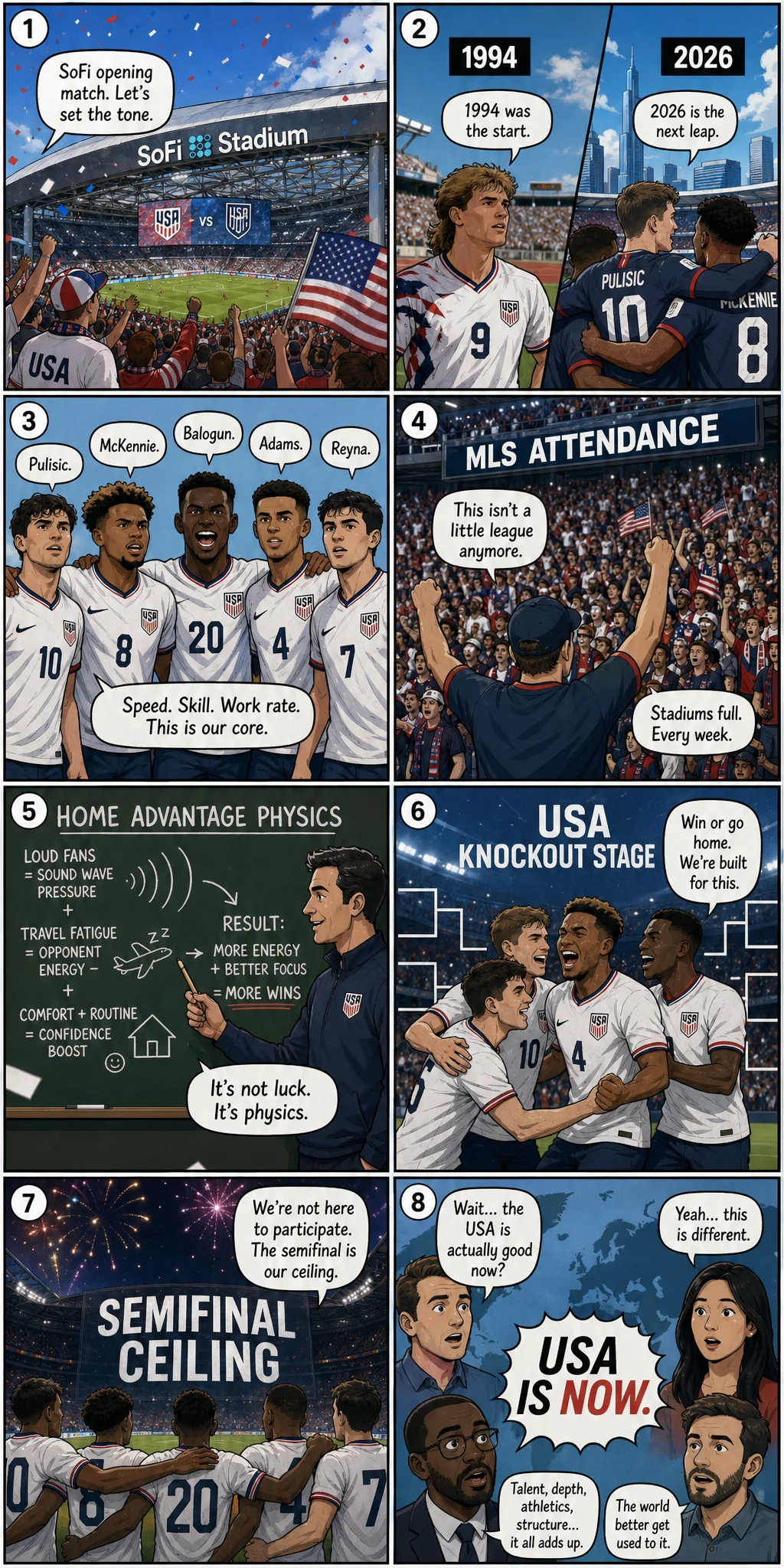
Something has shifted in American soccer. You can feel it in the stadiums, in the bars, in the way people talk about the national team -- not with the hopeful, slightly apologetic tone of a niche interest hoping to be taken seriously, but with the confidence of a movement that has reached critical mass. The 2026 World Cup, co-hosted on home soil, represents the culmination of three decades of investment, immigration, and incremental progress. The question is no longer whether the United States can compete. The question is whether this team -- the deepest, most talented, most expensively assembled squad in American soccer history -- can do something that no US men's team has done since 1930: reach the semifinals of a World Cup.
Let us begin with what is not in dispute: this is the most talented American squad ever assembled. The previous claim to that title, the 2002 team that reached the quarterfinals in South Korea, featured a genuine star in Claudio Reyna, a precocious young winger in Landon Donovan, and a collection of hard-working professionals who understood their roles and executed them with admirable discipline. But the 2002 team did not have a player starting regularly for Chelsea, as Christian Pulisic does. It did not have a midfielder anchoring one of Italy's most storied clubs, as Weston McKennie has done at Juventus. It did not have a Champions League winner -- Tyler Adams, who lifted the trophy with RB Leipzig's sister club structure before his move to the Premier League -- or a striker developed in Arsenal's academy who chose to represent the United States over England, as Folarin Balogun did in one of the most consequential eligibility decisions in American soccer history.
The depth is what separates this team from its predecessors. In 2002, Bruce Arena's squad had maybe 14 or 15 players who could be trusted in a knockout match. Gregg Berhalter's successor -- the managerial situation remains in flux, a subject for another day -- will have 20 or more. The midfield alone is an embarrassment of riches: McKennie, Adams, Yunus Musah (who chose the US over England and Italy), Gio Reyna (when fit, a creative talent unmatched in the American pool), Luca de la Torre, Johnny Cardoso. For the first time in American soccer history, there are difficult selection decisions to be made in positions other than goalkeeper -- where Matt Turner, Ethan Horvath, and Zack Steffen represent the deepest pool of American goalkeeping talent ever assembled.
But talent, as any veteran of international tournaments will tell you, is only part of the equation. The other part -- the part that has historically undermined American World Cup campaigns -- is the intangible alchemy of tournament readiness: the ability to navigate the psychological pressure of a World Cup, to perform when the margin between triumph and disgrace is a single misplaced pass, to withstand the intensity of a knockout match against an opponent whose players have been competing at this level since they were teenagers. And here, the American ledger is thin. The 2022 World Cup was, in many respects, a four-year early preview of 2026: a young American team, the youngest in the tournament by average age, faced the Netherlands in the round of 16 and learned, in the most painful way possible, the difference between competing and winning. The Dutch did not outplay the United States; they out-thought them. Every American mistake was punished. Every moment of tactical naivety was exploited. The scoreline -- 3-1 -- was flattering to the Americans, and the players knew it.
The value of that experience, painful as it was, is incalculable. The core of the 2026 team -- Pulisic, McKennie, Adams, Musah, Reyna, Dest, Robinson, Turner -- has now played a World Cup knockout match. They have felt the weight of the occasion and the speed of the transition from group stage to elimination football. They have stood in the tunnel before a round of 16 match and looked across at opponents who have been here before, who know what is coming, who have learned the lessons that can only be learned through loss. The 2022 defeat to the Netherlands was not, in retrospect, a failure. It was tuition. The bill for that education comes due in 2026.
The home advantage cannot be overstated, because it is not merely a matter of crowd support -- though the crowds will be enormous, passionate, and overwhelmingly partisan. It is a matter of logistics, of familiarity, of the thousand small comforts that accumulate across a five-week tournament and compound into a genuine competitive advantage. The American team will train at facilities they know. They will eat food they recognize. They will sleep in hotels whose climate control systems operate in Fahrenheit. They will not cross a single time zone in the group stage. Every other team in the tournament will be, to some degree, displaced. The United States will be home.
And home, in the specific context of the 2026 tournament, means something more than comfort. It means pressure. The American sporting public, conditioned by decades of global dominance in basketball, by the commercial juggernaut of the NFL, by the expectation that the United States should compete for championships in every sport it takes seriously, will not be satisfied with a round of 16 appearance -- not on home soil, not with this squad, not after thirty years of promises about the coming American soccer revolution. The quarterfinal is the floor. Anything less will be treated as a failure, fairly or not, and the players know it.
Can they reach the semifinal? The question is not absurd, which itself represents progress. The 2026 draw, when it arrives, will determine much: a favorable path through the group stage and a round of 32 matchup against a beatable opponent, followed by a round of 16 match that avoids the tournament's genuine heavyweights, could open a corridor to the quarterfinals that an American team of this quality should navigate. From there, the semifinal becomes a one-match proposition -- 90 or 120 minutes against an opponent that may be superior on paper but is not immune to the chaos that tournament football reliably produces.
I think back to that bar in Austin, to the faces of the young Americans who had discovered soccer not as a foreign curiosity but as their own. Their sons and daughters, growing up in a country where the World Cup was played on home soil, where an American team reached the semifinals, will inherit a different kind of soccer fandom -- one rooted not in hope but in memory, not in aspiration but in achievement. That is the prize. Not the trophy, not yet. But the memory. The proof that it can be done. The 2026 World Cup is not the end of the American soccer journey. It is the beginning.