
One Leg Worth a Billion
There is a specific kind of silence that descends on a stadium when a player does not get up. It is not the silence of respect or anticipation; it is the silence of a crowd collectively holding its breath, running the calculations that every football
Published: June 6, 2026
Comic content and match statistics are for entertainment purposes only and may contain inaccuracies. For Accurate Data, please refer to the reference's official website.
# The Fragility of Favorites: Injuries That Could Reshape the 2026 World Cup
There is a specific kind of silence that descends on a stadium when a player does not get up. It is not the silence of respect or anticipation; it is the silence of a crowd collectively holding its breath, running the calculations that every football fan learns to perform instinctively. How bad does it look? Is he moving? Was it the knee, the ankle, the hamstring? The silence lasts only a few seconds before the murmuring begins, but in those seconds, a tournament can pivot on its axis. A team that entered the match as a favorite can leave it as a question mark, and the question -- will he be fit for the next round, the next match, the rest of the tournament? -- can dominate the days that follow with a gravity that no tactical adjustment or formation change can match.
The 2026 World Cup, by virtue of its expanded format and compressed schedule, will be unusually vulnerable to the disruptive power of injury. The 48-team, eight-match campaign demands more from its participants than any previous World Cup, and the players who matter most -- the stars around whom entire tactical systems are constructed -- will enter the tournament after club seasons that have already extracted a toll that no amount of sports science can fully recover. The question is not whether injuries will affect the tournament. It is which injuries will reshape it, and which contenders will see their campaigns defined by the absence of a single irreplaceable player.
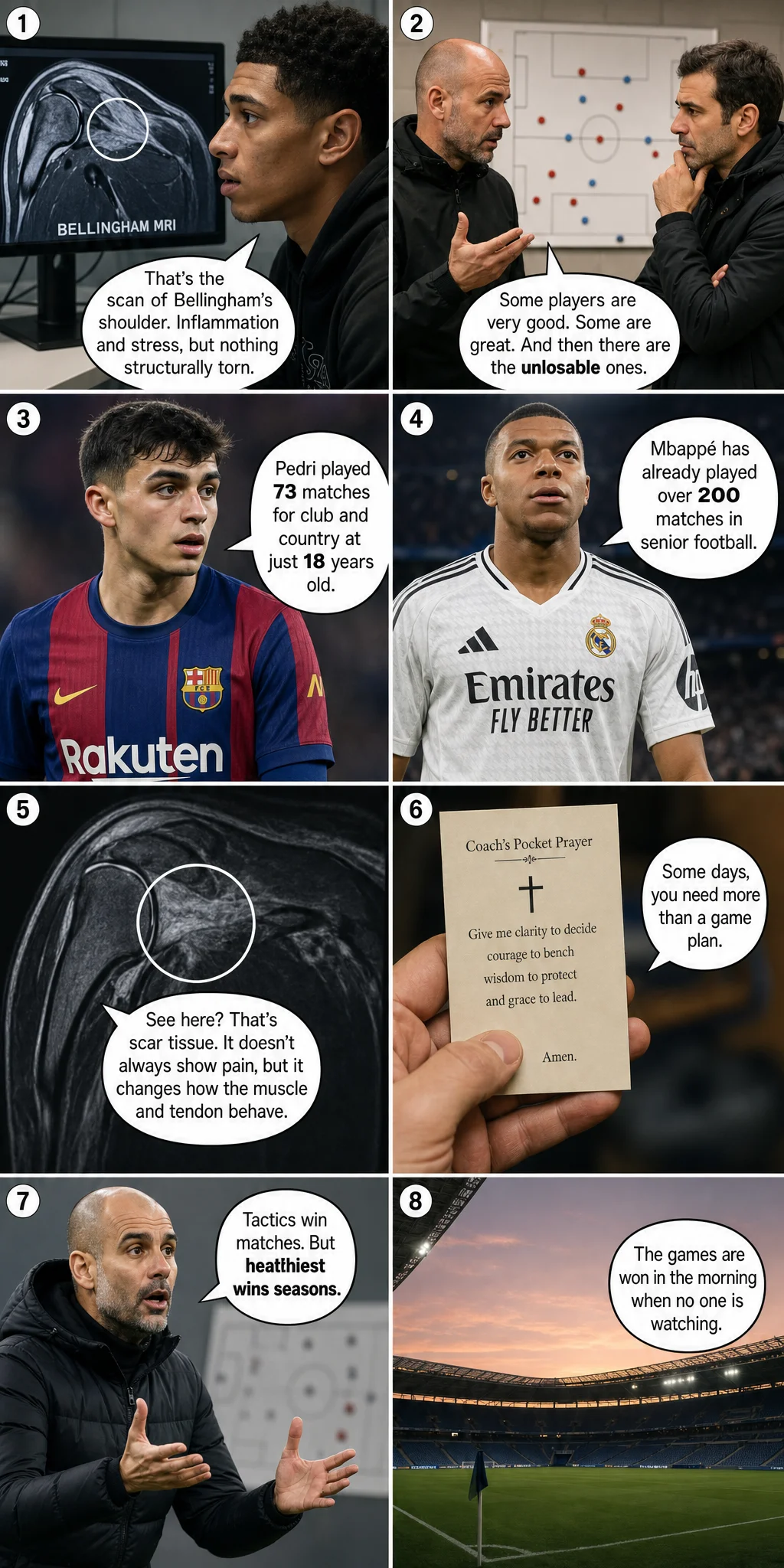
Consider France. The defending champions in 2022, defeated finalists on penalties, and arguably the deepest national team pool in world football -- but France without Kylian Mbappe is not simply a weaker version of France. It is a fundamentally different team, one that loses not merely its best goalscorer but its entire attacking identity. Mbappe's game is built on explosive acceleration, on the ability to go from stationary to full sprint in fewer steps than any defender can match, and that explosiveness is precisely the quality most vulnerable to wear and tear. A hamstring strain, a calf issue, even the kind of cumulative fatigue that makes a player 5 percent slower off the mark -- any of these can reduce Mbappe from a generational talent to a merely excellent forward, and France's margin for error, even with a squad that includes Ousmane Dembele, Kingsley Coman, and the emerging Desire Doue, is not wide enough to absorb that reduction without consequence.
The structural dependence on a single player is not a flaw specific to France; it is a feature of international football, where the talent distribution is inherently uneven and where the loss of one elite player cannot be compensated by signing a replacement in the transfer market. Spain's entire attacking system under Luis de la Fuente has been constructed around the verticality and unpredictability that Lamine Yamal provides from the right wing -- a player who, at 18 years old, is still physically developing and whose body is being asked to absorb the demands of a full La Liga season, a Champions League campaign, and a World Cup within a 12-month window. Yamal is not merely Spain's most creative player; he is the player who makes Spain's possession structure threatening rather than sterile, the one who forces defenses to stretch in ways that create space for Pedri and Dani Olmo to operate. If Yamal is unavailable or diminished, Spain's tactical identity loses its sharpest edge.
Brazil presents a variation on the same theme, with Vinicius Junior occupying a role in the Selecao's attacking structure that no other player in the squad can replicate. Vinicius is not simply a left winger; he is a one-man defensive disruption system, a player whose ability to beat his marker from a standing start forces defenses to commit a second defender to his side of the pitch and thereby creates the overloads that Brazil's other attackers -- Rodrygo, Endrick, Raphinha -- are designed to exploit. The mathematical value of this gravitational pull is difficult to quantify in conventional statistics, but the eye test is unambiguous: Brazil with Vinicius is a team that can stretch any defense in the world; Brazil without him is a collection of talented individuals whose talents do not quite cohere into a system.
England's dependence is distributed across multiple players, but the most consequential single absence would be Jude Bellingham, whose role in Thomas Tuchel's midfield is not merely to create and score -- though he does both -- but to provide the physical and technical link between England's defensive structure and its attacking talent. Bellingham is the rare midfielder who can receive the ball under pressure, turn, and progress it through the lines with both his passing and his carrying, and his capacity to do so is what allows England's front three to receive the ball in positions where they can actually hurt opponents rather than in areas where they are isolated against set defenses. Declan Rice provides the defensive platform; Bellingham provides the transition from platform to attack. Without him, that transition becomes slower, more predictable, easier to defend.
The injury risk is not evenly distributed across the tournament. The group stage, with its compressed two-match format, offers little margin for recovery: a player who sustains a minor injury in the opening match has perhaps four or five days before the second group match, and the pressure to return -- to avoid elimination, to secure qualification, to justify the expectations of a nation -- will be immense. The medical staffs that manage these decisions will be operating under conditions that no amount of preparation can fully simulate: the pressure of a World Cup, the desperation of a player who has waited four years for this moment, the knowledge that a conservative decision that preserves a player's long-term health may cost a team its tournament.
There is, too, the question of what happens when injuries accumulate across a squad rather than concentrating on a single star. The 48-team format's eight-match campaign will test squad depth more rigorously than any previous World Cup, and teams that appear formidable on paper may reveal vulnerabilities in their second and third tiers that were not apparent during qualification. This is particularly relevant for nations whose talent pools are concentrated in specific positions: a team with three world-class central midfielders but limited depth at full-back may find itself exposed by an injury to a single player in a position where the drop-off from starter to reserve is steep.
The 2026 World Cup will be shaped by injuries in ways that cannot be predicted but can be anticipated. The favorites will enter the tournament knowing that their campaigns depend, in part, on factors beyond their control -- on the physics of soft tissue, on the randomness of contact injuries, on the thousand small vulnerabilities that even the best-prepared athletes carry into the sport's most demanding competition. The champions will not necessarily be the most talented team. They will be the team whose talent remains available, whose stars stay healthy, whose bodies hold up across eight matches and 39 days. In a tournament of this scale and intensity, durability is not a secondary quality. It is the first prerequisite of victory.