
England vs France: Two Billion Euros
The history of Anglo-French football rivalry is not written in the blood and poetry of a true derby. There is no shared border dispute, no colonial wound, no centuries-old grievance that attaches itself to every tackle and every goal celebration. Wha
Published: June 6, 2026
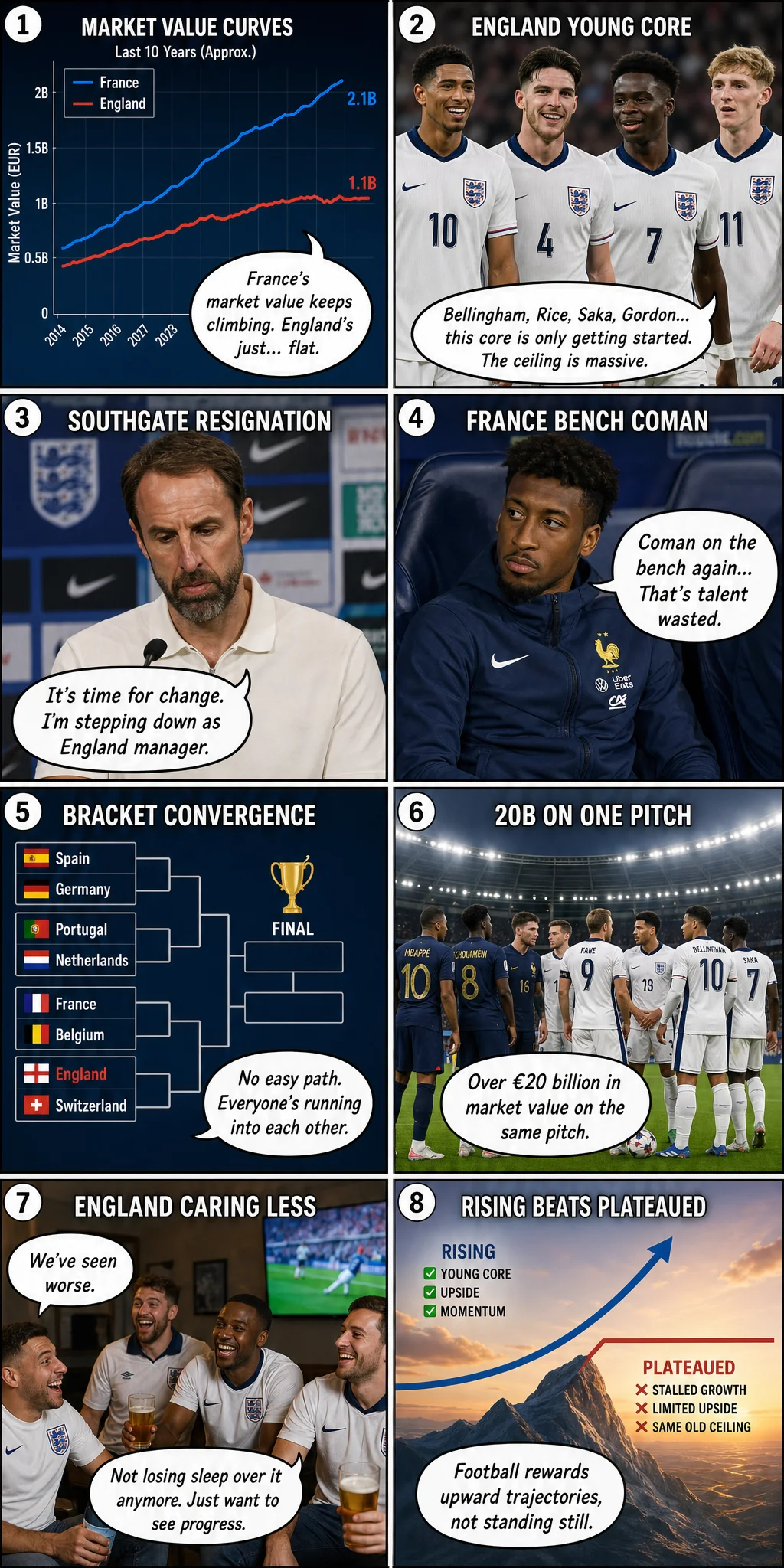
Comic content and match statistics are for entertainment purposes only and may contain inaccuracies. For Accurate Data, please refer to the reference's official website.
# The Channel Derby: England and France on a Collision Course
The history of Anglo-French football rivalry is not written in the blood and poetry of a true derby. There is no shared border dispute, no colonial wound, no centuries-old grievance that attaches itself to every tackle and every goal celebration. What exists instead is something cooler, more modern, and in its own way more compelling: the rivalry of neighbors who have spent a millennium defining themselves against each other and who now find themselves in possession of the two most expensively assembled squads in international football, on a trajectory that -- if the tournament draw cooperates, and if form holds -- will bring them into contact in a World Cup quarterfinal that would carry a combined squad value north of two billion dollars.
That figure -- $2 billion, give or take the fluctuations of the transfer market -- is not merely a statistic. It is a statement about what England and France have become. These are not national teams in the traditional sense, assembled from whatever talent a country happens to produce in a given generation. They are the products of the two most sophisticated youth development systems in European football, systems that have spent two decades refining the production of elite footballers with an industrial efficiency that earlier generations would have found almost dystopian. Clairefontaine and St George's Park are not merely training centers; they are factories of excellence, and the players emerging from them -- Mbappe, Bellingham, Camavinga, Foden, Tchouameni, Saka -- represent the highest concentration of footballing talent ever assembled in the history of either nation.
The tactical collision, when it comes, will be framed as a contest between two managers who embody different traditions of football thought. Thomas Tuchel, the German who has been entrusted with England's golden generation after Gareth Southgate's dignified exit, is a coach whose tactical philosophy is both more complex and more flexible than the stereotypes suggest. At Chelsea, he demonstrated the ability to construct a defensive structure that could neutralize the most potent attacks in European football while still generating enough offensive output to win matches at the highest level -- a Champions League final victory over Pep Guardiola's Manchester City remains the definitive statement of his tactical intelligence. At Paris Saint-Germain, he managed the egos and expectations of a superstar squad with more success than most of his successors. At Bayern Munich, he learned -- perhaps the hard way -- that even the most accomplished tactician cannot succeed without institutional alignment.
Didier Deschamps, by contrast, has spent more than a decade constructing a France team that is, in its deepest essence, anti-ideological. Deschamps does not have a philosophy in the way that Guardiola or Jurgen Klopp or Marcelo Bielsa has a philosophy. He has a method: identify the best players available, organize them in a structure that maximizes their collective output while minimizing their individual defensive liabilities, and trust that over seven or eight matches in a tournament context, talent plus organization will defeat tactics plus ideology. The criticism of Deschamps -- that his France teams are less than the sum of their prodigious parts, that they win without playing beautiful football, that their 2018 World Cup triumph was achieved through efficiency rather than artistry -- misses the point. Deschamps does not care about beauty. He cares about winning, and he has reached three major tournament finals in the last decade, a record that no active international manager can match.
The individual matchups that would define an England-France quarterfinal are almost absurdly rich. Bellingham versus Tchouameni in central midfield -- the 22-year-old who has become the complete midfielder, capable of influencing a match in every phase of play, against the 24-year-old whose defensive intelligence and passing range make him the most important structural element in the French midfield. Mbappe versus Kyle Walker, presuming Walker remains England's first-choice right-back at 36 -- the fastest attacker in world football against one of the few defenders who has demonstrated the capacity to match him stride for stride. Foden versus Theo Hernandez -- the left-footed creator drifting inside from the right, a role Foden has refined under Guardiola, against the left-back whose attacking contributions are so integral to France's buildup that he effectively functions as an auxiliary midfielder.
But the match would not be decided by individual duels alone. It would be decided by the structural choices each manager makes about how to approach a knockout match against an opponent of comparable quality. Tuchel, the tactician, would likely attempt to construct a specific game plan that neutralizes France's primary threats -- denying Mbappe the space to run into behind the defense, congesting the central areas where Griezmann operates as France's creative fulcrum, forcing France to build through wide areas where England's defensive shape is most secure. Deschamps, the pragmatist, would likely respond by doing what he always does: conceding possession, maintaining defensive compactness, and waiting for the moments of transition where France's athletic advantages -- and Mbappe's otherworldly speed -- are most devastating.
The psychological dimension of an England-France World Cup knockout match would be inescapable, particularly given the recent history between the two nations. Their meeting in the quarterfinal of Qatar 2022 produced a match that was statistically even and emotionally draining, decided by a single Olivier Giroud header and a missed Harry Kane penalty that will haunt the England captain for the rest of his career. The 2022 match was not, in retrospect, a meeting of equals; it was a match in which England played well enough to win and did not, a result that reinforced the narrative -- fair or not -- that France possesses a tournament-winning instinct that England has yet to develop.
The 2026 edition, if it materializes, would carry different stakes. England's generation has now accumulated enough tournament experience -- a World Cup semifinal in 2018, a European Championship final in 2021, a World Cup quarterfinal in 2022 -- that the "learning curve" narrative has exhausted its explanatory power. This team is expected to win, not merely to compete, and a quarterfinal exit to France would represent not progress but stagnation. France, for its part, enters the 2026 tournament with the weight of expectation that attaches to a team that has reached three consecutive major tournament finals and won one of them. Deschamps' France is not rebuilding or developing; it is defending a status as the world's preeminent international team, and anything short of a semifinal appearance would be treated as a failure.
The $2 billion figure, in the end, is both illuminating and misleading. It captures the market value of the players who would take the field, but it cannot capture the value of what is at stake: the right to define an era, the chance to transform a generation of near-misses into a legacy of achievement, the simple, irreducible glory of victory in a match between two nations that have spent a thousand years measuring themselves against each other. The Channel divides England and France geographically. It has never divided them culturally. In the summer of 2026, on a football pitch somewhere in North America, the two nations will meet again, and the stakes will be exactly what they have always been: everything.