
Brazil Stopped Dancing
There is a photograph from the 2002 World Cup final that every Brazilian of a certain age can describe from memory. Ronaldo -- the real Ronaldo, the Fenomeno -- wheeling away from Oliver Kahn with his arms spread wide, the number 9 on his yellow shir
Published: June 6, 2026
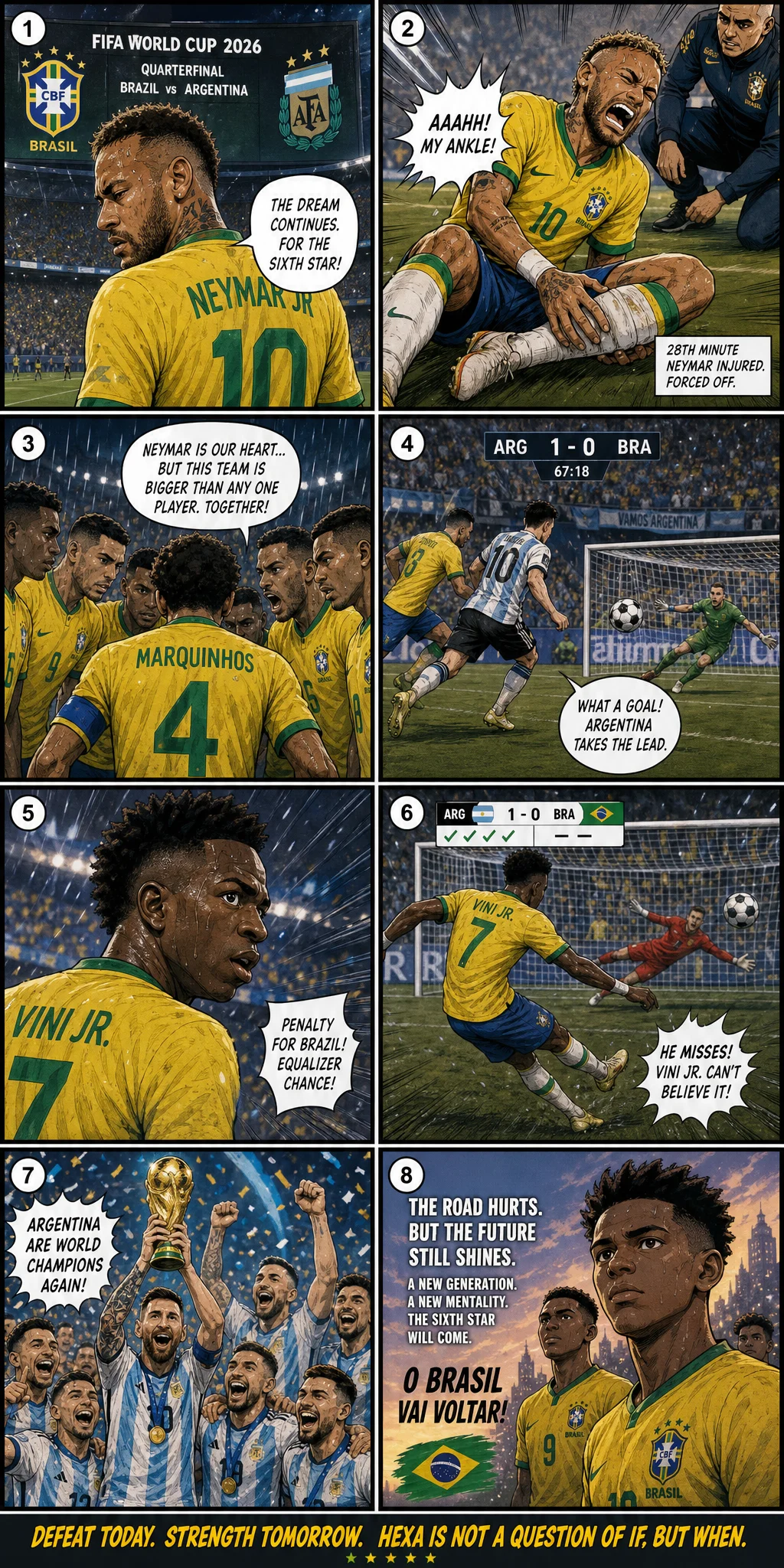
Comic content and match statistics are for entertainment purposes only and may contain inaccuracies. For Accurate Data, please refer to the reference's official website.
# Ancelotti's Last Tango: Can Brazil End the 24-Year Drought?
There is a photograph from the 2002 World Cup final that every Brazilian of a certain age can describe from memory. Ronaldo -- the real Ronaldo, the Fenomeno -- wheeling away from Oliver Kahn with his arms spread wide, the number 9 on his yellow shirt, the Yokohama night sky behind him. That was the last time Brazil won the World Cup. Twenty-four years later, the photograph has acquired the sepia of history, and the nation that produced Pele, Garrincha, Zico, Romario, and both Ronaldos -- the nation that has won the tournament five times, more than any other country -- has spent nearly a quarter-century watching others lift the trophy that was once considered Brazilian birthright.
Enter Carlo Ancelotti, in what may prove to be the most remarkable marriage of manager and national team since... well, ever. Ancelotti is not Brazilian. He is, in the most stereotypical sense, the opposite: a northern Italian from Emilia-Romagna whose public persona -- the raised eyebrow, the calm half-smile, the air of a man who has seen everything and been surprised by nothing -- is about as far from the carnival energy of Brazilian football culture as it is possible to be. And yet the Brazilian Football Confederation, in one of the most consequential decisions in its history, chose Ancelotti to lead the Selecao into the 2026 World Cup, betting that the most decorated club manager in Champions League history could translate his alchemical ability to manage superstars into a context where the superstars wear the same yellow shirt and carry the weight of a nation's self-conception on their shoulders.
The logic of the appointment is easier to grasp than the psychology. Ancelotti's greatest gift -- the quality that has enabled him to win league titles in Italy, England, France, Germany, and Spain, to win the Champions League four times as a manager, to command the respect of players as varied in temperament as Zlatan Ibrahimovic, Cristiano Ronaldo, and Luka Modric -- is his ability to manage egos without suppressing them. He does not demand that players subordinate their personalities to a system; he constructs systems that accommodate personalities. This is, in the context of the Brazilian national team, not merely an advantage but a necessity. The Selecao has always been a collection of individuals, and the managers who have succeeded -- Tele Santana in 1982, even if he did not win the tournament, and Luiz Felipe Scolari in 2002 -- understood that Brazilian football's genius lies not in collective discipline but in the liberation of individual expression within a structure loose enough to accommodate it.
The players Ancelotti inherits are, by any reasonable measure, the most talented Brazilian generation since the cohort that won the 2002 tournament. Vinicius Junior is the most devastating left winger in world football, a player whose combination of speed, technical ability, and goal-scoring instinct has made him the focal point of Real Madrid's attack and the heir apparent to the lineage of Brazilian number sevens that stretches from Garrincha through Jairzinho to Bebeto. Rodrygo, Vinicius's club teammate, is a different kind of talent -- less explosive, more cerebral, a player whose movement and spatial intelligence allow him to find pockets of space in crowded penalty areas with an intuition that cannot be taught. And then there is Endrick, the 18-year-old who has been anointed as Brazil's next great number nine since he was 15, and whose combination of physical power and technical refinement at an age when most players are still learning to shave justifies at least some of the Messianic expectations that have attached themselves to his name.
The midfield presents Ancelotti with a more complex puzzle. Bruno Guimaraes, the Newcastle United metronome, provides the passing range and defensive industry that any balanced midfield requires, but the identity of his partner -- or partners, depending on formation -- is less certain. Lucas Paqueta, when his mind is right and his off-field situation is settled, offers the creative link between midfield and attack that Brazil has lacked in recent tournaments. Joelinton, Guimaraes's club teammate at Newcastle, provides a physical dimension that no other Brazilian midfielder can match -- the kind of ball-carrying power through central areas that can break defensive lines in ways that passing alone cannot. And then there is the endless Brazilian production line of deep-lying playmakers, the tradition of the volante that stretches back to Didi and Clodoaldo, now represented by players like Andre Trindade and Joao Gomes who may force their way into Ancelotti's plans before the tournament begins.
The defensive unit is, historically, where Brazilian World Cup campaigns have been won or lost. The great Brazilian teams -- 1958, 1970, 1994, 2002 -- all possessed defensive foundations that were overlooked in favor of the attacking brilliance that defined their public image, but that were essential to their success. Ancelotti's Brazil will be built around Marquinhos, the Paris Saint-Germain center-back whose quiet excellence has never quite received the international recognition it deserves, and Eder Militao, whose recovery speed and physical presence make him the ideal partner for Marquinhos's more cerebral approach. The full-back positions, once the most distinctively Brazilian positions on the pitch -- think of Cafu and Roberto Carlos in 2002, of Carlos Alberto in 1970 -- are now occupied by players whose excellence is more orthodox: whoever emerges from the competition between Danilo, Vanderson, and the returning options available to Ancelotti.
The goalkeeping position deserves a paragraph of its own, because it represents perhaps the most significant evolution in Brazilian football culture over the past quarter-century. Alisson Becker and Ederson are not merely two of the best goalkeepers in the world; they are two of the best goalkeepers in the history of Brazilian football, and their simultaneous emergence has transformed a position that was once considered Brazil's perennial weakness into a position of unmatched strength. The competition between them -- Alisson the more complete shot-stopper, Ederson the better distributor -- gives Ancelotti a selection headache that most international managers would envy, and it means that Brazil will enter the 2026 tournament with the best goalkeeping situation of any team in the competition.
The question that hangs over all of this talent is the same question that has hung over every Brazilian team since 2002: can it survive the psychological pressure of a World Cup campaign in which anything less than victory is treated as catastrophe? Brazil is the only nation for which winning the World Cup is not an aspiration but an expectation, and the weight of that expectation has crushed more talented Brazilian teams than this one. The 2006 team, featuring the "Magic Quartet" of Ronaldinho, Kaka, Ronaldo, and Adriano, were eliminated in the quarterfinals by a France team they were expected to beat. The 2010 team, built around Kaka and Luis Fabiano, collapsed against the Netherlands after taking an early lead. The 2014 team, playing at home, suffered the most traumatic defeat in Brazilian football history -- the 7-1 semifinal against Germany that remains an open wound in the national psyche. The 2018 and 2022 teams, both talented and well-organized, were eliminated by Belgium and Croatia respectively in matches they could have won and did not.
Ancelotti's presence addresses this pattern of underperformance in ways that are difficult to quantify but impossible to ignore. He has spent his career managing expectation at clubs where winning is not an ambition but an obligation -- AC Milan, Chelsea, Real Madrid -- and his temperament, that imperturbable calm that has survived sackings and triumphs with equal equanimity, may be precisely what Brazil needs to navigate the psychological pressure of a World Cup. He will not panic if Brazil concedes first. He will not overreact to a poor group stage performance. He will not allow the external noise -- and the external noise around the Brazilian national team is louder than around any other team in world football -- to penetrate the bubble of calm that he has spent four decades cultivating.
Whether this is enough to end the 24-year drought is a question that cannot be answered in advance. The 2026 tournament will feature formidable opposition: a France team bidding for a third consecutive World Cup final, an England team whose talent pool rivals Brazil's, an Argentina team led by a Lionel Messi who will be 39 but who has defied every prediction of decline. But Brazil under Ancelotti will not be going to the World Cup hoping to win. They will be going expecting to win, and the difference between hope and expectation is the difference that 24 years of waiting has inscribed in the Brazilian football soul. Ancelotti cannot erase that history. But he can write a new chapter, and he has spent his career proving that the calmest person in the room is often the most dangerous.