
The Softest Path Ever Drawn
There is a moment, approximately two hours after the World Cup draw concludes, when the initial excitement of seeing which teams will face each other gives way to a more cold-blooded calculation. Fans and analysts begin tracing paths through the brac
Published: June 6, 2026
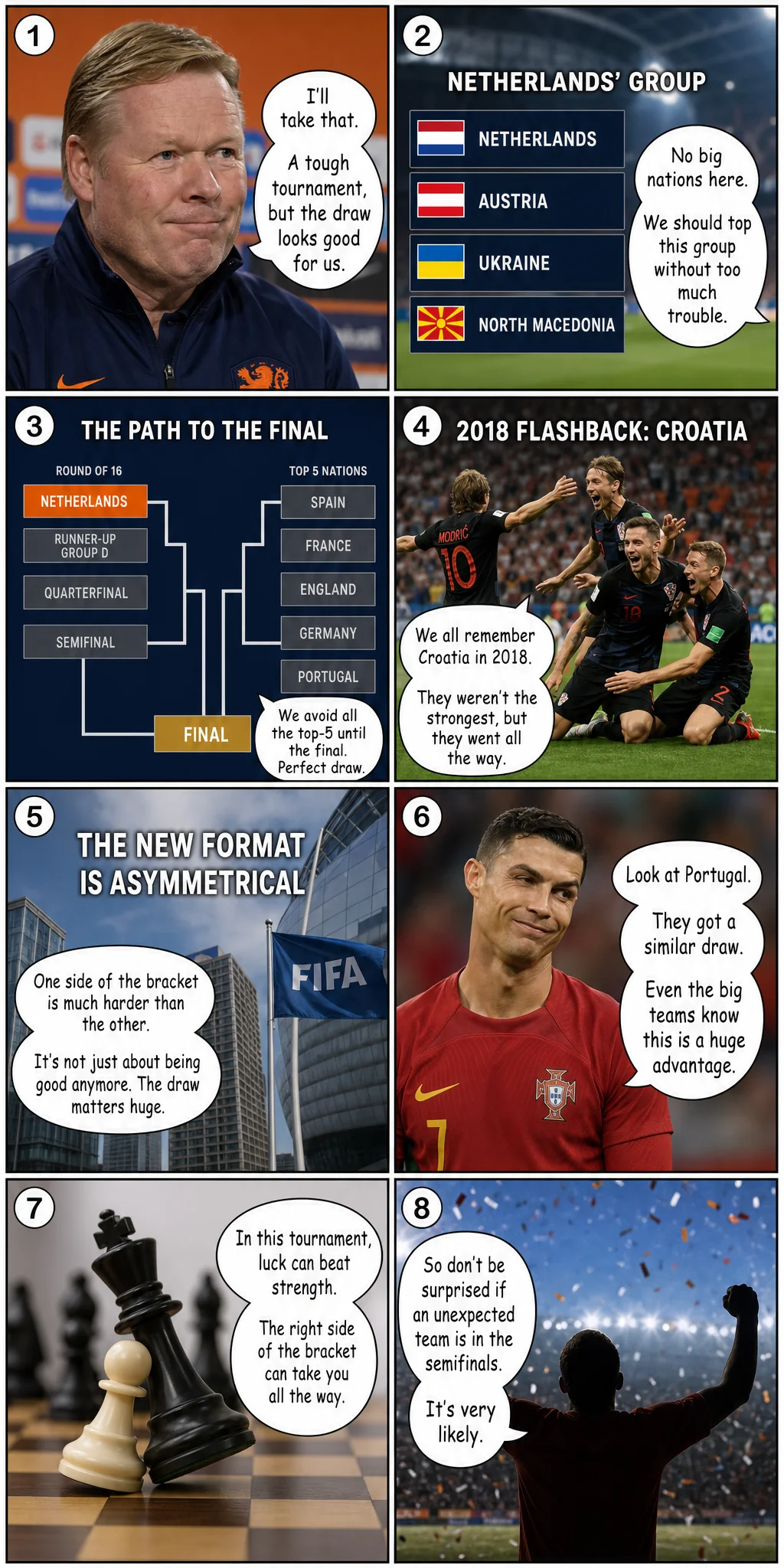
Comic content and match statistics are for entertainment purposes only and may contain inaccuracies. For Accurate Data, please refer to the reference's official website.
# The Geometry of Fortune: Bracket Asymmetry in the 48-Team World Cup
There is a moment, approximately two hours after the World Cup draw concludes, when the initial excitement of seeing which teams will face each other gives way to a more cold-blooded calculation. Fans and analysts begin tracing paths through the bracket -- if Team A wins Group X, they face the runner-up of Group Y, and then the winner of that match faces the winner of Group Z's section -- and the realization dawns, as it always does, that not all paths to the semifinal are created equal. Some are paved with former champions and current contenders. Others are conspicuously, almost suspiciously, clear.
The 48-team World Cup format amplifies this asymmetry to a degree unprecedented in the tournament's history. The expansion from 32 to 48 teams, with its 16 groups of three feeding into a 32-team knockout bracket, creates structural pathways through the tournament whose difficulty varies not incrementally but geometrically. The difference between the hardest possible path to the semifinal and the easiest is not a matter of one difficult opponent versus one beatable one; it is the difference between navigating a minefield and walking through an open field, and the team that draws the right side of the bracket may find that its journey to the final weekend requires less than the sum of its talents.
The mathematics of bracket asymmetry are straightforward, even if their implications are not. In a 32-team knockout bracket, the tournament is divided into two halves of 16 teams each, and the teams that occupy the top half can only meet teams from the bottom half in the final (or the third-place match, though that fixture's competitive significance is negligible). Within each half, further subdivisions create quarterfinal quadrants, and the draw -- which allocates group winners and runners-up to specific positions in the bracket according to a predetermined template -- determines which teams occupy which quadrants. A team that draws a quadrant containing, say, the third-best team from South American qualifying and a European playoff winner faces a fundamentally different challenge than a team whose quadrant contains Brazil, Germany, and the runners-up from the African qualifying competition.
The 48-team format introduces new variables into this already-complex equation. The 32-team knockout bracket, with its 16 group winners and 16 group runners-up, creates 16 different pathways through the round of 32 and round of 16, and the distribution of quality across these pathways is governed by the draw's allocation of teams to groups and groups to bracket positions. A team that wins its group -- and therefore avoids another group winner in the round of 32 -- gains a structural advantage that compounds across the tournament: an easier round of 32 opponent, a more favorable round of 16 matchup (on average), and a quarterfinal path that avoids, by definition, the strongest group winners in the opposite half of the bracket.
The historical evidence for bracket asymmetry's impact on tournament outcomes is substantial but often overlooked in analysis that focuses on individual matchups. The 2002 World Cup, the last time the tournament produced a genuinely surprising finalist (Turkey), was shaped by a bracket in which the "weaker" half -- the half that did not contain Brazil, England, Germany, or Argentina -- created a pathway to the semifinals for teams that would not have survived the other half. South Korea's run to the semifinals, assisted by home advantage and controversial officiating, is the most famous example, but Turkey's parallel journey to the semifinals on the other side of the same weakened quarter of the bracket was equally dependent on structural fortune. Turkey defeated Japan and Senegal to reach the semifinals -- respectable opponents, but not the caliber of team they would have faced in a different quadrant.
The 2018 World Cup provided a more recent illustration. England's path to the semifinals -- Colombia in the round of 16, Sweden in the quarterfinal -- was materially easier than the paths faced by the other semifinalists (France defeated Argentina and Uruguay; Croatia defeated Denmark and Russia on penalties; Belgium defeated Japan and Brazil). This is not to diminish England's achievement, which required winning the matches in front of them, but to acknowledge that winning those matches was a different proposition than winning the matches that France or Belgium were required to win. The bracket, in that tournament as in many others, was not a neutral arbiter of quality; it was a structural determinant of opportunity.
The 2026 format will produce these asymmetries on a larger scale and with greater consequences, because the larger bracket creates more quadrants and more pathways, and the variance in difficulty across those pathways is proportionally greater. A team that draws a quadrant containing, hypothetically, a group winner from Asia, a runner-up from Africa, and a group winner from CONCACAF faces a fundamentally different challenge than a team whose quadrant contains Brazil, the Netherlands, and the reigning African champion. Both teams must win the same number of matches to reach the semifinal, but the probability of doing so is not remotely comparable.
The implications for tournament strategy are subtle but significant. A team that recognizes that its group placement -- and, by extension, its bracket pathway -- is unusually favorable may choose to manage its resources differently than a team facing a gauntlet. If winning the group opens a corridor to the quarterfinals that avoiding the group winner's path would close, the incentive to win the group increases, and the calculus of risk-reward in the group stage's decisive moments shifts accordingly. Managers who have internalized bracket asymmetry as a strategic variable -- and the best international managers are exquisitely attuned to these structural dynamics -- will make decisions in the 80th minute of the second group match that are influenced not merely by the scoreline but by the bracket implications of finishing first versus second.
There is, too, the question of competitive justice. The World Cup has never been a pure meritocracy, and no one seriously expects it to be; the luck of the draw is an accepted feature of tournament sport, and the randomness it introduces is part of what makes the competition compelling. But the expansion to 48 teams increases the variance introduced by the draw to a level that may strain the tolerance of fans and participants alike. A team that reaches the semifinal primarily because of bracket fortune will be subject to scrutiny that a team with a harder path does not face, and the question of whether the tournament's structure adequately rewards excellence rather than luck will be asked with increasing urgency as the asymmetries of the 2026 bracket reveal themselves.
The draw will be conducted months before the tournament begins, in a ceremony that will be televised globally and analyzed exhaustively. But the true shape of the bracket will not be visible until the group stage concludes and the pathways through the knockout rounds solidify. At that moment, some teams will look at the road ahead and see opportunity. Others will see a mountain. Both assessments will be accurate, and both will have been determined, in large part, by the geometry of fortune.