

Morocco Isn't a Fluke
The images from Qatar 2022 that will endure -- beyond the final, beyond Messi lifting the trophy, beyond the spectacle and the controversy -- include a specific tableau from the semifinal. The Morocco team, having been defeated 2-0 by France, standin
Published: June 6, 2026
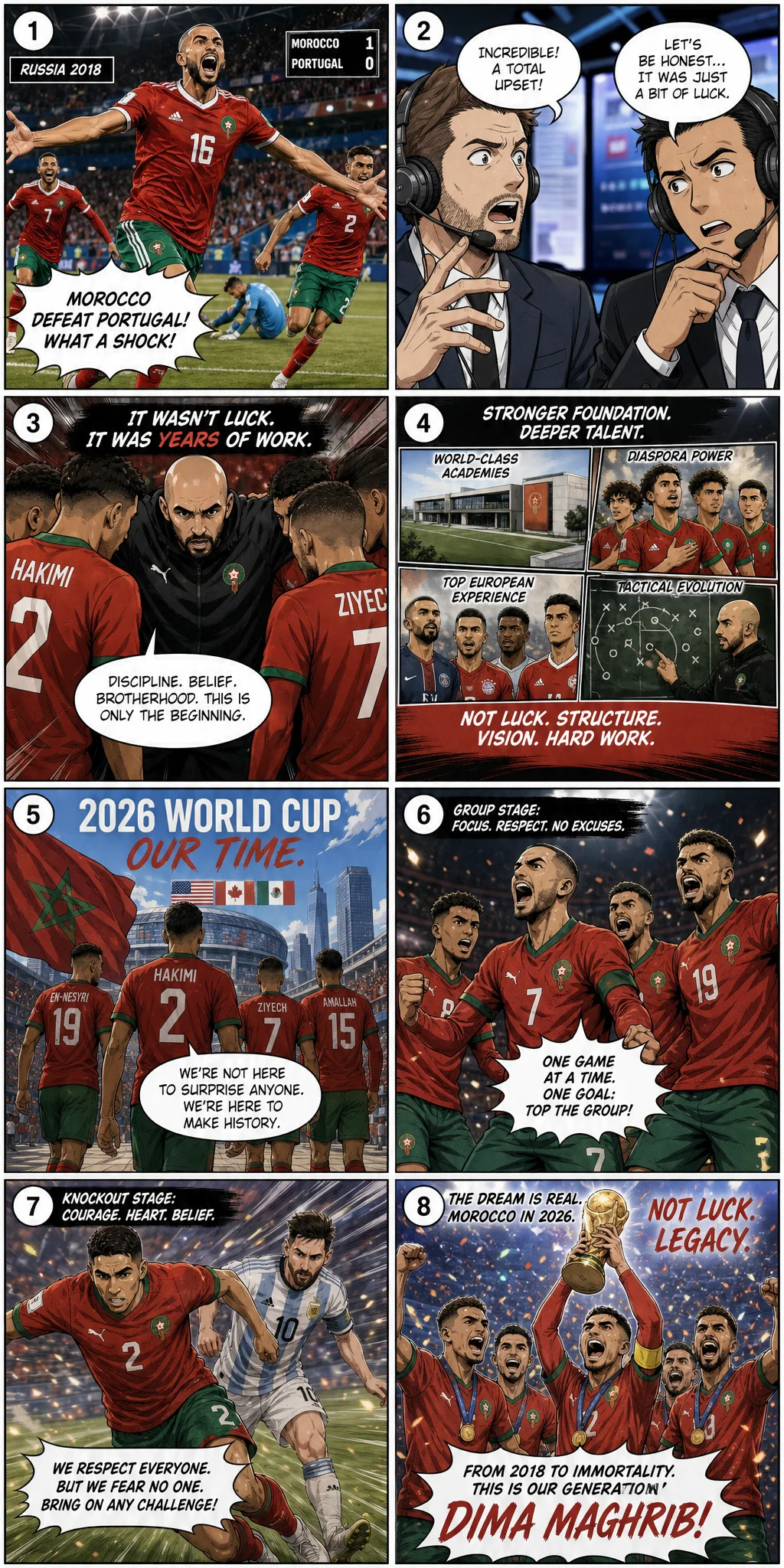
Comic content and match statistics are for entertainment purposes only and may contain inaccuracies. For Accurate Data, please refer to the reference's official website.
# Morocco Returns: Why 2022 Was Not a Fluke
The images from Qatar 2022 that will endure -- beyond the final, beyond Messi lifting the trophy, beyond the spectacle and the controversy -- include a specific tableau from the semifinal. The Morocco team, having been defeated 2-0 by France, standing in a line at the Al Bayt Stadium, applauding their supporters. Not applauding politely, the way losing semifinalists often do, a gesture of obligation and gratitude. They were applauding with the conviction of people who understood exactly what they had achieved: the first African and first Arab nation to reach a World Cup semifinal, a run that had eliminated Belgium, Spain, and Portugal along the way, that had conceded exactly one goal -- an own goal -- across five matches before the semifinal collapse, that had transformed the Moroccan national team from a perennial underachiever into the most compelling story in international football.
The question that has hung over Moroccan football since that night is whether the 2022 run was a lightning strike -- a convergence of favorable circumstances, inspired defending, and the tournament chaos that reliably produces one improbable semifinalist -- or the visible tip of a structural transformation that would make Morocco a permanent presence in the upper reaches of international football. The evidence accumulating in the four years since Qatar suggests the latter, and when Morocco takes the field at the 2026 World Cup, it will do so not as a curiosity or a feel-good story but as a nation that has built the infrastructure -- institutional, developmental, cultural -- to sustain excellence.
The architect of this transformation is Walid Regragui, a figure whose public persona suggests a football manager who has read a great deal more than the coaching manuals. Regragui was appointed in August 2022, barely three months before the World Cup began, inheriting a talented but fractured squad that had underperformed at the Africa Cup of Nations and was riven by the personal and political tensions that often accompany a diaspora-heavy national team. His first task was not tactical but psychological: convincing a squad that included players born in the Netherlands, France, Belgium, Spain, and Italy that representing Morocco was not a fallback option for those who could not make their birth nations' teams, but a project worthy of their highest ambitions.
The diaspora pipeline is, in fact, the defining structural feature of Moroccan football, and understanding it is essential to understanding why the 2022 run was not a fluke. The Moroccan diaspora in Europe numbers approximately five million people, concentrated in France, the Netherlands, Belgium, Spain, and Italy, and within this population is a footballing talent pool that rivals many medium-sized European nations. The Royal Moroccan Football Federation, under the leadership of Fouzi Lekjaa, has invested heavily in a scouting and recruitment infrastructure that identifies dual-national players at increasingly young ages, builds relationships with their families, and presents the Moroccan national team as a destination of choice rather than a consolation prize.
The results of this investment are visible in the squad that will travel to North America in 2026. Achraf Hakimi, born in Madrid to Moroccan parents, developed in Real Madrid's academy, and now one of the world's premier right-backs at Paris Saint-Germain. Noussair Mazraoui, born in the Netherlands, developed in Ajax's academy alongside a generation of Dutch talent, now at Bayern Munich. Sofyan Amrabat, also born in the Netherlands, the midfield anchor whose performances in Qatar earned him a move to Manchester United. Brahim Diaz, born in Malaga, developed at Manchester City and Real Madrid, who chose Morocco over Spain in one of the most significant nationality decisions of the current cycle. These are not players who chose Morocco because they had no other options. They are players who chose Morocco because Morocco had become a project worth choosing.
The institutional infrastructure supporting this talent has been transformed in ways that are less visible but equally significant. The Mohammed VI Football Academy, opened in 2009, has become one of Africa's premier talent development centers, producing technically refined players whose foundational training rivals that of European academies. The domestic league, the Botola Pro, has benefited from increased investment and improved governance, though it remains a development league whose primary function is to prepare players for European moves rather than to compete with Europe's major competitions. The coaching education system has been overhauled, with an emphasis on the tactical sophistication -- particularly defensive organization -- that has become the hallmark of Regragui's approach.
That defensive organization deserves its own consideration, because it is the tactical identity that Morocco has cultivated and that will define its approach to 2026. The 2022 World Cup semifinal run was built on a defensive structure of almost absurd resilience: five matches, one goal conceded (an own goal by Nayef Aguerd against Canada), and a pattern of absorbing pressure with such composure that opponents -- Spain completed over 1,000 passes in their round of 16 match without scoring -- were reduced to sterile possession and frustrated long-range efforts. This was not the desperate defending of a team hanging on; it was the systematic defending of a team that had been organized with the precision of a military unit, each player understanding exactly when to press, when to drop, and how to maintain the compactness that made Morocco almost impossible to play through.
The tactical challenge for Morocco in 2026 is that the element of surprise that aided the 2022 run -- opponents underestimated Morocco's defensive quality and were punished for it -- will not be available. Every team that faces Morocco in the group stage and beyond will have studied the 2022 matches, will have prepared specific strategies for breaking down the compact 4-1-4-1 block that Regragui deploys, and will approach the match with the respect that a World Cup semifinalist commands. The evolution from hunter to hunted is one of the most difficult transitions in international football, and Morocco's capacity to manage it will determine whether the 2026 campaign represents consolidation or regression.
The attacking evolution will be equally important. Morocco's 2022 run was defensively brilliant but offensively limited: the team scored only five goals in six matches, and three of those came in the group stage victory over a disintegrating Belgium. For Morocco to progress beyond the round of 16 or quarterfinals in 2026, it will need to develop a more reliable attacking output without sacrificing the defensive structure that remains its competitive advantage. The emergence of attacking talents -- Brahim Diaz's creativity, the continued development of young forwards like Youssef En-Nesyri's successor -- will determine whether Morocco can become a team that wins matches rather than simply surviving them.
The 2026 World Cup offers Morocco a stage and a context that are, in important respects, more favorable than Qatar. The expansion to 48 teams means that the group stage -- a three-team group, likely seeded favorably given Morocco's elevated FIFA ranking post-2022 -- represents a manageable hurdle rather than a survival test. The North American setting, with its cooler climates and more traditional football infrastructure, will impose fewer physical and logistical challenges than Qatar's compact, air-conditioned environment. And the Moroccan diaspora in North America, particularly in Montreal and across the northeastern United States, will provide passionate support that approximates a home-crowd advantage.
But the most important factor in Morocco's 2026 prospects is not tactical or logistical: it is the belief that the 2022 semifinal instilled in a generation of Moroccan players and the broader Moroccan football culture. Before Qatar, the idea that an African nation could reach a World Cup semifinal was a theoretical proposition rather than a demonstrated reality. Now it is memory, and memory is more powerful than theory. The Moroccan players who take the field in 2026 will not be hoping to make history. They will be remembering that history has already been made, and that they are its inheritors.