
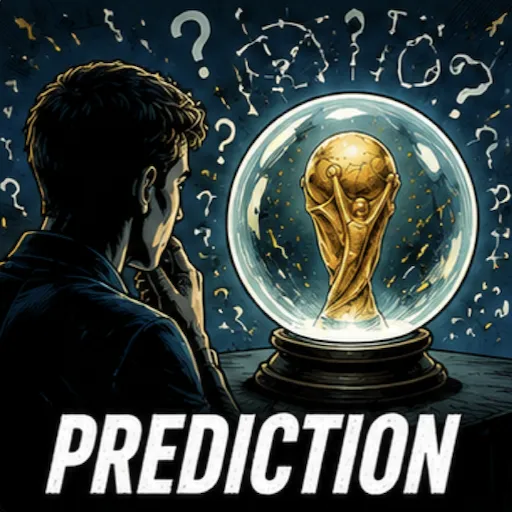
Third Place Champion? Possible.
The 48-team World Cup format creates a counterintuitive path where finishing third in your group could be the smartest route to the final. This analytical feature dismantles the bracket mathematics, identifies scenarios where a third-place finish yields a weaker knockout path, and asks the uncomfortable question: could engineering a specific group position be the smartest World Cup strategy ever devised?
Published: June 6, 2026
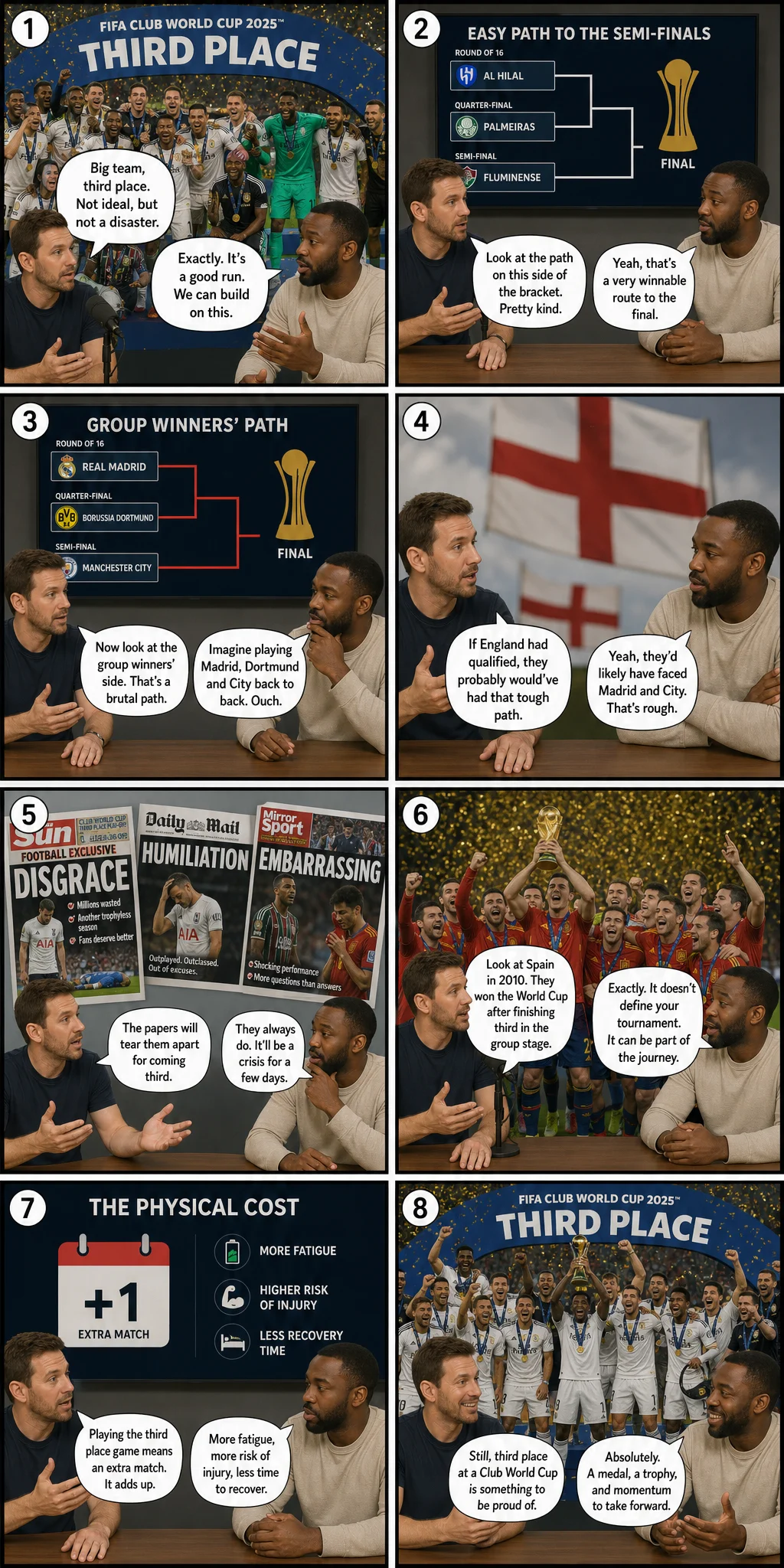
Comic content and match statistics are for entertainment purposes only and may contain inaccuracies. For Accurate Data, please refer to the reference's official website.
Third Place Champion: How the 48-Team Format Creates the Darkest of Dark Horse Paths
The 48-team World Cup format -- three-team groups, the top two advancing along with eight of twelve third-placed finishers -- introduces a structural peculiarity that no previous tournament has contained. Finishing third in a group, the position that in every World Cup since 1930 has meant elimination before the knockout stage begins, may in 2026 produce a more favourable path to the quarterfinals than winning the group. This is not a conspiracy theory. It is a mathematical consequence of bracket architecture that FIFA's tournament design created, almost certainly inadvertently, and that the smartest teams have already modelled.
The arithmetic works as follows. A third-placed team that scrapes through as one of the eight best third-placed finishers enters the round of thirty-two facing a group winner -- on paper, the most difficult possible opening knockout draw, a fixture that places the underdog against a team that has just demonstrated its capacity to navigate a three-team group without stumbling. If that third-placed team wins its round-of-thirty-two match -- an upset, by definition, but upsets happen in every World Cup knockout stage, and the 48-team format creates more of them by sheer volume -- it inherits the bracket position of the eliminated group winner. That position was designed, by the bracket's original architecture, to face another group winner, then a runner-up, then potentially a runner-up again before encountering the tournament's genuine elite. The result is a path through the bracket that may require one genuinely difficult victory -- the round-of-thirty-two upset -- followed by a sequence of opponents that the original bracket assumed would be occupied by a higher seed but which, through the chaotic algebra of tournament football, have been vacated by the teams they were designed for.
This asymmetry is not a bug in the format. It is a mathematical inevitability of expanding from thirty-two to forty-eight teams while preserving a knockout bracket that progresses through powers of two. The 1982 World Cup -- the only previous tournament to feature a second group stage rather than a round of sixteen -- faced similar structural complaints, though its format was genuinely more forgiving: a team could lose a group match and still reach the semifinals without having won its initial group. The 2026 format is less forgiving in its group stage but more chaotic in its bracket consequences. A third-placed team that navigates the round of thirty-two finds itself in a bracket segment that was designed for a group winner and may now contain only one of the original top seeds that were assigned to that quadrant.
History offers precedents for this kind of structural exploitation, though none exactly analogous. Argentina in 1990 reached the final after finishing third in a group that contained Cameroon, Romania, and the Soviet Union -- but that was a tournament where third-placed teams could advance directly, not a format where a third-placed finish was punished with a theoretically harder initial opponent followed by a practically easier subsequent path. Portugal in 2016 won the European Championship after finishing third in a group containing Iceland, Austria, and Hungary -- a tournament that introduced the 24-team format with third-placed qualifiers, and that Portugal navigated by drawing all three group matches, beating Croatia in extra time, Poland on penalties, and Wales and France in normal time. The Portuguese path was not evidence of a format flaw but of a format feature: third place in a weak group can be the optimal launching point for a deep tournament run.
The implications for 2026 are specific and measurable. A team that models every possible third-place path through the bracket and identifies the route requiring the fewest upsets -- the path where the seeded opponents are the weakest group winners and the subsequent bracket segment is the most depleted by early-round chaos -- gains an advantage that has nothing to do with talent acquisition or tactical preparation. It is an advantage in tournament literacy, the capacity to understand the competition's architecture and position oneself within it. Somewhere, a data analyst employed by a national federation has already produced this model. The question is whether their manager is listening, and whether the team can execute the specific sequence of results -- lose to the group's strongest team, beat the group's weakest team, draw with the middle team, then produce one round-of-thirty-two upset -- that transforms a group-stage disappointment into a deep tournament run. The 48-team format does not merely expand the tournament. It rewrites the strategic logic by which the tournament is won. The first team to fully understand that rewrite may be the first team to lift the trophy through a path that no previous format could have produced.