

Four Stars, Two Missed World Cups, and a Country That Refuses to Be Forgotten
Italy has won four World Cups — 1934, 1938, 1982, 2006. Only Brazil, with five, has more. The four stars embroidered above the Azzurri crest represent a century of footballing excellence, a tradition that includes Vittorio Pozzo's back-to-back champi
Published: June 6, 2026
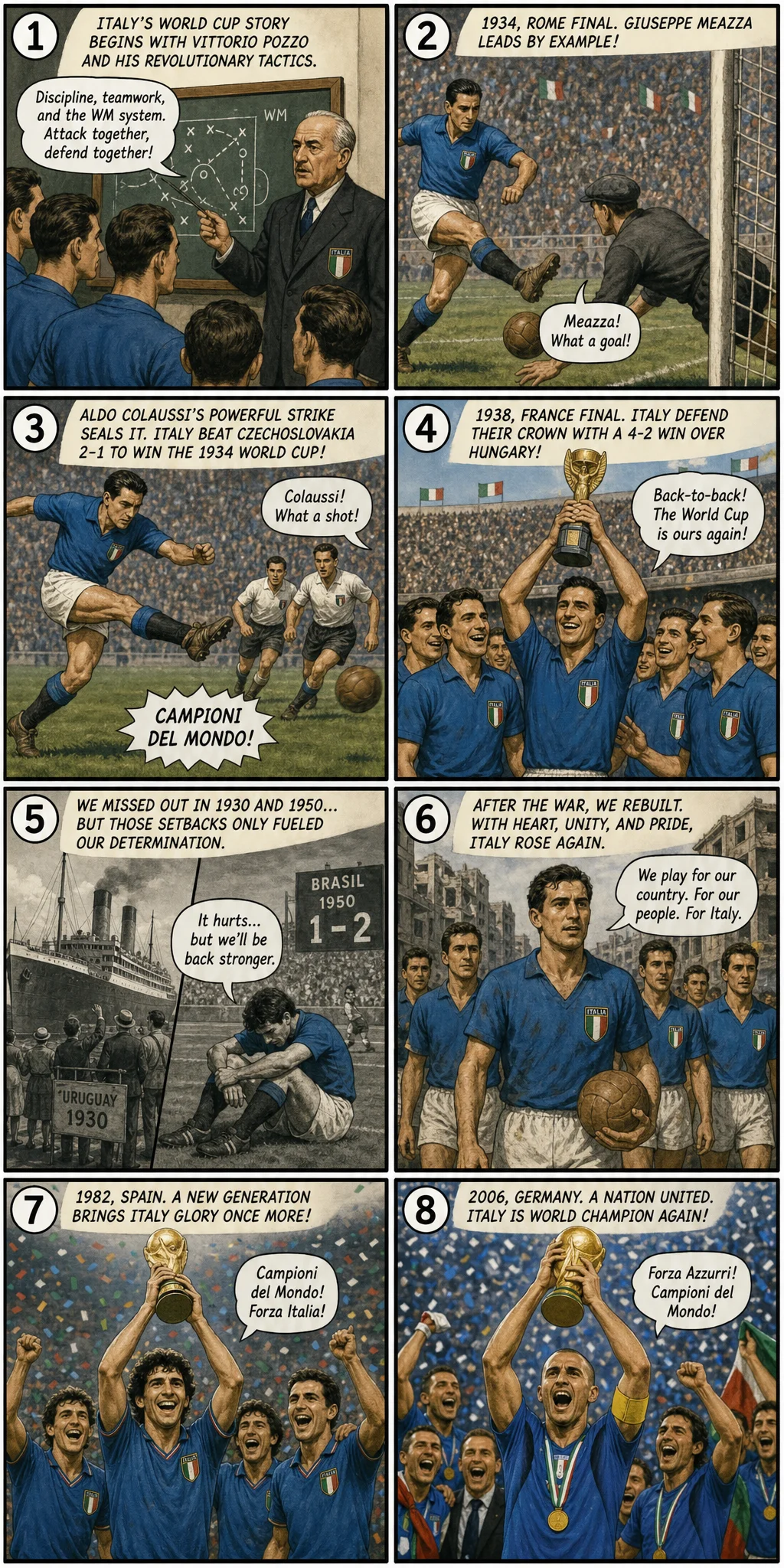
Comic content and match statistics are for entertainment purposes only and may contain inaccuracies. For Accurate Data, please refer to the reference's official website.
# Four Stars, Two Absences: Italy's Impossible Contradiction
Italy has won four World Cups — 1934, 1938, 1982, 2006. Only Brazil, with five, has more. The four stars embroidered above the Azzurri crest represent a century of footballing excellence, a tradition that includes Vittorio Pozzo's back-to-back champions of the 1930s, the Paolo Rossi-inspired triumph of 1982 that emerged from a match-fixing scandal that had imprisoned half the squad's clubs, and the Marcello Lippi-led victory of 2006 that was simultaneously the peak of a golden generation and the last great achievement of Italian football before its precipitous decline. And then Italy failed to qualify for the 2018 World Cup. And then Italy failed to qualify for the 2022 World Cup. The only four-time champion in football history to miss consecutive World Cups. A nation that owns nearly a quarter of all European World Cup victories, absent from the tournament that defines the sport. The disconnect between Italy's historical greatness and its contemporary irrelevance represents the most dramatic identity crisis in international football.
The 2018 absence was shocking in its specifics and devastating in its implications. A playoff defeat to Sweden — a nation with a fraction of Italy's footballing history, resources, and institutional prestige, a nation that had not qualified for a World Cup since 2006 and would go on to reach the quarterfinals in Russia without Italy's presence to impede them — eliminated the Azzurri from a World Cup for the first time since 1958. The second leg at San Siro, the temple of Italian football, ended 0-0. Sweden defended with the organized discipline that Italian football had taught the world, and Italy could not score. The irony — the nation that invented catenaccio being eliminated by a superior defensive performance — was so heavy it bordered on cruelty. Gianluigi Buffon, the captain and the last active link to the 2006 champions, wept during his post-match interview. The tears of a thirty-nine-year-old goalkeeper who had won everything the sport could offer except a second World Cup became the defining image of Italian football's institutional failure.
The 2022 absence was somehow worse. Another playoff campaign, another decisive match against an opponent that Italian football history would dismiss as beneath consideration. This time North Macedonia — a nation of two million people, ranked sixty-seventh in the world, whose entire football history could fit into a single chapter of Italy's — scored in stoppage time and eliminated the European champions. The European champions. Between the two World Cup absences, Italy had won Euro 2020, defeating England on penalties at Wembley in one of the most dramatically satisfying tournament victories in recent memory. Roberto Mancini's team played a style of football that was distinctly un-Italian — expansive, attacking, possession-dominant, aesthetically ambitious — and won a European championship doing it. Then the same federation that had celebrated Wembley could not qualify for the World Cup that followed. The emotional whiplash — European champions, World Cup absentees — captures the specific dysfunction of modern Italian football more comprehensively than any tactical analysis.
The explanations are structural and they are uncomfortable. Serie A's decline relative to the Premier League's financial dominance has reduced the competitive intensity of the domestic league that historically produced Italy's national team spine. The failure to develop elite centre-forwards — the position that Paolo Rossi, Salvatore Schillaci, Christian Vieri, and Luca Toni occupied for successive Italian generations — has left the Azzurri consistently unable to convert the chances that Italy's midfield continues to create. The chronic instability of the Italian Football Federation, which has cycled through presidents, reform commissions, and structural reorganizations with a frequency that makes institutional memory impossible, has prevented the long-term planning that modern international football requires. The deeper truth concerns identity. Italy's football tradition — catenaccio, the defensive pragmatism that won four World Cups — became increasingly difficult to sustain as football globalized, accelerated, and evolved beyond the tactical vocabulary that had defined Italian excellence for generations. The four stars are permanent. The recent absences may prove equally permanent unless Italian football can reconcile its historical identity with football's contemporary demands. The contradiction between greatness and irrelevance is Italy's defining football challenge, and the 2026 qualification was merely the latest chapter in a crisis that has been building for a generation.
Italy qualified for the 2026 World Cup — ending the cycle of absence that had threatened to become permanent — and the manner of that qualification illuminated both the progress and the persistent fragility of the project. Under Luciano Spalletti, appointed after Mancini's sudden departure for the Saudi Arabia national team job, Italy navigated a qualification group that was more navigable than formidable, collecting the necessary points without ever suggesting the kind of dominance that the four stars on the jersey might imply. The Spalletti era represents a pragmatic pivot: less ideological commitment to a specific style, more tactical flexibility, a recognition that the material available to the Italian national team — talented but limited, technically proficient but physically unremarkable, tactically intelligent but lacking the individual genius that defines the world's elite national teams — requires a system that adapts to opponents rather than imposing itself upon them. The 2026 squad features no player who would command a place in the all-time Italy XI, no Ballon d'Or contender, no individual whose name alone alters the tactical calculations of opposing coaches. What it possesses is the specific quality that has always defined successful Italian teams: the capacity to be greater than the sum of its parts, to find within its collective organization a level of performance that no individual component would suggest is possible.
The historical weight of Italy's four World Cup victories creates a burden that no other football nation except Brazil must carry. Every Italian player who pulls on the Azzurri shirt is measured against the ghosts of Meazza and Piola, of Rivera and Mazzola, of Rossi and Zoff, of Cannavaro and Pirlo. The comparison is impossible and unavoidable. Brazilian players understand this dynamic — it is the condition of wearing the most decorated shirt in football history — but Italy adds a uniquely Italian dimension: the conviction that failure is always more likely than success, that the beautiful game will inevitably break your heart, that the World Cup is a tournament Italy enters expecting to suffer. This tragic sensibility is not defeatism; it is a cultural orientation that has, paradoxically, produced four of the most triumphant moments in World Cup history. The 1982 team won while the national press excoriated them. The 2006 team won while the Calciopoli scandal consumed domestic Italian football. Italy's greatest football achievements have emerged from its deepest institutional crises, and if that pattern holds, the crisis that produced two consecutive World Cup absences may yet generate a response that restores the Azzurri to the position their history commands.
The 2026 tournament tests whether the restoration is genuine or merely statistical — a return to the World Cup rather than a return to World Cup relevance. The group stage will reveal whether Spalletti's system can produce results against opponents who will study Italy's qualification campaign for patterns and vulnerabilities. The knockout stage, if Italy reaches it, will reveal whether the competitive intensity that Italian football has historically brought to elimination matches — the capacity to raise performance when elimination threatens, a quality that no statistical model can quantify — still resides in a generation of players who grew up watching Italy fail to qualify for World Cups. The challenge is not simply to advance; it is to demonstrate that the four stars on the jersey represent a living tradition rather than a historical museum piece. The 2026 World Cup is Italy's opportunity to prove that the contradiction between greatness and irrelevance can be resolved — not in the abstract realm of football philosophy, but on the pitch, in the results, in the specific outcomes that determine whether a football nation is remembered for what it once was or respected for what it still is.