

Three World Cups. One Man. Zero Doubts.
Pele won three World Cups. 1958, 1962, 1970. The record has stood for fifty-six years, and the structural conditions of modern tournament football — eight-match knockout campaigns, competitive parity that makes repeat victories exponentially more dif
Published: June 6, 2026
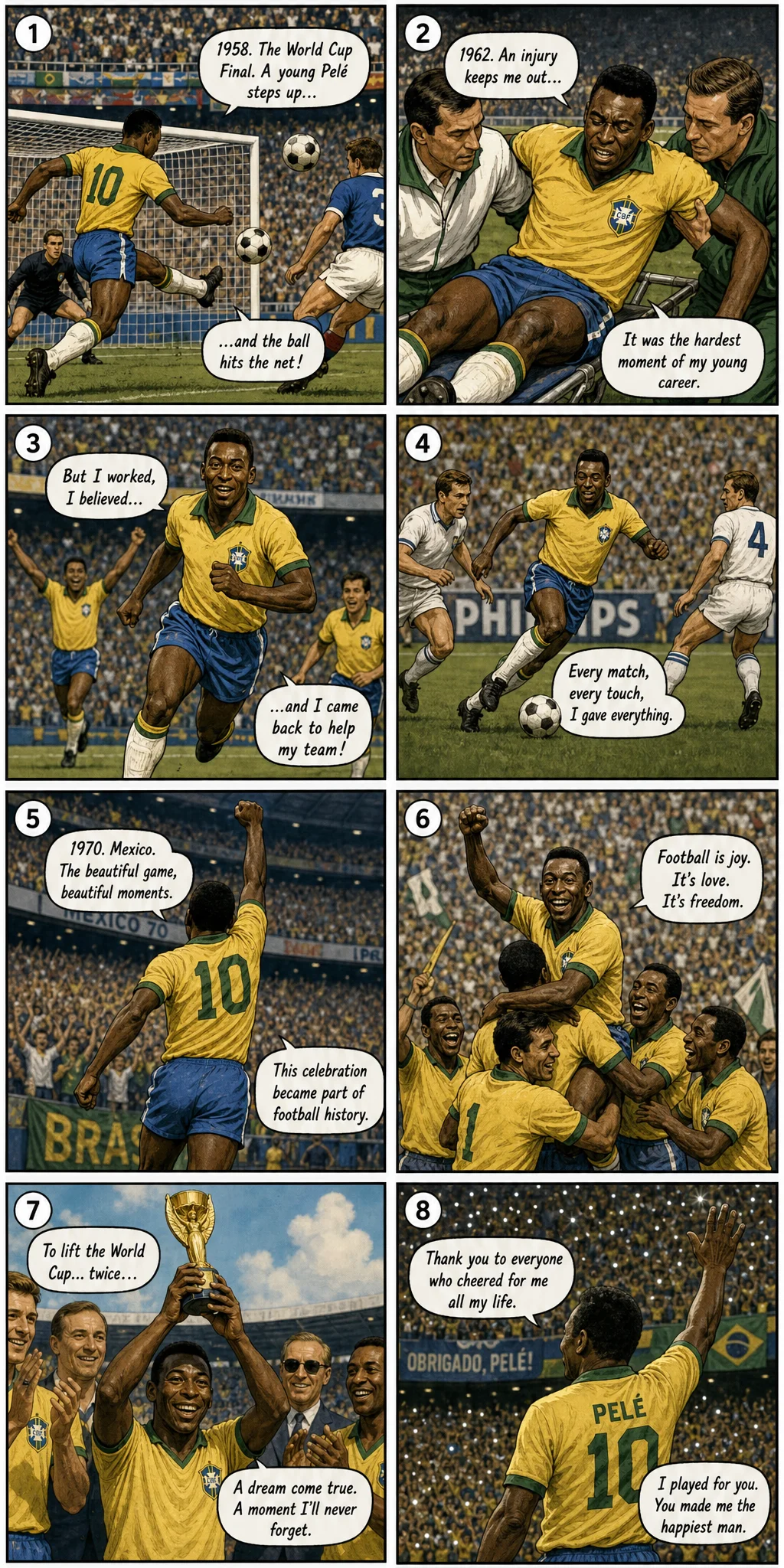
Comic content and match statistics are for entertainment purposes only and may contain inaccuracies. For Accurate Data, please refer to the reference's official website.
# Three World Cups, One Man: The Geometry of Pele's Immortal Trinity
Pele won three World Cups. 1958, 1962, 1970. The record has stood for fifty-six years, and the structural conditions of modern tournament football — eight-match knockout campaigns, competitive parity that makes repeat victories exponentially more difficult, the physical toll of contemporary football that degrades elite performance across multiple cycles — make its replication impossible. Mbappe can win two. A third? The question answers itself. Three World Cups won across twelve years represents not merely individual brilliance sustained through time but the capacity to function as the central figure in three fundamentally different Brazil teams, operating within three tactical systems, against three generations of opponents.
The 1958 tournament established the mythology. Pele arrived in Sweden as a seventeen-year-old carrying a knee injury that had nearly kept him home. Brazil's coaching staff employed a team psychologist — an innovation cited for decades as evidence of institutional modernity — who recommended against selecting both Pele and Garrincha, categorizing them as psychologically unprepared. The staff overruled the recommendation, producing the most significant personnel override in football history. Pele scored a semifinal hat-trick against France and two goals in the final against Sweden — the first, a chest control and volley of such technical purity that it remains the most famous goal ever scored by a teenager, the ball controlled on his chest, flicked over the defender's head, and volleyed past the goalkeeper in a single fluid motion suggesting a thirty-year-old's decision-making within a seventeen-year-old's body.
The 1962 tournament demonstrated Brazil could win without him. Pele was injured in the second group match, pulling a thigh muscle while attempting a long-range shot. He missed the remainder of the tournament. Garrincha carried the team through the knockout stage with performances of such individual brilliance that the tournament is sometimes called "Garrincha's tournament" — a description that emphasizes both Garrincha's genius and the fact Pele's absence did not prevent Brazil defending their title. The victory transformed Pele's achievement from a single moment of teenage genius into membership in a football culture that had institutionalized excellence to the point where it could lose its greatest player and still win the World Cup.
The 1970 tournament was the masterpiece. Pele at twenty-nine, leading what is widely considered the greatest international team ever assembled — Jairzinho, Tostao, Rivelino, Gerson, Carlos Alberto, a collection of attacking talent whose combined brilliance has never been matched. His opening goal in the final — rising above the Italian defense to head Brazil into the lead — announced the teenager had become the master. The assist for Jairzinho's goal. The dummy that let a pass run through his legs to Carlos Alberto for the fourth goal — the rolling thunderbolt concluding a move involving eight of ten outfield players, the most beautiful team goal in World Cup final history. Pele orchestrated everything. The finish belonged to Carlos Alberto. The goal belongs to Pele, as everything in that tournament belongs to Pele, because he was the gravitational center around which football's greatest team organized its brilliance.
What distinguishes Pele's trinity from other multiple winners is the nature of his contribution across the three tournaments. In 1958, he was the teenage prodigy whose emergence transformed a good Brazil team into champions. In 1962, his injury forced the team to find other mechanisms for winning — and they did. In 1970, he was the mature master, the one player whose presence elevated a collection of extraordinary individuals into the greatest team ever assembled. Three different roles, three different relationships to the team's success, three different versions of the same footballer — and all of them produced the same result.
The record is structurally untouchable. Modern international football does not permit players to win three World Cups. The tournament has expanded from sixteen teams in Pele's era to forty-eight. The knockout path is longer. The competitive parity is greater — no modern team will face the equivalent of the 1970 final against an Italy that had been exhausted by its semifinal against West Germany while Brazil had cruised past Uruguay. The physical demands of contemporary football, the fifty-match club seasons, the accumulated toll of multiple tournament cycles — these factors make the achievement impossible to replicate. Pele's trinity represents the apex of what a footballer can achieve in the tournament that defines the sport. The apex, by definition, admits only one occupant. He has occupied it for fifty-six years. He will occupy it forever.
The deeper truth of Pele's three World Cups is that they represent something more than individual achievement. They represent the last era when a single player's presence could define an entire tournament cycle's outcome. Modern football has become too systematized, too physically demanding, too tactically complex for any individual — however brilliant — to impose his will across multiple World Cups the way Pele did. Messi needed until age thirty-five and his fifth tournament to win one. Ronaldo Nazario won two but was an unused substitute in 1994. Mbappe has one and may win a second, but a third — the number that defines Pele's trinity — belongs to a category of achievement that the structural evolution of the sport has permanently closed. The boy from Tres Coracoes who cried on the pitch in Stockholm, the injured spectator of 1962, the master orchestrator of 1970 — three tournaments, three versions of the same footballer, and all of them produced the same result. It is not merely a record. It is a boundary marking the limits of what football allows any human being to achieve. Pele defined the boundary. No one else has approached it. No one else will.
The statistical framework around Pele's record has been debated for decades — whether his achievements in the era of smaller tournaments, less systematic opponent preparation, and a less physically demanding game would translate to the modern era is a question that generates more heat than light. But the question itself misses the point. Pele did not merely win three World Cups; he was the defining player in two of them and an injured contributor to the third. The 1970 Brazil team is still, more than half a century later, the aesthetic gold standard against which all great international teams are measured. Pele was its centerpiece. The teenager who wept in Stockholm, the twenty-nine-year-old who orchestrated the most beautiful team goal in World Cup final history — they were the same person, separated by twelve years and three trophies. The record is not merely a statistic. It is a documentary of what one human being can achieve in the tournament that defines the sport. It has stood for fifty-six years. It will stand forever.