

Five Goals in One Game: The Russian Who Stole a World Cup
I have spent a lot of time thinking about Oleg Salenko — more time, I suspect, than Salenko has spent thinking about Salenko in the years since his career ended and he faded into the specific category of post-Soviet football obscurity that has claime
Published: June 6, 2026
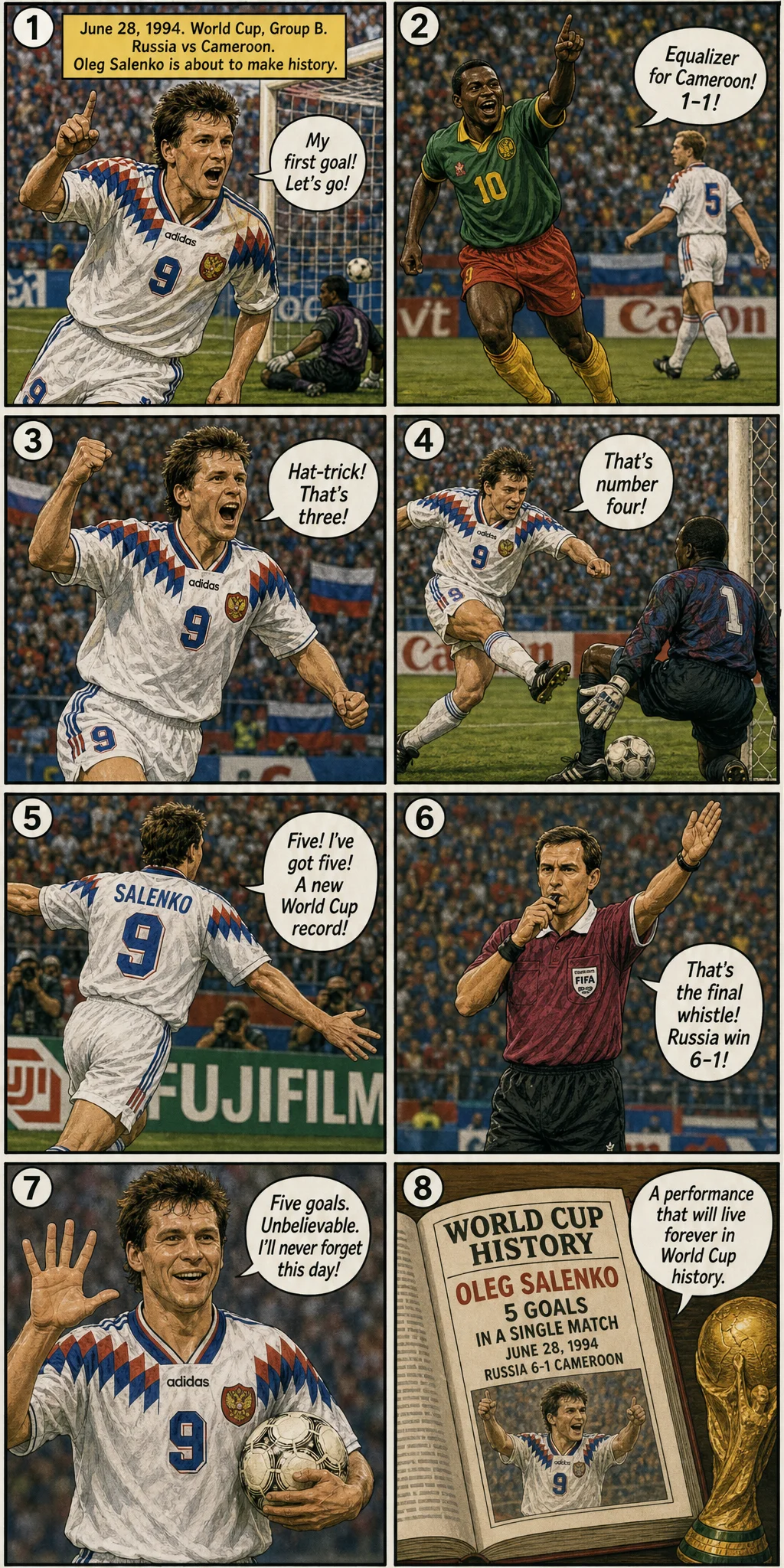
Comic content and match statistics are for entertainment purposes only and may contain inaccuracies. For Accurate Data, please refer to the reference's official website.
# Five Goals in One Match: Oleg Salenko and Football's Strangest Afternoon
I have spent a lot of time thinking about Oleg Salenko — more time, I suspect, than Salenko has spent thinking about Salenko in the years since his career ended and he faded into the specific category of post-Soviet football obscurity that has claimed so many players who briefly illuminated the tournament. Salenko is the custodian of the strangest individual record in World Cup history — five goals in a single match, jointly held with only one other player in tournament history. The record has survived three decades of attacking evolution, resisting every attempt by Messi, Ronaldo, Mbappe, and every other great goalscorer to equal or surpass it. And the man who holds it is not Gerd Muller, not Ronaldo Nazario, not Miroslav Klose. It is a Russian striker whose entire international career consisted of eight appearances and six goals.
The match took place on June 28, 1994, at Stanford Stadium in California. Russia versus Cameroon. Both teams already eliminated, their fates sealed by earlier results, rendering the fixture competitively meaningless — the specific category of dead rubber that players and broadcasters pretend matters while privately acknowledging it matters not at all. The attendance was sparse. The television audience was minimal. Nobody involved had any reason to expect they were about to witness a permanent feature of the World Cup's statistical landscape. And then Salenko scored. And scored again. And scored again. And scored again. And scored again.
The first goal came from a near-post run, the kind strikers make dozens of times per match, producing goals when delivery is precise and the defender's attention has wandered. Salenko arrived ahead of his marker and directed the ball past the Cameroonian goalkeeper. The second followed a similar pattern: defensive disorganization, a gap in marking, Salenko positioned exactly where a striker should be positioned. The third was a penalty, converted with adequate power — the moment the afternoon transformed from competitive irrelevance to statistical permanence. The fourth and fifth goals were scored against a defense that had, by any objective measure, stopped defending. The goalkeeper's positioning suggested a man whose body was still occupying the goal while his mind had departed the stadium entirely. The fifth goal — the record-breaker — was a tap-in from six yards, the kind any professional striker would expect to score.
The context that produced this anomaly is essential. Cameroon's 1994 preparations were disrupted by a player bonus dispute — the specific category of financial conflict between players and federation that has periodically undermined African teams at World Cups. By the time Cameroon faced Russia, with elimination confirmed and the dispute unresolved, several squad members had mentally departed the tournament. Their bodies remained in California. Their competitive intensity had boarded flights to Yaounde and Douala months earlier. The defending for the fourth and fifth goals suggested not merely a bad day but a defense that had stopped competing entirely — marking abandoned, runs untracked, the fundamental responsibilities taught to children abandoned.
Salenko, to his lasting professional credit, recognized what was happening and exploited it with clinical efficiency. None of the five goals were moments of individual genius. They were competent finishes, well-executed, against an opponent whose defensive effort had deteriorated to the point where competence was sufficient to produce a record. His entire international goalscoring record is contained within a single tournament — five against Cameroon, one against Sweden — the statistical signature of a player whose international career was a brief, anomalous spike rather than a sustained contribution. His club career was respectable but unremarkable: Valencia, Rangers, smaller Spanish clubs, eventually Russia and Ukraine, never a Champions League-level player.
The Golden Boot he shared with Hristo Stoichkov illustrates the gap between the achievement and greatness. Stoichkov's six goals were scored against Argentina and Germany, in matches of maximal competitive significance, carrying Bulgaria to the semifinals. Salenko's six were scored in a dead rubber against a disintegrating Cameroon and a defeat to Sweden. The goals count equally in the Golden Boot calculation. They do not count equally in any honest assessment.
The record has survived for three decades because the specific circumstances — elimination, bonus disputes, a goalkeeper and defenders who had mentally departed, a competent striker who recognized the opportunity — have never converged in exactly the same configuration. It is the World Cup's most democratic record, proof you do not need to be a great footballer to achieve something no great footballer has ever achieved. You only need to be in the right place at the right time with the right combination of competence and opportunity. Salenko was. The record is his. And the record, in all likelihood, will remain his for as long as World Cups are contested, because the specific circumstances that produced Oleg Salenko's five goals are circumstances that the modern World Cup, with its professionalism and preparation and financial structures that have largely eliminated the bonus disputes that once periodically undermined African teams, will never reproduce. The strangest afternoon in World Cup history produced the strangest record in World Cup history. A Russian striker whose name, for as long as the record stands, will never be entirely forgotten — which is, when you consider the alternative, a victory of its own kind. The record is a monument to the specific category of sporting achievement that exists at the intersection of preparation and luck — the preparation that enabled Salenko to convert the chances presented to him, and the luck that placed him on that particular pitch against that particular opponent in that particular state of competitive disintegration. Five goals in ninety minutes. The number that separates the merely excellent from the genuinely historic. And the man who holds it was, for one strange afternoon in California, excellent enough.
The Salenko record raises an uncomfortable question about how football history evaluates achievement. Do five goals against a disintegrating opponent count the same as five goals against peak competition? The statistical record answers yes. The Golden Boot Salenko shared with Stoichkov in 1994 answers yes — a goal is a goal, regardless of context. But the broader football consciousness answers differently, and Salenko himself, in the years since, has seemed to understand this. He has not campaigned for his record to be celebrated. He has not demanded recognition as one of the game's great goalscorers. He has simply been the custodian of the strangest record in World Cup history, the answer to a trivia question that will outlast his own memory of the afternoon that created it. Five goals in ninety minutes. A Golden Boot shared with one of the greatest footballers of his generation. A club career that never reached the Champions League. A name that survives in the archives for one anomalous afternoon in California. That, in the end, is the Oleg Salenko story. It is stranger than fiction. It is also, in its own peculiar way, the most democratic story the World Cup has ever produced.