

Eleven Seconds: The Fastest Goal in History
There is a clock at the Daegu World Cup Stadium in South Korea — or there was, in 2002, when the tournament was happening in Asia for the first time and everything about it felt like the beginning of something. On June 29 of that year, in the strange
Published: June 6, 2026
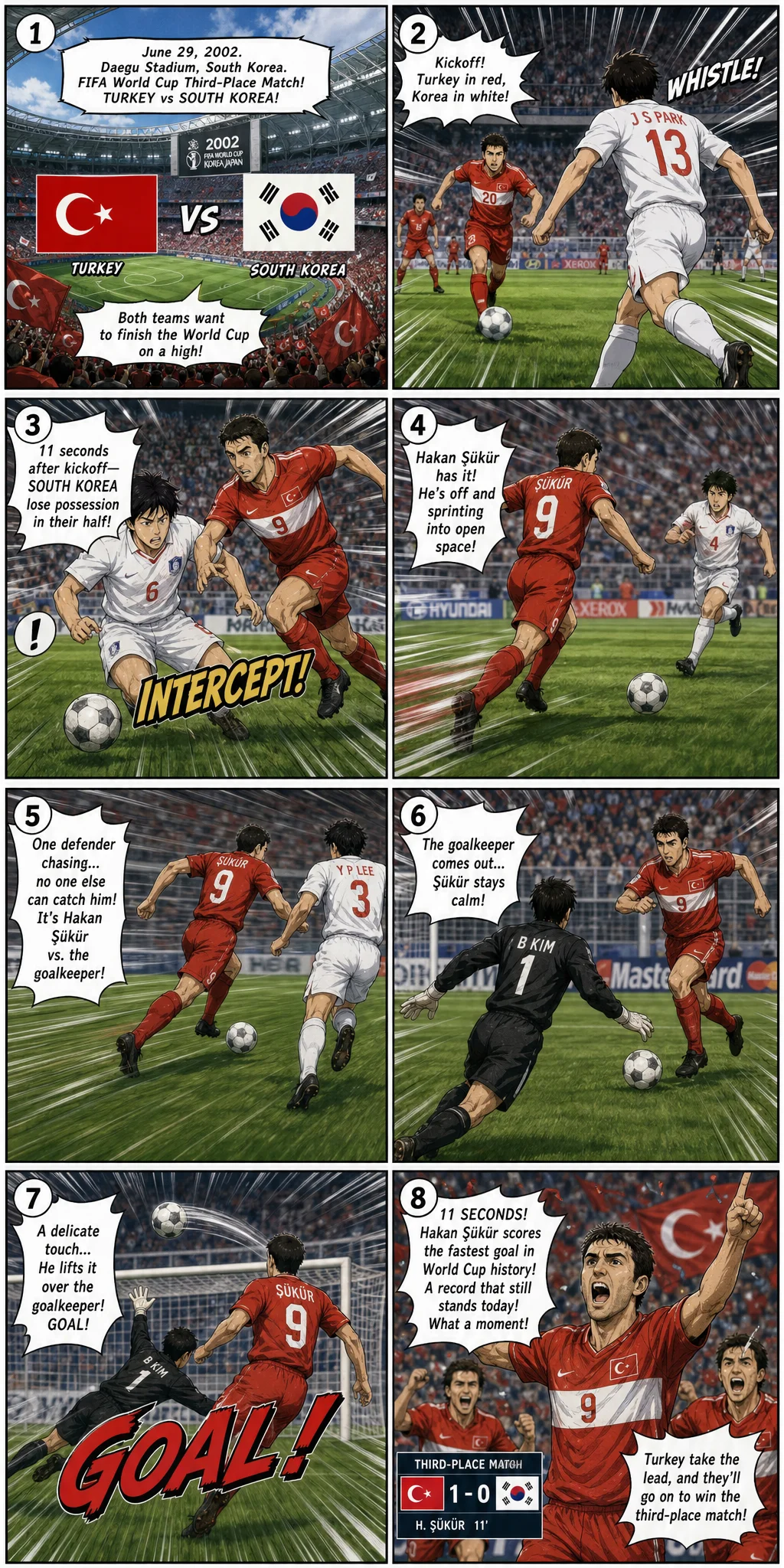
Comic content and match statistics are for entertainment purposes only and may contain inaccuracies. For Accurate Data, please refer to the reference's official website.
# Eleven Seconds: Hakan Sukur and the Goal That Time Cannot Catch
There is a clock at the Daegu World Cup Stadium in South Korea — or there was, in 2002, when the tournament was happening in Asia for the first time and everything about it felt like the beginning of something. On June 29 of that year, in the strange twilight of the third-place match — a fixture that exists in the emotional space between competitive significance and ceremonial irrelevance — that clock recorded something unprecedented. Eleven seconds. The time between the referee's opening whistle and the ball crossing the South Korean goal line. The fastest goal in World Cup history.
Try to count to eleven in your head while imagining a World Cup match beginning. One: the whistle blows, the ball is played backward to the Turkish defense. Two, three, four: the ball is played forward into the South Korean half, a long clearance that would, in any normal match, be dealt with comfortably. Five, six, seven: the South Korean defender — Hong Myung-bo, the captain, the most capped player in South Korean history at that time, a man playing in his fourth consecutive World Cup and concluding his international career in this match — hesitates. Eight, nine: the brain, still processing that a World Cup match has begun, fails to transmit the signal to the body quickly enough. Ten: Hakan Sukur reads the hesitation the way great strikers read hesitation everywhere — not as a mistake to be exploited but as an invitation to be accepted. Eleven: the ball is in the net. The South Korean goalkeeper has barely finished adjusting his gloves.
The mechanics of the goal were devastatingly straightforward. There was no elaborate kickoff routine, no rehearsed sequence — just the standard kickoff, ball backward, defender plays it long, the kind of speculative clearance that occurs dozens of times in every match and produces a goal approximately never. Hong Myung-bo was not some nervous youngster making his debut. He was the captain, the leader, a man who had seen everything international football has to offer. He was supposed to be the player whose experience and composure prevented exactly this kind of mistake. The routine clearance he had executed thousands of times — head it back to the goalkeeper, reset the defensive shape — became, in the space between intention and execution, the assist for the fastest goal in World Cup history.
Sukur's role in the goal is almost incidental to its mechanics and absolutely central to its meaning. He did not produce a moment of individual brilliance. He read the hesitation of the defender — the specific category of defensive uncertainty great strikers are trained to recognize — and acted with the instantaneous decisiveness that separates strikers who score from strikers who almost score. The interception was clean. The touch was economical — one touch, no wasted movement. The finish was clinical. Sukur did what any competent striker would have done. The record belongs to him not because he did something no other striker could have done, but because he did something any competent striker could have done, and he did it in the specific eleven-second window when competence was sufficient to produce history.
The broader context of Sukur's career adds poignancy. He was thirty, Turkey's all-time leading scorer — a record he still holds. He had been the focal point of Turkish football's golden generation, the striker around whom the attacking patterns of a team that reached the World Cup semifinals were constructed. His club career was distinguished: Galatasaray, where he won the UEFA Cup in 2000, followed by Inter Milan, Parma, and Blackburn Rovers. He was, by any reasonable assessment, the greatest Turkish striker of his generation. The fastest goal in World Cup history — the achievement mentioned in the first sentence of every obituary and retrospective — is simultaneously the most famous thing he ever did and the least representative of the player he actually was. Sukur was not a poacher, not a goal-hanger. He was a complete center-forward — strong in the air, technically proficient, capable of holding the ball up and bringing midfielders into the attack.
The record has survived every attempt at its destruction. Modern kickoffs, in the era of sophisticated set plays and rehearsed patterns, have become significantly more dangerous than the kickoff of 2002. Teams design elaborate sequences for the opening moments — multiple players executing coordinated movements, pressing triggers integrated into the immediate post-kickoff phase. The pitches are faster, the balls lighter, the athletes quicker over the first five meters. Yet no team, in any World Cup match in the two decades since, has scored faster than eleven seconds. The gap between theoretical possibility and practical reality is the gap Sukur's record occupies.
The specific quality the record celebrates is not one football's analytical apparatus can measure: attentional vigilance. The capacity to be fully present, fully engaged, from the absolute first second of competition. Sukur possessed this quality in that specific moment. Hong Myung-bo, for eleven seconds, did not. The difference between them was not technical quality or physical capacity. It was simply attention — the willingness to be fully alive to the competitive reality of the moment rather than the psychological reality of the occasion. Eleven seconds. Count to eleven. That was all the time it took. That was all the time that was needed.
The record will fall eventually. This is the nature of records — they exist to be broken, and the specific combination of attacking evolution, tactical innovation, and relentless optimization of elite football performance will eventually produce the ten-second goal, the nine-second goal, the goal that arrives so quickly after the opening whistle that the television director has not yet cut from the pre-match graphic to the wide shot. When it falls, the new record-holder will receive the attention Sukur has received for more than two decades. The new record will be celebrated, analyzed, and inscribed in the tournament's archives. And the old record — eleven seconds, Hakan Sukur, June 29, 2002, Daegu, South Korea — will recede into the category of surpassed records remembered only by the people who were watching when they were established. But for as long as it stands, it represents something specific about what attention means in sport. The capacity to be fully present, fully engaged, from the absolute first second of competition. Sukur possessed it. Hong Myung-bo, for eleven seconds, did not. The difference between them was not talent. It was simply the willingness to be alive to the moment. And eleven seconds, if you are paying attention, is enough.