

Seventeen Years, 239 Days: The Boy Who Broke Football
Pele was seventeen years and 239 days old when he scored twice in the 1958 World Cup final against Sweden. He remains the youngest goalscorer in a World Cup final, the youngest player to appear in a final, and the youngest World Cup champion in the t
Published: June 6, 2026
Comic content and match statistics are for entertainment purposes only and may contain inaccuracies. For Accurate Data, please refer to the reference's official website.
# Seventeen Years, Two Hundred Thirty-Nine Days: The Boy Who Bent Time
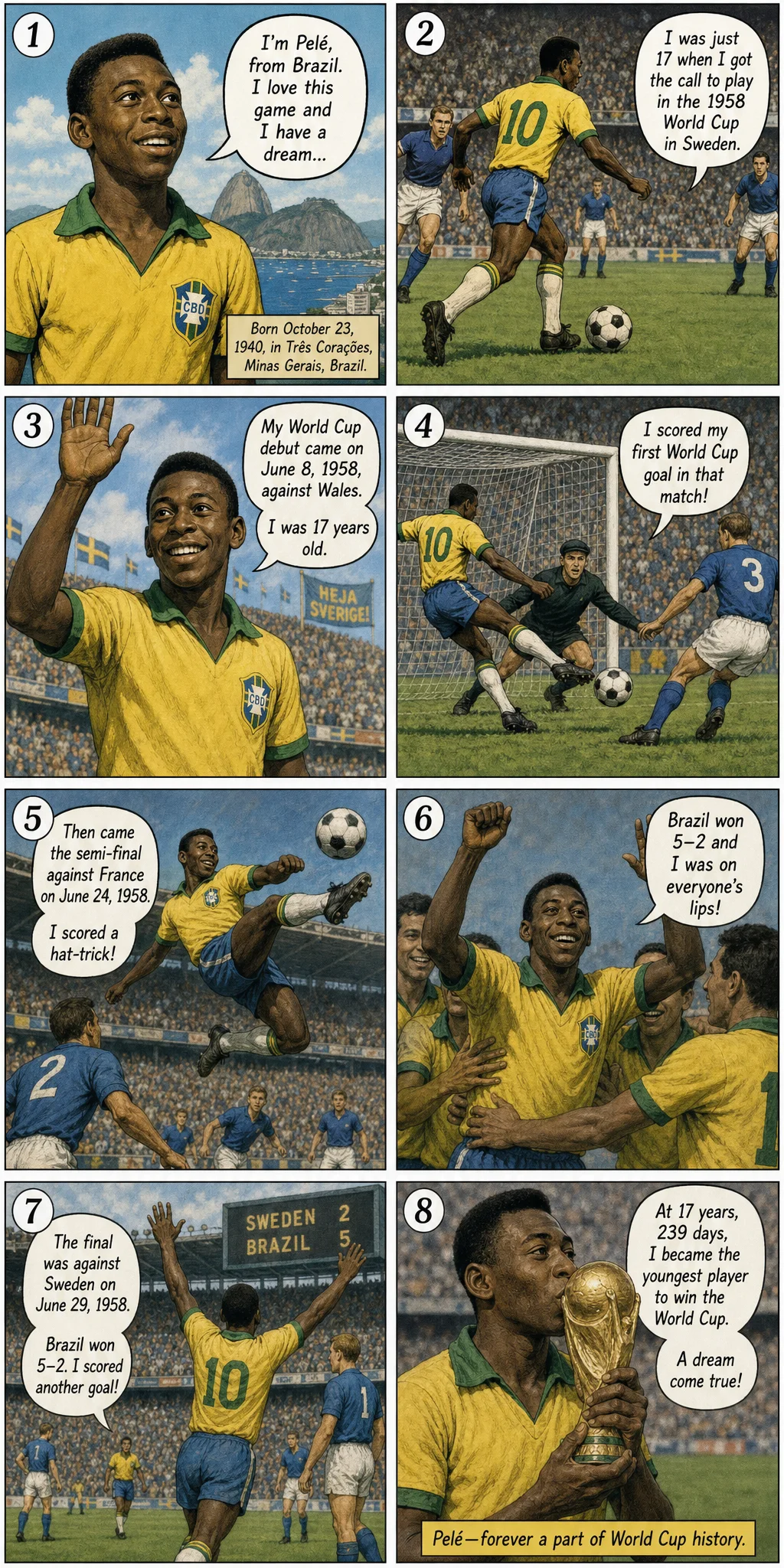
Pele was seventeen years and 239 days old when he scored twice in the 1958 World Cup final against Sweden. He remains the youngest goalscorer in a World Cup final, the youngest player to appear in a final, and the youngest World Cup champion in the tournament's history. These records have stood for nearly seven decades. They will never be broken, because modern football, for all its investment in youth development and celebration of teenage prodigies, does not entrust seventeen-year-olds with World Cup finals. The youngest player at Qatar 2022 was Youssoufa Moukoko at eighteen years and one day — ancient by Pele's standard, a full year older than the Brazilian was when he lifted the Jules Rimet trophy above a head that had not yet finished growing.
The context of Pele's arrival in Sweden is essential to understanding why these records resist every attempt at approach. He arrived carrying a knee injury that had nearly ruled him out of the tournament entirely. Brazil's coaching staff, led by Vicente Feola, debated whether he was physically ready for the intensity of senior international competition at a World Cup. The team psychologist — yes, the 1958 Selecao employed a team psychologist, an innovation cited for decades as evidence of Brazilian football's institutional sophistication — recommended against selecting both Pele and Garrincha, categorizing them as psychologically unprepared for the pressures of international football. The coaching staff overruled the recommendation. The decision saved Brazilian football from what would have been its greatest institutional blunder and produced the tournament that established the Pele mythology.
He did not play in Brazil's first two group matches. He was introduced in the third, against the Soviet Union, with the world champions of 1956 and Olympic champions of 1956 across the pitch. Brazil won 2-0. Pele did not score, but the reports from journalists present describe a player whose spatial intelligence operated at a frequency his opponents could not access, movement that created separation from defenders tracking the ball rather than the man, the specific capacity to function within a team system while simultaneously transcending it. The quarterfinal against Wales produced his first World Cup goal — the winner, a moment of improvisational brilliance, the ball flicked up and volleyed past Jack Kelsey with a precision that announced the teenager's arrival. The semifinal against France produced a hat-trick, three goals in a match Brazil won 5-2 against a Just Fontaine-inspired French team that would, across the tournament, see Fontaine score thirteen goals — still the record for a single World Cup. Pele scored three in a semifinal. He was seventeen.
Then came the final against the host nation in Stockholm. Brazil versus Sweden at the Rasunda Stadium, June 29, 1958. The Swedes scored first, Nils Liedholm putting the hosts ahead after four minutes. Brazil equalized through Vava. Vava scored again. Then Pele took over.
The first goal is the one that survives in the archive of football's collective memory, replayed and analyzed and mythologized until the actual footage feels inseparable from the legend. A long ball played into the penalty area toward the teenager with his back to goal. Pele controlled it on his chest. In a single fluid motion — one that suggested a thirty-year-old's decision-making capacity operating within a seventeen-year-old's body — he flicked the ball over the defender's head, turned, and volleyed past the Swedish goalkeeper Kalle Svensson. Nearly seven decades later, it remains the most famous goal ever scored by a teenager in a World Cup final, not because of athletic explosiveness but because of the cognitive processing speed it revealed. Pele knew where the defender was without looking. He knew where the goal was without scanning. He understood the geometry of the entire situation — trajectory of the incoming ball, position of the marker, space behind the marker, narrow window past the goalkeeper — and executed the complete sequence before the defender had finished processing the first element.
The second goal was a header, planted past Svensson with an authority that belied both his age and his modest physical stature at that point in his development. Brazil won 5-2. Pele wept at the final whistle, tears that became the first iconic image of his career — the boy champion, overwhelmed by an achievement whose magnitude he could feel but not yet comprehend, a seventeen-year-old being consoled by grown men who had just won the World Cup.
After the final, the photographs circulated worldwide. A black seventeen-year-old Brazilian, tears streaming, being hoisted onto the shoulders of his teammates, the Jules Rimet trophy somewhere in the frame. In 1958, this image carried a significance that extended well beyond football. Brazil had long carried a national insecurity about its place in the world — the "mongrel complex" that the writer Nelson Rodrigues identified, the fear that a mixed-race nation could never produce excellence. Pele demolished that anxiety in ninety minutes in Stockholm. He was black, poor, from the interior of Sao Paulo state, the son of a failed footballer whose career had been ended by injury, a boy whose family had been so poor that he learned to play with a sock stuffed with newspaper because they could not afford a ball. And at seventeen years and 239 days, he became the greatest footballer on earth, lighting a fuse that would burn through the next twelve years and three World Cup victories. The boy who bent time also bent Brazil's understanding of itself.
The nature of Pele's teenage genius is frequently misunderstood. He was physically small at seventeen — his adult physical dominance was still developing, his body not yet the instrument that would eventually make him the most recognizable athlete on the planet. What separated him was cognitive. He understood where space would appear before it materialized. He understood where defenders would move before they themselves knew they were moving. This quality — anticipation operating at a level that appears precognitive to observers — cannot be coached. It can only be recognized when it appears, and the Brazilian coaching staff, to their eternal credit, recognized it in time.
Modern football produces teenage prodigies. Mbappe scored in a World Cup final at nineteen — ancient by Pele's standard. Lamine Yamal and other teenage stars carry national expectations. But the specific conjunction of extreme youth, mature decision-making, and tournament-defining impact that Pele demonstrated belongs to a different era with fundamentally different developmental pathways and competitive pressures. The records will stand forever — not because modern teenagers lack talent, but because modern football has evolved systems of caution, player protection, and gradual integration that make Pele's 1958 achievement structurally impossible to replicate. A seventeen-year-old will never again start a World Cup final. A seventeen-year-old will never again score in one. The boy from Tres Coracoes did both. The man who grew from that boy won three World Cups. But it all started in Stockholm, with a chest control, a flick, and a volley that bent time.