

Forty-Two Years Old, and He Still Did the Dance
Roger Milla was forty-two years and thirty-nine days old when he scored against Russia at the 1994 World Cup — still the oldest goalscorer in the competition's history, a record that has resisted every approach across three decades of tournaments tha
Published: June 6, 2026
Comic content and match statistics are for entertainment purposes only and may contain inaccuracies. For Accurate Data, please refer to the reference's official website.
# Forty-Two Years Old, and He Still Did the Dance: Roger Milla's Defiance of Time
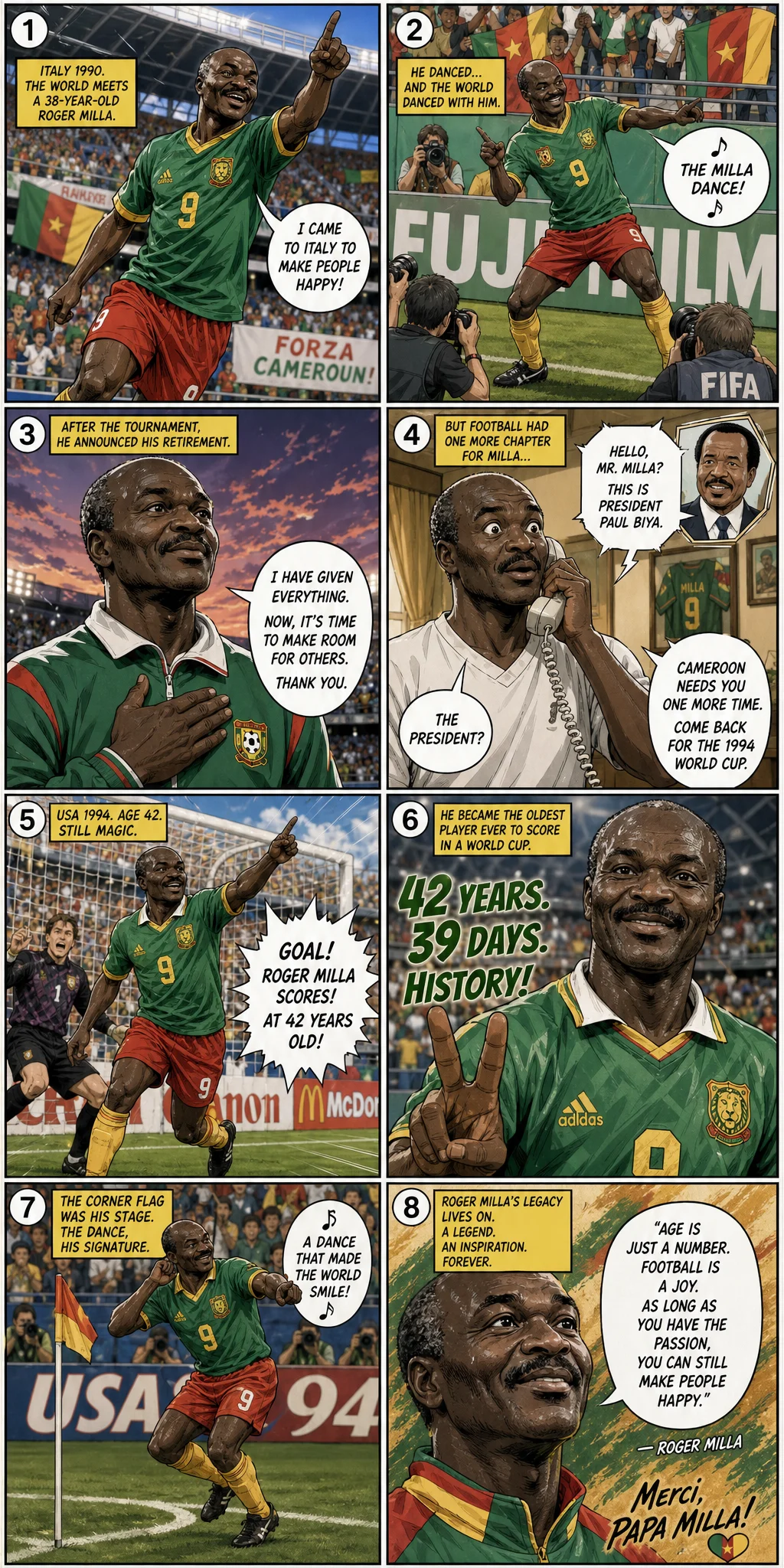
Roger Milla was forty-two years and thirty-nine days old when he scored against Russia at the 1994 World Cup — still the oldest goalscorer in the competition's history, a record that has resisted every approach across three decades of tournaments that have featured some of the greatest strikers the game has produced. He received the ball at the edge of the penalty area with his back to goal, turned with the economical movement of a man who had been turning with his back to goal for twenty professional seasons, and scored. Then he jogged to the corner flag and performed the dance. The same hip-wiggling, corner-flag-shaking celebration that had made him the face of the 1990 World Cup four years earlier, when at thirty-eight he had become the oldest player to score in tournament history. He was four years older in 1994 and the dance was unchanged. The joy was unchanged. The man, in the ways that mattered, was unchanged.
Milla's 1990 tournament is the kind of story football produces once a generation and then spends decades trying and failing to replicate. He had retired from international football in 1988 and was playing semi-professionally for JS Saint-Pierroise on the French Indian Ocean island of Reunion, a world away from the elite European football that defines modern careers. Cameroon qualified for Italia 90. Their president, Paul Biya, telephoned Milla personally and asked him to return. Milla agreed. He arrived in Italy as a thirty-eight-year-old substitute and scored four goals — all off the bench, each followed by the corner-flag celebration that became the iconic image of the tournament. Cameroon reached the quarterfinals, the first African nation to do so. Milla was the face of that achievement.
To understand the magnitude of what he did, you have to understand what Cameroon represented before 1990. African football had been participating in World Cups since Egypt in 1934, but no African team had ever been taken seriously as a genuine contender. Zaire had conceded nine goals to Yugoslavia in 1974. African teams were treated as exotic curiosities — physically gifted, tactically naive, good for a colorful group-stage story before the serious football began. Cameroon changed that perception permanently. They opened the tournament against Argentina, the defending champions, Diego Maradona's Argentina, at the San Siro in Milan. Cameroon won 1-0, a result so shocking that it recalibrated what the world thought African football could achieve. Francois Omam-Biyik scored the winner, a looping header that seemed to defy physics. Cameroon finished the match with nine men — two players sent off, defending a one-goal lead against the world champions with every available resource exhausted. Milla was on the pitch, the thirty-eight-year-old substitute who had returned from retirement at his president's request, organizing the defensive structure, holding the ball in the attacking third to relieve pressure, providing the emotional anchor that kept nine men believing they could do the impossible.
The goals that made him famous came later. Two against Romania in the group stage, both as a substitute, each followed by the sprint to the corner flag and the dance that became the tournament's signature image. Two more against Colombia in the round of sixteen, in a match that pitted Milla against Rene Higuita, the most flamboyant goalkeeper football has ever produced. Higuita's approach to goalkeeping — charging out of his penalty area to intercept through-balls, dribbling past opposing forwards, treating the halfway line as a personal challenge rather than a structural boundary — was hypnotic and self-destructive in equal measure. In extra time, Higuita ventured far outside his area to collect a ball he had no business collecting. Milla dispossessed him — a thirty-eight-year-old stripping the ball from the goalkeeper thirty yards from goal — and rolled it into the empty net. Cameroon won 2-1. Africa had its first World Cup quarterfinalist. The corner-flag celebration that followed was the most joyful moment of the entire tournament.
The quarterfinal against England is where the fairy tale ended, Gary Lineker's penalties dragging England through after a 3-2 extra-time thriller that remains one of the great World Cup knockout matches. But Cameroon had already achieved what no African nation had achieved. Milla was the face of that campaign, and the image of him dancing at the corner flag — hips moving, face split by a grin of pure joy — became the defining image of a tournament that also featured Maradona's tears in the final and Paul Gascoigne's tears in the semifinal. Against that backdrop of anguish, Milla's joy communicated something that statistics could not capture: that football at its best is not about efficiency or optimization but about joy expressed physically, about the specific freedom of an athlete who has stopped worrying about how he looks and started simply being what he is.
Then he returned in 1994 and did it again. The goal against Russia at Stanford Stadium extended his own record, the oldest goalscorer becoming older still. At forty-two, his movement had lost the explosiveness of his twenties and the sharpness of his thirties. He compensated with intelligence: positioning that anticipated where the ball would arrive, economy of movement that conserved energy for the moments that mattered, an understanding of space that only decades of elite competition can provide. He jogged to the corner flag — not sprinted, those days were gone, and Milla was honest enough not to pretend otherwise — and performed the same dance at forty-two that he had performed at thirty-eight. The continuity of the gesture communicated the same message: that joy does not age, that the body deployed with wisdom can do extraordinary things long after conventional sports science has declared its expiration date.
Milla's record extends beyond statistics into meaning. A forty-two-year-old man dancing at a World Cup, proving that the specific freedom of an athlete who plays for celebration rather than obligation is available at any age. He was not Cameroon's only aging contributor in 1994 — the squad also featured the forty-year-old Francois Omam-Biyik, hero of the 1990 Argentina victory — but he was the one who scored, who celebrated, who demonstrated that at forty-two a player could still change a World Cup match. For African football, Milla's legacy operates on two levels simultaneously: the competitive breakthrough that opened the door for Senegal's quarterfinal run in 2002 and Ghana's near-semifinal in 2010, and the emotional legacy of a player who proved that the World Cup stage belonged as much to Yaounde and Douala as it did to Rome and Buenos Aires. Cristiano Ronaldo, forty-one during the 2026 tournament, is the nearest contemporary threat. But the dance, like the defiance that produced it, never gets old. Roger Milla proved that forty-two years and thirty-nine days is just a number — and that joy, properly expressed, has no expiry date.