

Forty-Five Years Old, and He Saved a Penalty
The oldest player in World Cup history is not Italian, German, Brazilian, or Argentine. He is Egyptian. Essam El Hadary was forty-five years and 161 days old when he walked onto the pitch at the Volgograd Arena on June 25, 2018. But the statistical f
Published: June 6, 2026
Comic content and match statistics are for entertainment purposes only and may contain inaccuracies. For Accurate Data, please refer to the reference's official website.
# Forty-Five Years Old, and He Saved a Penalty: Essam El Hadary's Promise
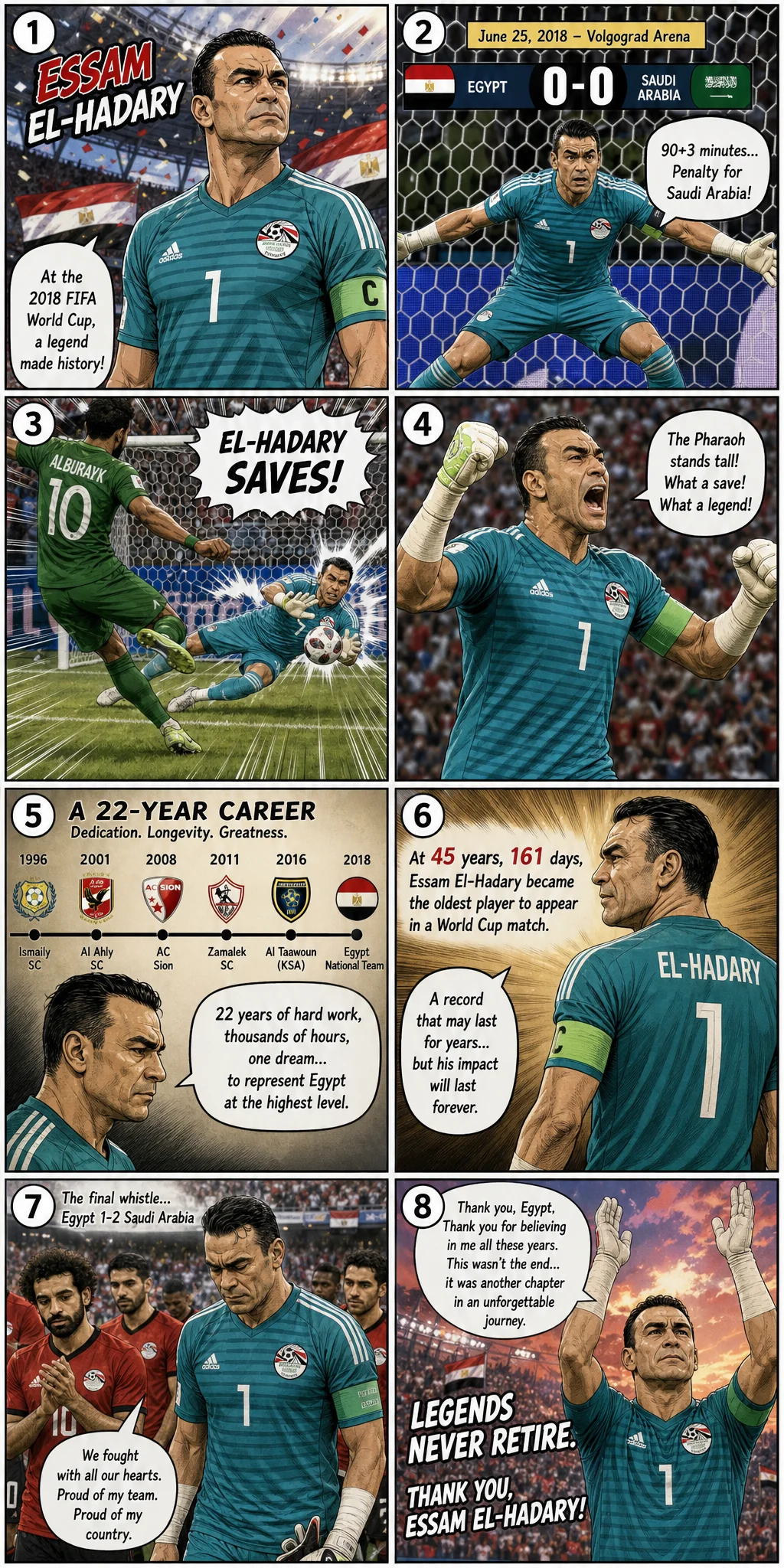
The oldest player in World Cup history is not Italian, German, Brazilian, or Argentine. He is Egyptian. Essam El Hadary was forty-five years and 161 days old when he walked onto the pitch at the Volgograd Arena on June 25, 2018. But the statistical footnote is not what matters. What matters is the penalty save — the dive to his left, the ball pushed onto the post, the promise kept publicly and spectacularly before a global audience that had expected nothing memorable from a dead rubber between two eliminated teams.
El Hadary had said, repeatedly and for years, that he would not retire from international football until he played in a World Cup. He said it at thirty-five, when Egypt had not qualified since 1990. He said it at thirty-eight, when Egypt had won three Africa Cup of Nations titles in a decade but could not translate continental dominance into World Cup qualification. He said it at forty, when the dignified choice would have been to accept that a career featuring four AFCON titles and the respect of an entire region was complete. The promise became a running joke in Egyptian football circles, mentioned with affection and slight embarrassment — the way you talk about a beloved uncle who insists he is going to run a marathon. And then Mohamed Salah happened.
The boy who was four when El Hadary made his debut in 1996 grew into the player who carried Egypt back to the tournament that had eluded them for twenty-eight years. Salah's seventeen goals during qualifying were the mechanism. The most famous was the stoppage-time penalty against Congo in Alexandria in October 2017: score 1-1 in the ninety-fifth minute, eighty thousand people holding their breath, a nation compressing nearly three decades of hope into a single twelve-yard kick. Salah scored. Egypt qualified. The video of the celebration — Salah mobbed, fans pouring onto the pitch, the streets of Cairo erupting — is the most-watched piece of Egyptian sports footage in history. Somewhere in that celebration was El Hadary, forty-four years old, the goalkeeper who had refused to retire. He was going to Russia.
His career defies probability. He debuted in 1996, played for Al Ahly during their continental dominance — CAF Champions League titles in 2001, 2005, 2006, and 2008 — and spent his entire career in African and Middle Eastern leagues, far from the European spotlight. He played for a dozen clubs, the last in the Egyptian Premier League at an age when most goalkeepers have transitioned to coaching or punditry. His longevity was the product of obsessive physical preparation: a training regimen legendary within Egyptian football circles, stretching sessions lasting hours, reaction drills performed until coaches begged him to stop, the monastic dedication of an athlete who decided early that his body would serve his ambition for as long as his ambition required.
When the 2018 World Cup squad was announced, El Hadary was not a ceremonial inclusion. He was the starting goalkeeper. Against Uruguay in the opener — a 1-0 defeat decided by Jose Gimenez's eighty-ninth-minute header, cruel because Egypt had defended superbly for eighty-eight minutes against Suarez and Cavani — El Hadary was between the posts. The record was his: oldest player in World Cup history, surpassing Faryd Mondragon of Colombia. Historically significant but not emotionally transcendent. That came four days later.
Egypt versus Saudi Arabia at the Volgograd Arena. Both teams already eliminated, a Monday afternoon dead rubber before a crowd with no competitive stake. These matches are the graveyard of World Cup narratives — journalists file dutiful reports and think about dinner, players go through motions. In the forty-first minute, Saudi Arabia won a penalty. Fahad Al Muwallad placed the ball on the spot. El Hadary, forty-five years and 161 days old, prepared on his goal line.
The save was not luck. El Hadary had studied Al Muwallad's penalty tendencies — preferred direction, approach angle, the subtle weight shift that preceded his strike — from footage compiled by Egypt's technical staff. The forty-five-year-old read the run-up, anticipated the direction, and deployed a body that had been playing international football since before most of his teammates were in primary school. He dived left. The ball struck the post and rebounded to safety. The oldest player in World Cup history had saved a penalty, in a stadium named after the city where the Soviet Union made its decisive stand against the Nazi invasion — a venue whose historical resonance seemed almost too fitting for a moment about defiance and the refusal to surrender.
The match did not end well. Saudi Arabia won a second penalty, Salman Al-Faraj converting. Egypt lost 2-1, finishing the tournament with zero points from three matches. But when Egyptian football remembers Russia 2018, it will not remember the defeats. It will remember the penalty save. It will remember the forty-five-year-old goalkeeper diving to his left and proving that promises kept are the only kind that matter.
El Hadary's record carries significance beyond the statistics. He is the oldest player in World Cup history, an Egyptian goalkeeper who spent his entire career outside the European spotlight that the football world uses to validate greatness. The record documents the age. The achievement documents something that age cannot measure: the specific human capacity to decide, decades in advance, what you will not accept, and then to refuse, decade after decade, to accept anything less. He saved a penalty at forty-five. He kept his promise. The image of El Hadary on the Volgograd pitch, arms raised after the save, face set in the specific expression of a man who has just fulfilled a vow made decades earlier, belongs in the small category of World Cup moments whose meaning transcends the competition. It was not about Egypt's tournament performance, which was poor. It was not about the result, which was defeat. It was about a goalkeeper who decided, when he was young, that his career would not be complete without a World Cup appearance. He then spent twenty-two years ensuring that decision became reality. The promise he made to himself, to his teammates, and to a nation that had waited a generation to see its team on this stage, he kept. In the end, that is the only thing that matters. Records document statistics. Human stories document something statistics cannot measure. Essam El Hadary: oldest player in World Cup history, an Egyptian goalkeeper who spent his entire career outside the European spotlight, and a man who proved that promises kept are the only kind that endure.