

Ten-One: The Day Football Became a Massacre
Hungary 10, El Salvador 1. June 15, 1982. El Molinon stadium, Gijon, on the northern coast of Spain. The largest margin of victory in the history of the men's World Cup. A record that has survived more than four decades — persisting through tournamen
Published: June 6, 2026
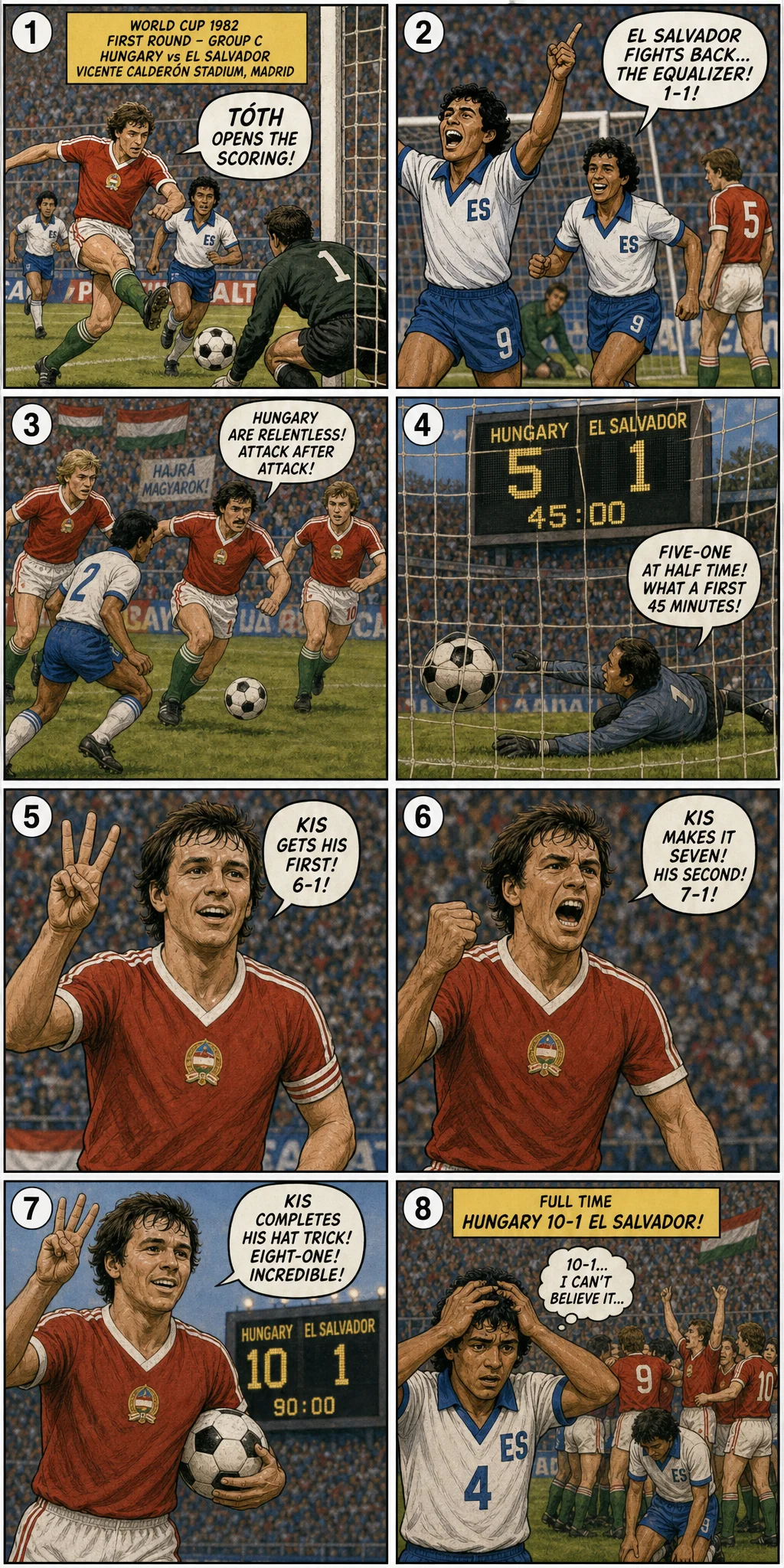
Comic content and match statistics are for entertainment purposes only and may contain inaccuracies. For Accurate Data, please refer to the reference's official website.
# 10-1: Hungary vs El Salvador and Football's Uncomfortable Reflection
Hungary 10, El Salvador 1. June 15, 1982. El Molinon stadium, Gijon, on the northern coast of Spain. The largest margin of victory in the history of the men's World Cup. A record that has survived more than four decades — persisting through tournament expansion from twenty-four teams to forty-eight, through the competitive leveling that globalization and professionalization were supposed to produce, through every reform and structural adjustment FIFA has deployed in the name of competitive balance. When nations built on fundamentally different footballing infrastructures meet on a World Cup pitch, the result is sometimes not a competition but an exposure.
El Salvador had qualified through a CONCACAF playoff system requiring ten matches — a remarkable achievement for a small Central American nation. The squad was predominantly semi-professional: players who trained in the evenings after working construction, agriculture, or service-industry jobs, whose football development had occurred not in academies but in weekend leagues and street football. These were the best footballers El Salvador had produced, selected through competitive processes, trained to the highest standard the nation's infrastructure could support. They were not deficient. They were participants in a system whose limitations reflected economic and developmental realities — a nation navigating the aftermath of civil war, whose football federation operated with resources that would have been considered wholly inadequate at the semi-professional level of European football.
Hungary, by 1982, was a fading European power — distant in time and capacity from the Mighty Magyars of 1954, the team that revolutionized football's tactical vocabulary and lost the Miracle of Bern final. But Hungary retained structural advantages: full-time training, players whose primary occupation was sport rather than construction, tactical preparation conducted across months, coaching staffs with access to sports science and medical resources that semi-professional football could not access. The technical gap was not fundamentally about talent in the sense football discourse typically uses that word. It was about infrastructure — and infrastructure gaps produce systematic, essentially inevitable disparities in competitive performance.
The goals accumulated in waves. Three before halftime, as the Salvadoran defensive structure began fracturing under pressure of Hungarian attacking movements that were not exceptional by European standards but operated at a level of speed and coordination the Salvadoran players had never encountered. Seven after halftime, as exhaustion set in — the specific exhaustion of athletes whose conditioning was the product of evening sessions after full days of physical labor, defending against full-time professionals whose stamina was built across years of daily training. The marking assignments were abandoned. The tracking of runs ceased. The defensive shape collapsed into chaos.
The Hungarian goals were not all brilliant attacking play. Several resulted from defensive errors that would have embarrassed a well-organized amateur team — the specific mistakes exhausted, demoralized players make when the gap between intention and execution widens beyond recovery. The Salvadoran defenders knew, in the abstract, what they were supposed to do. Against opponents whose pace of play was faster than anything they had experienced, whose physical conditioning enabled sustained intensity, the knowledge was not sufficient.
The Salvadoran goal — scored by Luis Ramirez Zapata when the score was 5-0 — deserves more attention than the scoreline typically permits. It was not a consolation in the traditional sense. It was scored when the match was still competitively alive, Zapata maneuvering past a Hungarian defender with technical quality creditable in any context. El Salvador had scored its first World Cup goal. Within the nation, within the community of Salvadoran football, the goal was celebrated with an intensity the broader football world would have found incomprehensible. It was the smallest possible victory — a single goal in a 10-1 defeat — but it was a genuine and meaningful victory.
The 10-1 catalyzed institutional reflection within FIFA whose consequences extend to the forty-eight-team World Cup of 2026. The expansion from twenty-four to thirty-two teams for France 1998 was driven partially by the desire to provide greater representation for smaller football nations. The allocation of additional qualification places, regional quotas, and development funding programs were shaped by the memory of El Molinon. The photograph of the scoreboard — white numbers stark against black — circulated through the global football media, carrying a moral charge the statistical record alone cannot convey. The reforms that followed did not eliminate the inequalities the match exposed. Structural inequality persists through the very mechanisms designed to address it. The forty-eight-team tournament represents the latest negotiation between the competing values of representation and competitive balance. The Hungary-El Salvador 10-1 stands as a monument to what the negotiation attempts to resolve — and a warning about what happens when it fails. The numbers alone are a record. The human story — eleven Salvadoran players who qualified through years of sacrifice and suffered the most lopsided defeat in tournament history because structural conditions they could not control made it essentially inevitable — deserves to be remembered alongside it.
I think, sometimes, about the Salvadoran goalkeeper who conceded ten goals at El Molinon. His name is not widely remembered — the specific anonymity that football's historical memory imposes on the players defined entirely by the goals they conceded rather than the goals they scored, whose competitive legacy is not an achievement but a record, not something they accomplished but something that happened to them. I think about what the experience of that match must have been like — the specific psychological experience of watching shots fly past you one after another, of diving for balls that are already in the net, of hearing the crowd's reaction shift over the course of ninety minutes from competitive engagement to something closer to embarrassment on behalf of the players suffering the defeat. The goalkeeper did not cause the 10-1. The structural inequalities of global football caused the 10-1: the specific disparity between a professional European football system that produced full-time athletes and a semi-professional Central American system that produced evening-trained laborers. The goalkeeper experienced it — in his body, in the specific physical sensation of repeatedly retrieving the ball from his own net, in the specific psychological trauma of a competitive humiliation he could not prevent and did not deserve. The distinction between causing an outcome and experiencing it — between the structural forces that produce competitive inequality and the individual human beings who suffer its consequences — is the distinction that football's statistical record, with its relentless reduction of human experience to numerical data, systematically erases. The Hungary-El Salvador 10-1 is a record. It will remain in the tournament's archives for as long as World Cups are contested. It is also, and more importantly, a human story. The story deserves to be remembered alongside the numbers.