

Twelve Goals, Forty Degrees, and a Match That Refused to End
Twelve goals in a single World Cup match. Austria 7, Switzerland 5. The 1954 quarterfinal in Lausanne, played on June 26 in conditions that no modern tournament would permit. The temperature exceeded forty degrees Celsius — 104 degrees Fahrenheit — a
Published: June 6, 2026
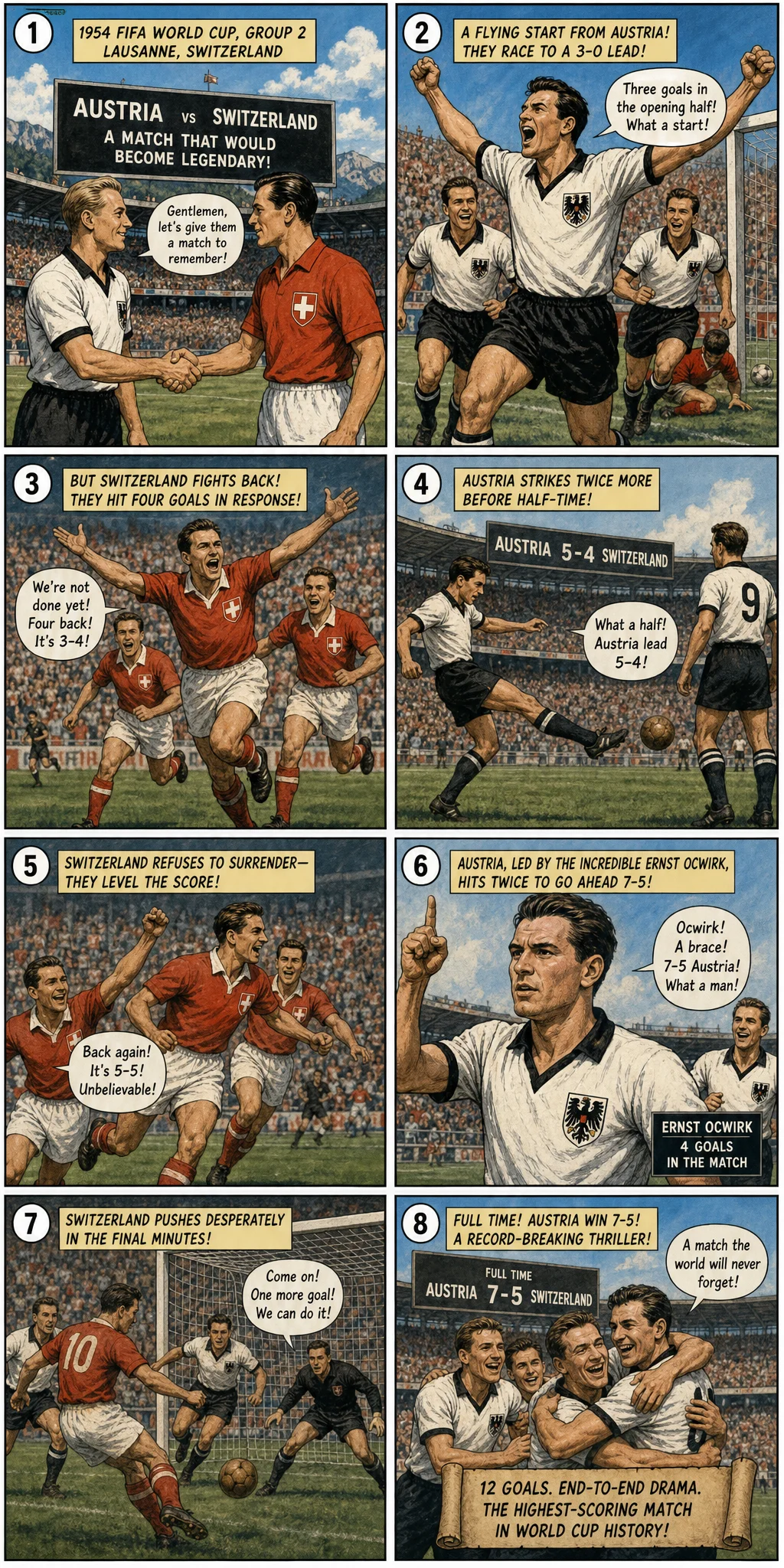
Comic content and match statistics are for entertainment purposes only and may contain inaccuracies. For Accurate Data, please refer to the reference's official website.
# Twelve Goals, Forty Degrees: Austria 7-5 Switzerland and the Match That Broke Physics
Twelve goals in a single World Cup match. Austria 7, Switzerland 5. The 1954 quarterfinal in Lausanne, played on June 26 in conditions that no modern tournament would permit. The temperature exceeded forty degrees Celsius — 104 degrees Fahrenheit — a level at which contemporary sports medicine would classify continued athletic exertion as a medical risk requiring intervention. The pitch, watered before kickoff in the hope of providing some relief from the heat, was baked solid by halftime. Players from both sides, in the decades after, described the experience not as a football match but as an endurance event that happened to involve a ball. The highest-scoring game in World Cup history belongs to a version of football whose physical demands were so fundamentally different from the modern sport that the comparison is almost meaningless.
The match began with a tempo that suggested neither team had received the meteorological memorandum. Austria scored first through Theodor Wagner in the third minute. They scored again in the fifteenth. Then again — Wagner completing his hat-trick — in the twenty-first. 3-0 after twenty-two minutes. Switzerland, the host nation playing before a home crowd in Lausanne, responded with three goals in six minutes. Robert Ballaman and Josef Hugi, dragging their team back from competitive oblivion, scored in rapid succession while the stadium produced a noise that contemporary witnesses described as physically overwhelming — the roar of a crowd that had traveled expecting a football match and been given something closer to a fever dream.
5-3 at halftime. Twelve goals in a typical World Cup match would be extraordinary, a statistical outlier generating headlines for decades. Twelve goals in forty-five minutes was something beyond extraordinary. It was the competitive manifestation of conditions that no longer exist in professional football — the absence of systematic defensive organization that contemporary opponents deploy as a matter of tactical instinct, the physical toll of heat exhaustion on athletes who had no access to hydration science or recovery protocols, the specific chaos of a match played at a tempo simultaneously unsustainable and unstoppable.
The second half was a study in human endurance. Wagner completed his hat-trick — four goals for the Austrian striker. Ballaman scored his second for Switzerland. Hugi completed his hat-trick, three goals in a losing effort, the kind of individual achievement normally celebrated for decades but which the match's broader insanity has permanently overshadowed. Austria scored twice more. 7-5. Twelve goals. The referee, a Scottish official named George Faultless — a name that deserves commemoration for having presided over chaos without losing control — reportedly considered abandoning the match at least twice. There were no substitutions in 1954. A player who started the match finished it or was carried off. The concept of tactical rotation, of protecting players from the accumulated physical toll of high-intensity exertion, did not exist. You played until you could not play, and then you kept playing because there was no mechanism for stopping.
The context of the 1954 tournament makes the match even more remarkable. That World Cup featured the highest goals-per-game average in tournament history — 5.38 goals per match across twenty-six fixtures, a record that stands to this day. The format was eccentric: four-team groups where seeded teams did not play each other, a structure that produced wildly uneven matchups. Hungary's Mighty Magyars, the greatest team never to win a World Cup, scored 17 goals before losing the final to West Germany in the Miracle of Bern. South Korea conceded 16 goals in two group matches. Turkey beat South Korea 7-0. The tournament was a carnival of attacking football precisely because defensive organization had not yet evolved into the systematic discipline that would define later eras. Defenders marked individually rather than zonally. Offside traps were primitive. The collective pressing that modern teams deploy as a matter of tactical instinct — the coordinated forward movement that suffocates space before it can be exploited — simply did not exist.
Austria's progress through the tournament ended in the semifinals, where they lost 6-1 to Uruguay. Switzerland's adventure was over. But the 7-5 has survived everything — every tournament expansion, every tactical revolution, every development in sports science and defensive organization across seven decades. Germany put seven past Brazil in a 2014 semifinal that shook the football world, but that was seven goals by five different scorers, a collective demolition rather than a mutual goal-fest. The 7-5 is different. It required both teams to participate in its insanity. Switzerland, scoring five goals in a losing effort, contributed as much to the record as Austria did. It was not a massacre. It was a collaboration between two teams too exhausted by the heat to defend and too committed to attacking to stop trying.
The 1954 quarterfinal is a time capsule from a version of football that no longer exists. Modern football does not permit the conditions that produced twelve goals — the heat exhaustion, the absence of substitutions, the defensive organization that would embarrass a contemporary Sunday league team. The record will never be broken because the sport has evolved specifically to prevent the chaos that produced it. Every defensive midfielder who screens the back four, every coach who drills his team in zonal marking, every sports scientist who monitors player workload and mandates substitutions at prescribed intervals — they are all, in their way, preventing another 7-5. The twelve goals of Lausanne survive as a monument to a more innocent, more chaotic, and in some fundamental sense, more entertaining version of the game. Football moved on. The record stayed behind, improbable and unreachable, waiting for a game that no longer exists.
The players who participated in that quarterfinal carried its memory for the rest of their lives. Theodor Wagner, the Austrian who scored four goals, never again experienced anything like that afternoon in Lausanne. Josef Hugi, whose hat-trick for Switzerland came in defeat, would be remembered primarily as a footnote to the match rather than as one of its protagonists — the peculiar injustice of being the tournament's second-highest scorer whose name is recalled only as the man who scored three and lost. The goalkeeper who conceded seven, the defenders who could not stop Wagner, the Swiss players who scored five and still walked off eliminated — every participant was defined, to some degree, by their presence in this specific match. It is the only World Cup fixture in history where both teams scored at least five goals. It is the only World Cup fixture where a player scored a hat-trick for the losing side. Its records are multiple and interlocking — twelve goals in a match, five goals by the losing team, three goals by a player on the losing side — and none of them will be broken because the sport has evolved specifically to prevent the chaos that produced them. The twelve goals of Lausanne survive as a monument to a more innocent, more chaotic, and in some fundamental sense, more entertaining version of the game.