

One Hundred Seventy-Three Thousand People Watched a Country Die
July 16, 1950. The Maracana Stadium, Rio de Janeiro. Brazil versus Uruguay — effectively the World Cup final in the tournament's eccentric final-round format that replaced knockout brackets with a four-team group to determine the champion. The offici
Published: June 6, 2026
Comic content and match statistics are for entertainment purposes only and may contain inaccuracies. For Accurate Data, please refer to the reference's official website.
# 173,000 People Watched a Nation's Heart Break: The Maracanazo
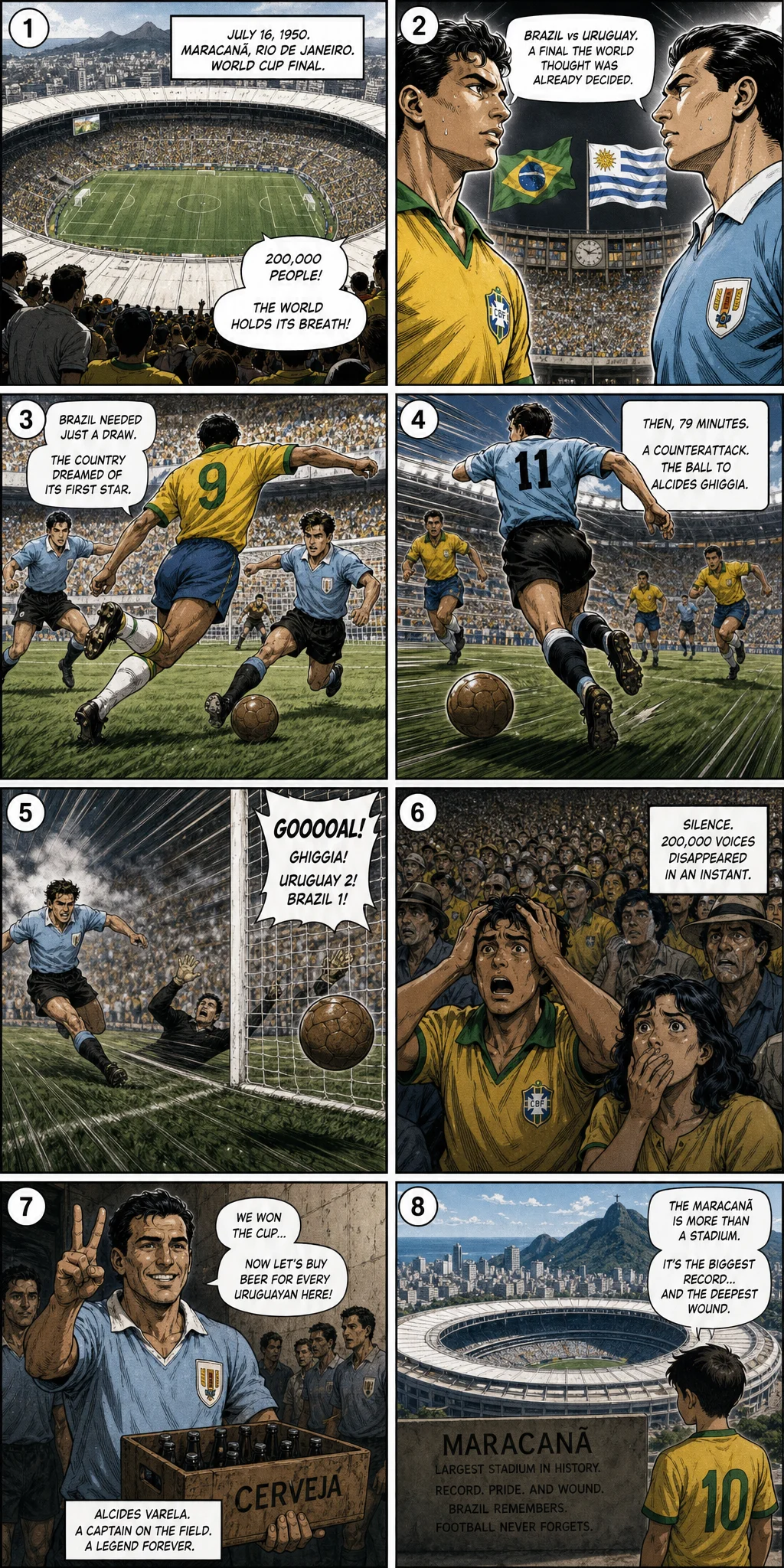
July 16, 1950. The Maracana Stadium, Rio de Janeiro. Brazil versus Uruguay — effectively the World Cup final in the tournament's eccentric final-round format that replaced knockout brackets with a four-team group to determine the champion. The official attendance, as recorded by the Brazilian football federation: 173,850. Unofficial estimates, compiled by journalists and historians who have spent decades attempting to document the largest football crowd ever assembled, place the actual figure closer to 200,000. The largest audience ever gathered for a football match assembled to witness what every Brazilian in attendance understood as a formality, a coronation rather than a competition: their nation's first World Cup triumph, the moment that would announce Brazil's arrival as a football superpower and validate the massive public investment in the Maracana itself, the stadium built specifically to host this tournament and this moment.
Brazil needed only a draw. Uruguay needed a victory. The mathematics favored the hosts so overwhelmingly that the mathematics were not discussed — the result was assumed, and the assumption was embedded in every aspect of the pre-match atmosphere. The Brazilian newspaper O Mundo had printed a special edition declaring Brazil world champions before kickoff, complete with photographs of the players under the headline "These Are the World Champions." The governor of Rio de Janeiro had prepared a victory speech. The samba bands that had accompanied Brazil's tournament campaign, providing the soundtrack to a national celebration that had been building for weeks, were positioned throughout the stadium, ready to transition from anticipation to jubilation the moment the expected result materialized.
When Friaça scored for Brazil early in the second half — a shot from a tight angle that squeezed between the Uruguayan goalkeeper and the near post — the Maracana erupted with a noise that witnesses have spent decades trying and failing to describe. It was, by multiple accounts, the loudest human-made sound those witnesses had ever heard, the collective roar of nearly two hundred thousand people simultaneously believing that history had arrived, that the decades of almost and not-quite were over, that Brazil was finally, definitively, about to be crowned. The samba bands played with renewed intensity. The crowd began composing victory songs, spontaneous celebrations that reflected the certainty that had been building throughout the tournament and that the Friaça goal had transformed from anticipation into inevitability.
Juan Alberto Schiaffino equalized for Uruguay in the sixty-sixth minute. The crowd grew nervous. The samba bands continued playing but with diminished conviction, the musicians sensing what the spectators were sensing — that the certainty of the first half, the assumption that had governed every aspect of the pre-match atmosphere, had been replaced by something more fragile. The crowd did not panic. Brazilians knew their team needed only a draw. The mathematics still favored them. The nervousness was not fear but the first stirrings of doubt, and doubt had not been part of the Brazilian emotional vocabulary for the entire tournament.
Then Alcides Ghiggia scored. The Uruguayan winger, who had been tormenting the Brazilian left side all afternoon, cut inside from the right wing and struck the ball at the near post. The Brazilian goalkeeper, Moacir Barbosa, was positioned slightly too far toward the center of his goal — the positional error of an instant, the kind of mistake that every goalkeeper makes and that almost none make in a World Cup final. The ball passed between Barbosa and the post. 2-1 Uruguay. Eleven minutes remained. The Maracana went silent.
Not the ordinary silence of a disappointed crowd, the temporary quiet that follows an opponent's goal before the encouragement resumes. The silence of nearly two hundred thousand people simultaneously discovering that the future they had been promised was not the future they would receive. That silence — I have spoken to Brazilians who were there, elderly men and women who have carried the memory for more than seven decades — is not the absence of sound. It is the presence of devastation. A collective emotional collapse made audible, the sound of an entire nation's expectations being extinguished in a single moment.
Brazil lost 2-1. The Maracanazo — the Maracana blow, the catastrophe at the Maracana — became the founding trauma of modern Brazilian football, the psychological wound that every subsequent Brazilian generation has carried. The white shirts with blue collars worn that afternoon were permanently retired, forever associated with the moment of collective psychological collapse. A nineteen-year-old newspaper illustrator named Aldyr Garcia Schlee won a competition to design Brazil's new kit — yellow shirt, blue shorts, white socks, incorporating all four colors of the national flag — creating the most recognizable visual identity in global sport from the ashes of the nation's greatest sporting disaster.
Moacir Barbosa, the goalkeeper blamed for Ghiggia's goal, spent the remainder of his life as a national scapegoat. The shot was struck from a tight angle, at the near post, a position that goalkeeping manuals identify as the goalkeeper's responsibility but which any honest technical analysis would classify as a difficult save rather than an egregious error. Barbosa carried the blame because Brazil needed someone to blame, and the goalkeeper's positional error provided a convenient target for grief that was too vast to be directed at the abstract cruelty of sport. Decades later, Barbosa summarized his existence with devastating precision: "In Brazil, the maximum prison sentence is thirty years. I have been paying for a crime I did not commit for more than forty." He died in 2000, fifty years after the Maracanazo, having never escaped the shadow of an afternoon that defined his life.
The Maracanazo was not a football match. It was a national psychological wound, and its scars remain visible in Brazilian football culture every time the Selecao plays a decisive match. The ghost of 1950 haunts every Brazilian World Cup campaign. The five subsequent victories — 1958, 1962, 1970, 1994, 2002 — have never fully exorcised it, because the Maracanazo was not about winning or losing. It was about certainty being shattered, and the pieces of shattered certainty can never be fully reassembled.