

Sixteen Yellow Cards, Four Red Cards, and a Referee Who Lost Control
The 2006 World Cup round of sixteen match between Portugal and the Netherlands produced a disciplinary record that will stand as long as the tournament exists: sixteen yellow cards and four red cards distributed across ninety minutes of football that
Published: June 6, 2026
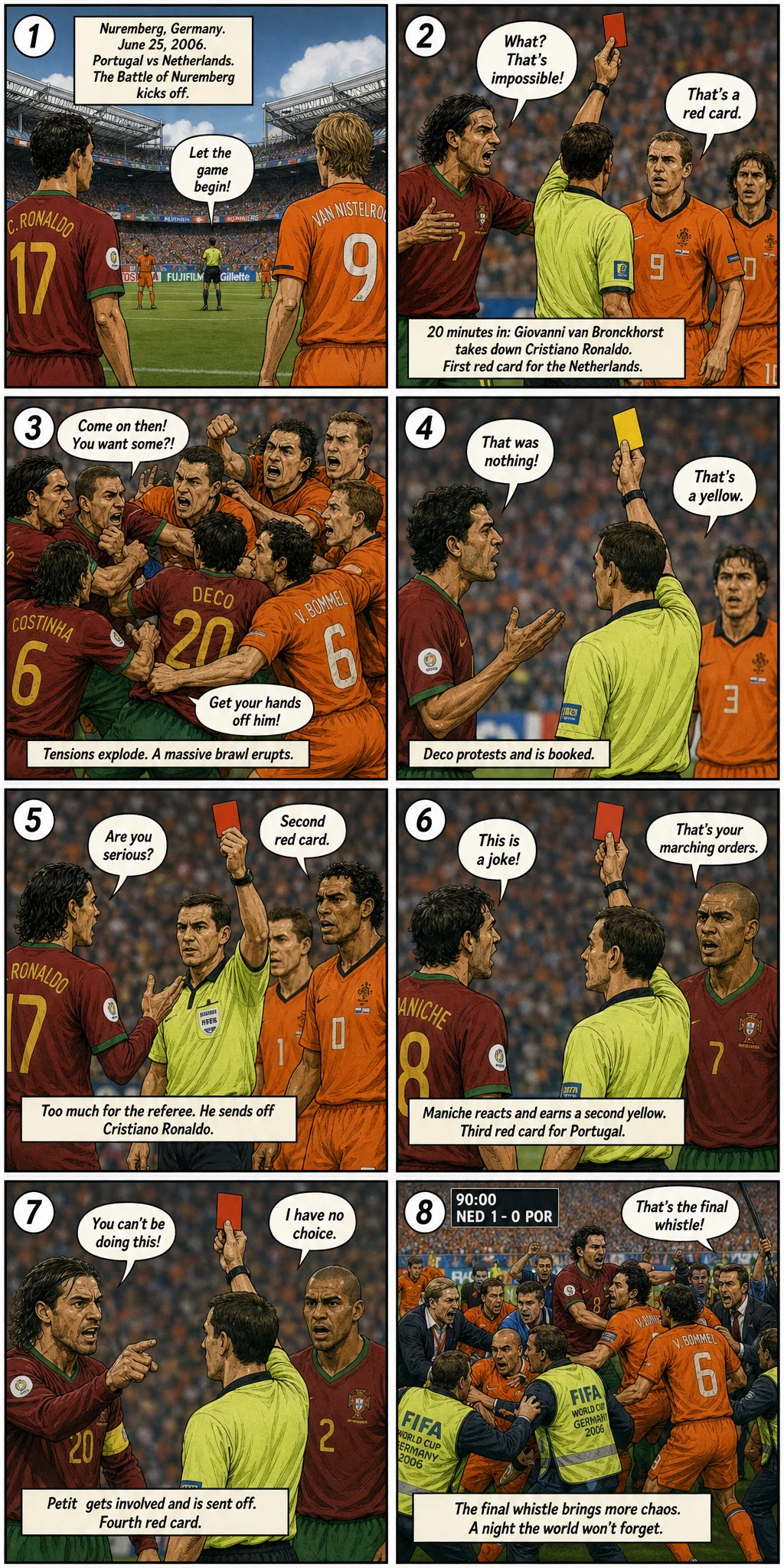
Comic content and match statistics are for entertainment purposes only and may contain inaccuracies. For Accurate Data, please refer to the reference's official website.
# Sixteen Yellow Cards, Four Red Cards: The Battle of Nuremberg as Institutional Failure
The 2006 World Cup round of sixteen match between Portugal and the Netherlands produced a disciplinary record that will stand as long as the tournament exists: sixteen yellow cards and four red cards distributed across ninety minutes of football that more closely resembled a sustained outbreak of institutionalized violence than an athletic competition. Four players sent off. Eight Portuguese players and eight Dutch players booked. FIFA president Sepp Blatter publicly criticized referee Valentin Ivanov — an unprecedented breach of institutional protocol, a federation president undermining his own match official — and the match instantly became the reference point for any discussion of when elite professionals, operating at the highest level of their sport, collectively decide that the rules no longer apply.
The violence was not spontaneous combustion. It was systematic from the opening minutes, and the systematic nature of the violence is what distinguishes the Battle of Nuremberg from the ordinary physical intensity of knockout football. Mark van Bommel's early foul on Cristiano Ronaldo — a tackle that arrived late, high, and with a force that suggested intent rather than mistimed aggression — established the parameters of engagement: physical, cynical, designed to unsettle rather than to compete. The message was clear, and the Portuguese players received it with the professional clarity of athletes who understood that the match they had prepared for was not the match they were about to play.
Ronaldo left the match in tears in the first half. A tackle from Khalid Boulahrouz, the Dutch defender whose physical approach to the game had been a subject of opposition scouting reports throughout the tournament, caught the Portuguese winger on the thigh with studs that should have produced a straight red card in any club competition. Ivanov, already demonstrating the leniency that would define and ultimately destroy his control of the match, produced only a yellow. Ronaldo, the tournament's most fouled player to that point, recognized that the protection he was entitled to under the laws of the game was not going to be provided, and his departure was both physical — the injury was genuine — and psychological. The most talented player on the pitch had been removed by a tackle that the referee had effectively sanctioned through inadequate punishment.
The yellow cards accumulated at a rate that initially suggested competitive intensity and gradually revealed something darker: a mutual understanding between the two teams that the rules of engagement had been suspended, that the referee had lost the capacity to enforce the standards of conduct that competitive football requires, and that the match would be decided not by tactical execution or technical quality but by which team could impose its physical will more comprehensively. The bookings blurred from disciplinary measures into administrative formalities — Ivanov continued producing cards because the match required them, but the cards had lost their deterrent function. Players who had been booked continued committing bookable offenses because the booking had not changed the calculus of acceptable risk.
By the final whistle, both teams had been reduced to nine men. Deco and Giovanni van Bronckhorst — club teammates at Barcelona, men who shared training sessions and tactical meetings and the specific camaraderie of winning trophies together — sat side by side on the sideline after being sent off, having a conversation that witnesses described as philosophical rather than confrontational. The image of two suspended Barcelona players, discussing their mutual expulsion while the match they had been expelled from continued without them, captured something essential about the Battle of Nuremberg. It was not primarily a football match. It was a case study in what happens when institutional authority loses control and the participants recognize that control has been lost.
The referee bears responsibility for the match's descent into chaos, but the responsibility is shared. Ivanov's early leniency — the failure to produce the straight red card that Boulahrouz's tackle on Ronaldo demanded — established a threshold for acceptable violence that the match subsequently exceeded. The players bear responsibility for recognizing that the threshold had been lowered and exploiting it. The football institutions that selected and supported Ivanov bear responsibility for placing a referee in a match whose intensity exceeded his capacity to manage. The Battle of Nuremberg is remembered for the cards — sixteen yellow, four red, an administrative ledger of institutional failure. The real lesson concerns the fragility of the rules that govern competitive sport, and how quickly those rules become irrelevant when the people enforcing them lose their grip.