

Four Times They Came Second, and Four Times They Came Back
The Netherlands has reached three World Cup finals — 1974, 1978, 2010 — and lost all three. No nation without a World Cup title has come closer on more occasions. The Dutch relationship with football's most important trophy is not a statistical recor
Published: June 6, 2026
Comic content and match statistics are for entertainment purposes only and may contain inaccuracies. For Accurate Data, please refer to the reference's official website.
# Three Finals, Zero Victories: The Netherlands and the Art of Beautiful Defeat
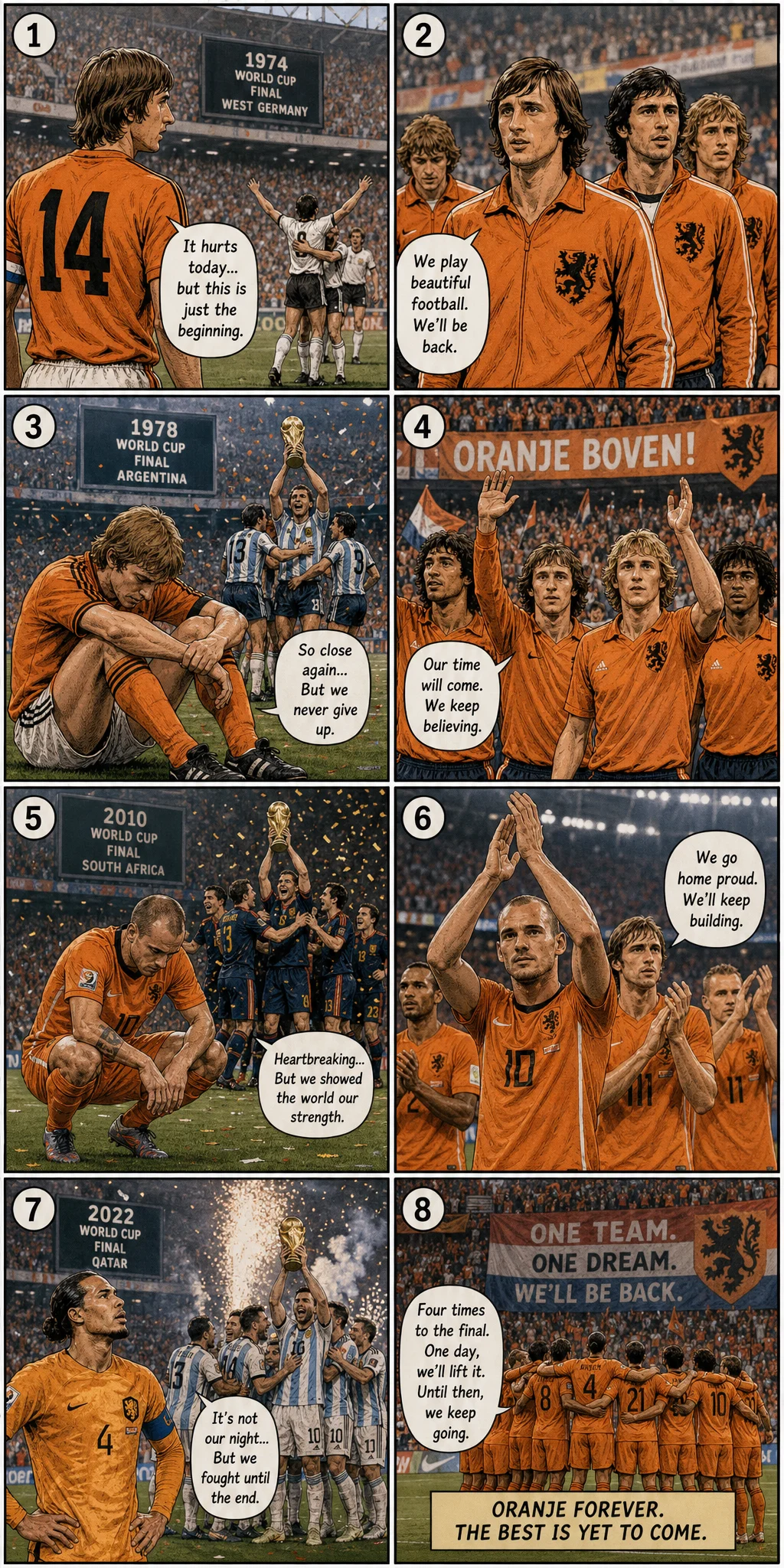
The Netherlands has reached three World Cup finals — 1974, 1978, 2010 — and lost all three. No nation without a World Cup title has come closer on more occasions. The Dutch relationship with football's most important trophy is not a statistical record but a cultural condition, a national narrative of beautiful near-miss that has been unfolding for more than half a century and shows no sign of resolution. The Dutch condition — brilliance without validation, aesthetic revolution without the trophy that would confirm it — is simultaneously the most romantic story in World Cup history and the most painful.
The 1974 final was supposed to be the coronation. Total Football — the tactical revolution that rendered positional rigidity obsolete, that transformed every outfield player into an interchangeable component of a fluid attacking system, that substituted spatial intelligence for fixed positions and thereby changed the sport's fundamental understanding of itself — had been invented in the Netherlands and brought to its highest expression by Johan Cruyff's Ajax and Rinus Michels' national team. The Dutch arrived at the final having played football that observers described in terms approaching religious experience: the constant rotation of positions, the collective pressing, the specific aesthetic of a team that seemed to be playing a different sport from its opponents. The final against West Germany began with a Dutch goal before a German player had touched the ball. Cruyff dribbled into the penalty area, was fouled by Uli Hoeness — the penalty that German football culture has debated for fifty years — and Johan Neeskens converted. 1-0 after eighty seconds. The most aesthetically revolutionary team in football history had taken the lead in the most important match in the sport without their opponents making a single meaningful intervention. Germany equalized through a Paul Breitner penalty — also debatable — and Gerd Muller scored the winner just before halftime. Total Football had been beautiful and insufficient.
The 1978 final was a near-replica. The Netherlands, playing in Argentina without Cruyff — who had retired from international football for reasons that remain debated, variously attributed to a kidnapping attempt on his family, a dispute with the Dutch federation, or simple exhaustion with the demands of being Johan Cruyff — reached the final again and lost again. Argentina in extra time, Mario Kempes scoring twice, the host nation winning its first World Cup while the Dutch collected their second silver medal. The pattern of beautiful defeat was hardening into a national characteristic: the Netherlands played football that the world admired and lost the match that the world remembered.
The 2010 final produced the ugliest Dutch team in history. The side that Bert van Marwijk constructed to reach the final in South Africa bore almost no resemblance to Cruyff's aesthetic vision. Nigel de Jong's tackle on Xabi Alonso — studs into the chest, an assault that would have been a red card in any club match and in most street fights — became the defining image of Dutch pragmatism taken to its violent extreme. Arjen Robben's two breakaway chances, both saved by Iker Casillas, represented the moments when the match could have been won through the individual quality that the Dutch system had been designed to suppress. Andres Iniesta scored in the 117th minute, the goal arriving so late that it felt like an injustice even as it represented the logical conclusion of a match Spain had controlled. The Dutch had abandoned their football philosophy in pursuit of victory and had been denied victory anyway — the cruelest outcome, the one that punished both the abandonment and the attempt.
The Netherlands has produced Cruyff, Van Basten, Gullit, Bergkamp, and Robben. It has produced a football philosophy that changed the sport's fundamental understanding of itself. It has produced the specific aesthetic of Total Football that remains, fifty years later, the reference point for tactical innovation. It has never produced a World Cup champion. That contradiction — beauty without the validation that only victory provides — is the Dutch condition, and the 2026 campaign represents another attempt to resolve it. Three finals. Three defeats. The near-miss that refuses to become a miss, and the beauty that refuses to accept that beauty alone is insufficient. The Dutch story is unfinished. That is both its tragedy and its enduring appeal.