

Forty-Eight Teams Walk Into a World Cup
The vote was cast on January 10, 2017, at FIFA headquarters in Zurich. The FIFA Council — the thirty-seven-member body that had replaced the disgraced Executive Committee after the 2015 corruption scandal that brought down Sepp Blatter and much of FI
Published: June 6, 2026
Comic content and match statistics are for entertainment purposes only and may contain inaccuracies. For Accurate Data, please refer to the reference's official website.
# From 32 to 48: The Vote That Changed the World Cup Forever
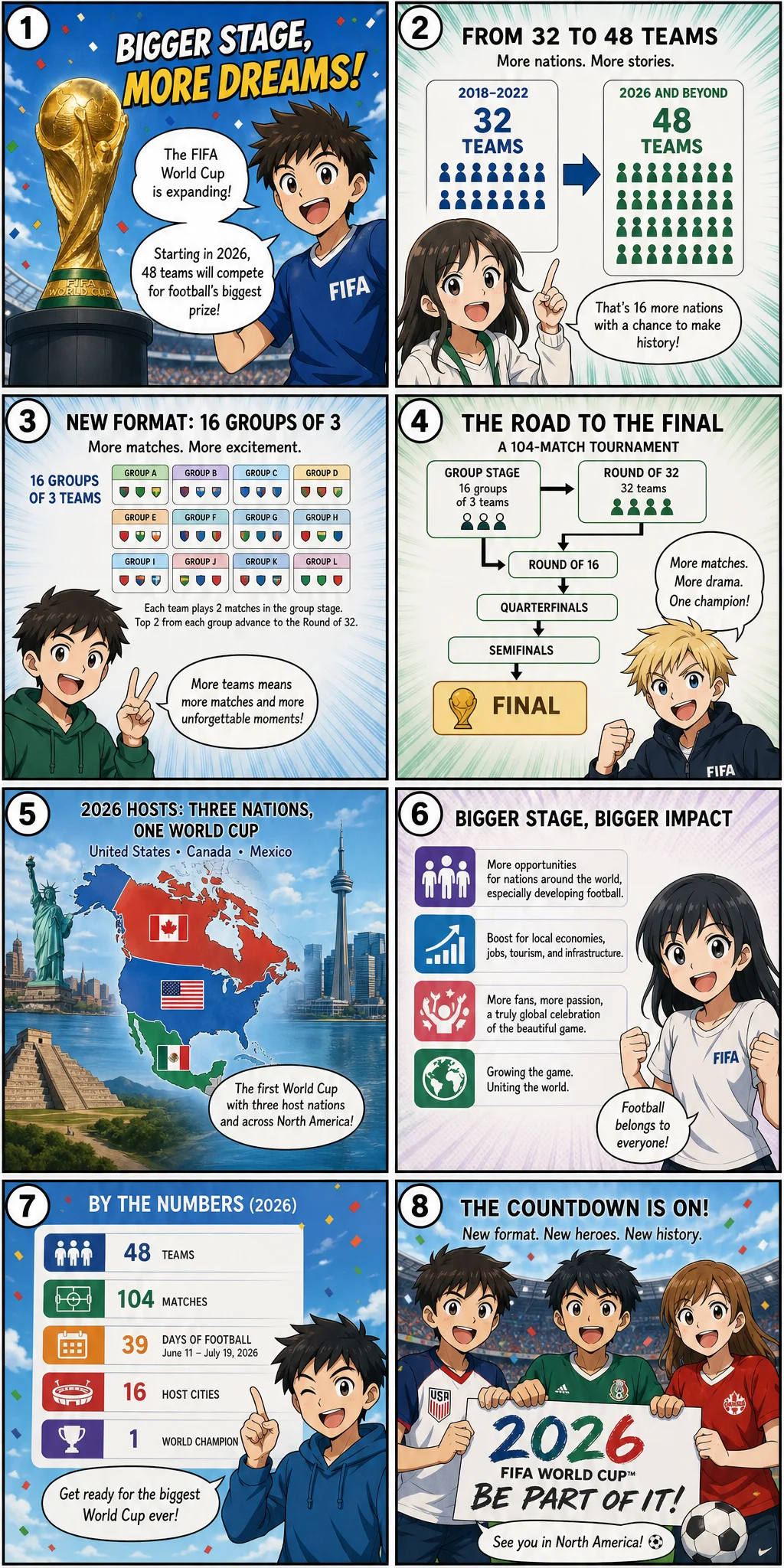
The vote was cast on January 10, 2017, at FIFA headquarters in Zurich. The FIFA Council — the thirty-seven-member body that had replaced the disgraced Executive Committee after the 2015 corruption scandal that brought down Sepp Blatter and much of FIFA's senior leadership — gathered to decide the future shape of football's most important competition. The proposal before them: expand the men's World Cup from thirty-two teams to forty-eight, effective with the 2026 edition to be hosted across the United States, Canada, and Mexico. The vote passed unanimously. Every confederation supported it. The most significant structural change in World Cup history — a 50% increase in participating nations, the addition of an entirely new knockout round, the transformation of the tournament's fundamental architecture — was approved without a single dissenting voice. FIFA had achieved a level of institutional consensus on a major issue that it had not managed in decades, and the consensus was achieved on a proposal that fundamentally changed the competition's identity.
The format that emerged — sixteen groups of three teams, the top two from each group advancing to a thirty-two-team knockout bracket — was not the only model considered. FIFA's technical committee evaluated multiple proposals, including a forty-team format with eight groups of five that would have maintained the traditional four-team group structure that had defined every World Cup since 1958. The forty-team model preserved what football traditionalists considered the tournament's essential competitive feature: the four-team group where every nation played three matches against three different opponents, and the final matchday featured four interdependent destinies producing the split-screen drama that had generated some of the tournament's most iconic moments. But the forty-team model required additional matchdays beyond the existing tournament calendar, compressed the schedule in uncomfortable ways, and ultimately fell victim to the same political logic that had driven the expansion proposal from its inception.
The forty-eight-team model prevailed for reasons that were simultaneously political and commercial. Politically, the expansion delivered substantial increases in World Cup participation to every confederation — Africa's guaranteed spots expanded from five to nine, Asia's from four-and-a-half to eight-and-a-half, CONCACAF's from three-and-a-half to six — satisfying the federations that constituted FIFA's voting majority. Commercially, the forty-eight-team format created eighty group-stage matches and a round-of-thirty-two knockout match that had not existed since 1938, generating additional broadcasting inventory, ticket revenue, and sponsorship exposure that FIFA's financial projections depended upon. The extra knockout round was marketed to the public as "more elimination drama," a phrase that FIFA's communications department deployed so frequently it began to feel less like a description and more like an incantation — the words chosen to transform a commercial calculation into a sporting enhancement.
The three-team group stage was described as "streamlined" — another communications-department incantation, a word applied to a format that created precisely the competitive asymmetries that the four-team group had been designed to eliminate. In a four-team group, every nation played three matches against three different opponents, and no team sat idle on the final matchday while its fate was decided by others. In a three-team group, each nation plays only two group-stage matches, and one team sits idle on the final matchday while the other two determine its destiny. The reduction from three matches to two means every moment carries proportionally greater weight: one bad performance, one refereeing error, one moment of individual brilliance can be decisive without the safety net that a third group match historically provided. The format creates a tournament where group-stage elimination is simultaneously more likely — fewer matches means fewer opportunities to recover from a poor result — and less likely, because the mechanism for advancing includes the eight best third-placed finishers.
The representation argument deserves more serious consideration than European traditionalists have generally granted it. Africa's allocation expanded from five guaranteed spots to nine, a near-doubling that reflects the continent's population — more than 1.4 billion people, nearly a fifth of humanity — and its historical underrepresentation in a tournament that claims to be global. Asia's allocation expanded from four-and-a-half guaranteed spots to eight-and-a-half. A continent containing sixty percent of the world's population had been represented by fewer than fifteen percent of tournament participants since the expansion to thirty-two teams in 1998. The forty-eight-team format partially corrects this imbalance, and the correction is significant regardless of whether one believes the World Cup's primary purpose is competitive excellence or global inclusion. FIFA has never resolved this tension between quality and representation. The forty-eight-team format picks a side — inclusion — and dares the competition to prove that representation and excellence can coexist across thirty-nine days and one hundred and four matches.
The expansion's critics — and they are numerous among the European football establishment — argue that the forty-eight-team format dilutes competitive quality, produces mismatches between football superpowers and nations whose football infrastructure cannot support World Cup-level competition, and transforms the World Cup from an elite competition into a participation event. The critics have evidence: the 2026 group stage features matchups between nations whose footballing resources differ by orders of magnitude, creating the potential for results that expose structural inequality rather than sporting merit. But the critics' argument against expansion is also an argument for preserving a status quo that systematically excluded the majority of the world's population from football's most important stage. The 2026 World Cup will answer the question that the 2017 vote posed: whether inclusion and competitive excellence can coexist within the same tournament structure. The answer will shape World Cup expansion debates for the next generation. The vote in Zurich was unanimous. The verdict on what that vote produced will not be.