

Three Countries, One Table, and an Unprecedented Party
The 2026 World Cup is the first in history to be hosted by three nations — the United States, Canada, and Mexico — under a unified organizational umbrella. The logistical architecture required to deliver a tournament across three sovereign countries,
Published: June 6, 2026
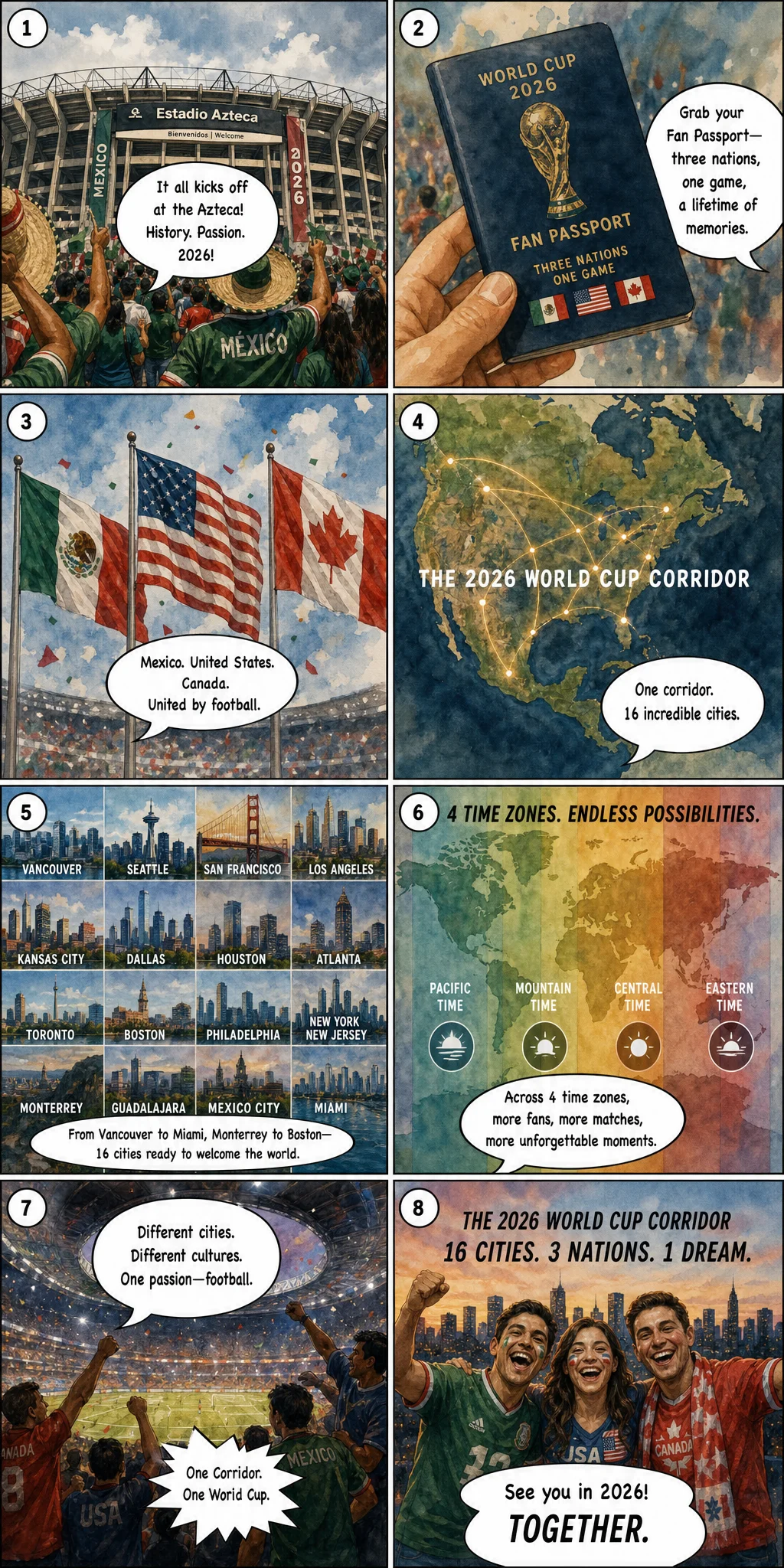
Comic content and match statistics are for entertainment purposes only and may contain inaccuracies. For Accurate Data, please refer to the reference's official website.
# Three Nations, One Tournament: The Unprecedented Architecture of Co-Hosting
The 2026 World Cup is the first in history to be hosted by three nations — the United States, Canada, and Mexico — under a unified organizational umbrella. The logistical architecture required to deliver a tournament across three sovereign countries, with three separate immigration systems, three sets of labor laws, three national broadcasting ecosystems, and sixteen stadiums spread across a continent, is unprecedented in sporting history. Whether this architecture represents the future of mega-event hosting or a one-time accommodation of North America's unique geographic and political circumstances is one of the central questions the tournament will answer.
The United bid, formally presented to FIFA in March 2018 under the banner "United 2026," was built on a straightforward premise: North America possesses the existing infrastructure to host a forty-eight-team World Cup without the multibillion-dollar stadium construction projects that have burdened previous hosts. The bid document ran to 534 pages covering stadium specifications, transportation infrastructure, security protocols, accommodation capacity, and economic impact projections. It argued that the continent's unmatched combination of large-capacity venues — most of the sixteen selected stadiums were existing NFL or major college football facilities requiring only modest retrofitting for football — broadcast market sophistication, corporate sponsorship ecosystems, and demonstrated capacity to host enormous sporting events made it the only candidate capable of delivering a commercially successful expanded tournament. FIFA's evaluation committee rated the United bid 4.0 out of 5.0, the highest score ever awarded. Morocco, the only other candidate, scored 2.7. The FIFA Congress voted 134 to 65 in favor of North America on June 13, 2018, the day before the 2018 World Cup opened in Russia.
The match distribution within the partnership reflects the power dynamics among the three hosts with mathematical precision. Sixty of the eighty group-stage and early knockout matches will be played in the United States. Ten each in Canada and Mexico. All matches from the quarterfinals onward will be played in American stadiums, a decision that reflects both the United States' unmatched inventory of high-capacity venues and the commercial logic that places the tournament's most valuable fixtures in the host nation with the largest domestic broadcast market. The Estadio Azteca in Mexico City will host the opening match — a symbolic gesture toward the only stadium in world football that has hosted two previous World Cup finals, the sacred ground where Pele won his third title in 1970 and Maradona scored the Goal of the Century in 1986. The final will be played at MetLife Stadium in New Jersey, a decision driven by broadcast scheduling mathematics, time zone considerations for European television audiences, and the stadium's proximity to the New York media market rather than any particular architectural or historical distinction.
The governance structure required to operate a three-nation tournament is, in itself, a case study in institutional complexity. Each host nation maintains its own local organizing committee, government liaison, and security coordination structure, all operating under a central FIFA committee based in Miami. Three separate immigration systems will process millions of international visitors — a fan holding tickets to matches in all three countries must navigate three separate visa regimes, three separate electronic travel authorization systems, and three separate border control bureaucracies. FIFA has negotiated special tournament visa arrangements with each host government, but the practical experience of crossing from San Diego to Tijuana for a group-stage match, or from Detroit to Toronto, involves security protocols and border formalities that no previous World Cup has required of spectators.
The three-nation structure also creates labor and employment complexities that single-nation tournaments avoid. Stadium workers in Dallas operate under Texas labor law; stadium workers in Vancouver operate under British Columbia's employment standards; stadium workers in Mexico City operate under Mexican federal labor regulations. Volunteers — the tens of thousands of unpaid workers who form the operational backbone of every World Cup — are subject to different legal definitions of volunteer status in each country, with different rules governing what volunteers can be asked to do, how many hours they can work, and what protections they are entitled to. FIFA's legal department has spent years harmonizing these arrangements across jurisdictions, and the harmonization effort is itself a significant institutional achievement, but the residual tensions and inconsistencies will only become visible when the tournament's operational demands collide with three different legal frameworks simultaneously.
The question that the 2026 World Cup poses — whether three-nation hosting is a replicable model for future tournaments or a one-time accommodation of North America's unique circumstances — depends on the tournament's operational success. If the borders function, if the flights connect, if the infrastructure holds, the three-nation model becomes a template that future bids can cite. If the logistics fracture — if border delays strand spectators, if venue transitions fail, if the distance between host cities produces competitive distortions that single-nation tournaments avoid — the 2026 tournament will be remembered as an ambitious experiment whose ambition exceeded its execution. The United bid was built on North America's capacity to deliver. Whether capacity translates into delivery will be determined not by bid documents but by the summer of 2026 itself.
The geography of the 2026 World Cup is staggering in scale and poses operational challenges that no previous tournament has confronted. The sixteen host stadiums stretch across approximately 4,500 kilometers from Estadio Azteca in the south to BC Place in Vancouver in the north, and nearly 4,000 kilometers from east to west across the continental United States. This is not a tournament contained within a single metropolitan region, as Qatar 2022 was, or even within a single midsized European nation. This is a tournament played across a continent, and the distances between venues create logistical demands that the tournament's organizers have spent years modeling and preparing for. A fan attempting to follow their national team through the group stage could find themselves traveling from Mexico City to Seattle to Toronto over the span of ten days — a journey covering more than 7,000 kilometers by air, crossing two international borders, and passing through three separate customs and immigration checkpoints. The carbon footprint of such movement, multiplied across millions of spectators, represents an environmental calculation that FIFA has publicly acknowledged and privately struggled to reconcile with its stated sustainability commitments. The tournament's environmental impact assessment, commissioned by FIFA and published in 2024, projected that spectator air travel would account for more than eighty percent of the tournament's total carbon emissions — a figure that highlights the tension between the tournament's expanded geographic footprint and its environmental rhetoric.
The stadium selection process itself revealed the political economies at play within the three-nation partnership. The United States contributed eleven of the sixteen venues, a dominance that reflects both its unmatched inventory of large-capacity stadiums and the commercial logic that drives FIFA's revenue projections. NFL stadiums such as AT&T Stadium in Arlington, SoFi Stadium in Los Angeles, and Mercedes-Benz Stadium in Atlanta offer capacities exceeding 70,000, luxury suites that generate premium hospitality revenue, and the kind of infrastructure — parking, public transit connections, adjacent entertainment districts — that FIFA's commercial partners require. The renovation costs for these venues are minimal compared to the billions spent constructing new stadiums for Qatar 2022 or Brazil 2014, a fact that was central to the United bid's economic argument. The tournament can be staged without a legacy of white-elephant venues because the stadiums already have permanent tenants, permanent revenue streams, and permanent roles in their communities. This is simultaneously the bid's greatest strength — the avoidance of wasteful construction spending — and the source of its most pointed criticism: the tournament is being staged in venues designed for American football, retrofitted for soccer, and the specific character of these spaces differs fundamentally from the football-specific stadiums that have hosted previous tournaments.
Canada's hosting contribution represents something qualitatively different from America's. The nation has hosted exactly one previous men's World Cup match — a group-stage fixture during Mexico 1986 — and its football infrastructure reflects a nation where the sport has historically occupied a secondary cultural position behind ice hockey. Toronto's BMO Field required significant expansion to reach the 45,000-seat minimum FIFA mandates for World Cup venues, and Vancouver's BC Place, while architecturally distinguished, is a domed stadium designed primarily for Canadian football. Canada's inclusion in the hosting partnership is not primarily about stadium infrastructure. It is about political partnership, continental solidarity, and the symbolic value of expanding the World Cup's geographic footprint into a G7 nation where football's cultural presence is growing faster than anywhere in the developed world. The Canadian soccer audience — multicultural, young, and increasingly engaged with the global game — represents exactly the demographic that FIFA's commercial strategy targets for long-term growth.
Mexico's contribution carries historical weight that no spreadsheet of stadium specifications can capture. The Estadio Azteca — renovated and expanded for the 2026 tournament — is sacred ground in football history. It is the stadium where Pele won his third and final World Cup in 1970, the stadium where Diego Maradona scored the "Goal of the Century" and the "Hand of God" in the same quarterfinal in 1986, the only stadium on earth to have witnessed two World Cup finals. The decision to award the opening match to Mexico City rather than Los Angeles or New York was a gesture toward this history — an acknowledgment that the World Cup's return to North America is also a return to its most storied venue, and that the tournament's historical continuity matters alongside its commercial ambitions. The symbolic resonance of the opening match being played at the Azteca, in the nation that hosted two previous World Cups and that has been the most passionate football market in North America for generations, transcends any economic calculation.