

The Ball With Canada's Maple Leaf, Mexico's Eagle, and America's Stars
The official 2026 World Cup match ball carries three national emblems arranged across its surface, a design challenge that no previous tournament ball has faced. Since the modern era of named, branded, and meticulously marketed match balls began with
Published: June 6, 2026
Comic content and match statistics are for entertainment purposes only and may contain inaccuracies. For Accurate Data, please refer to the reference's official website.
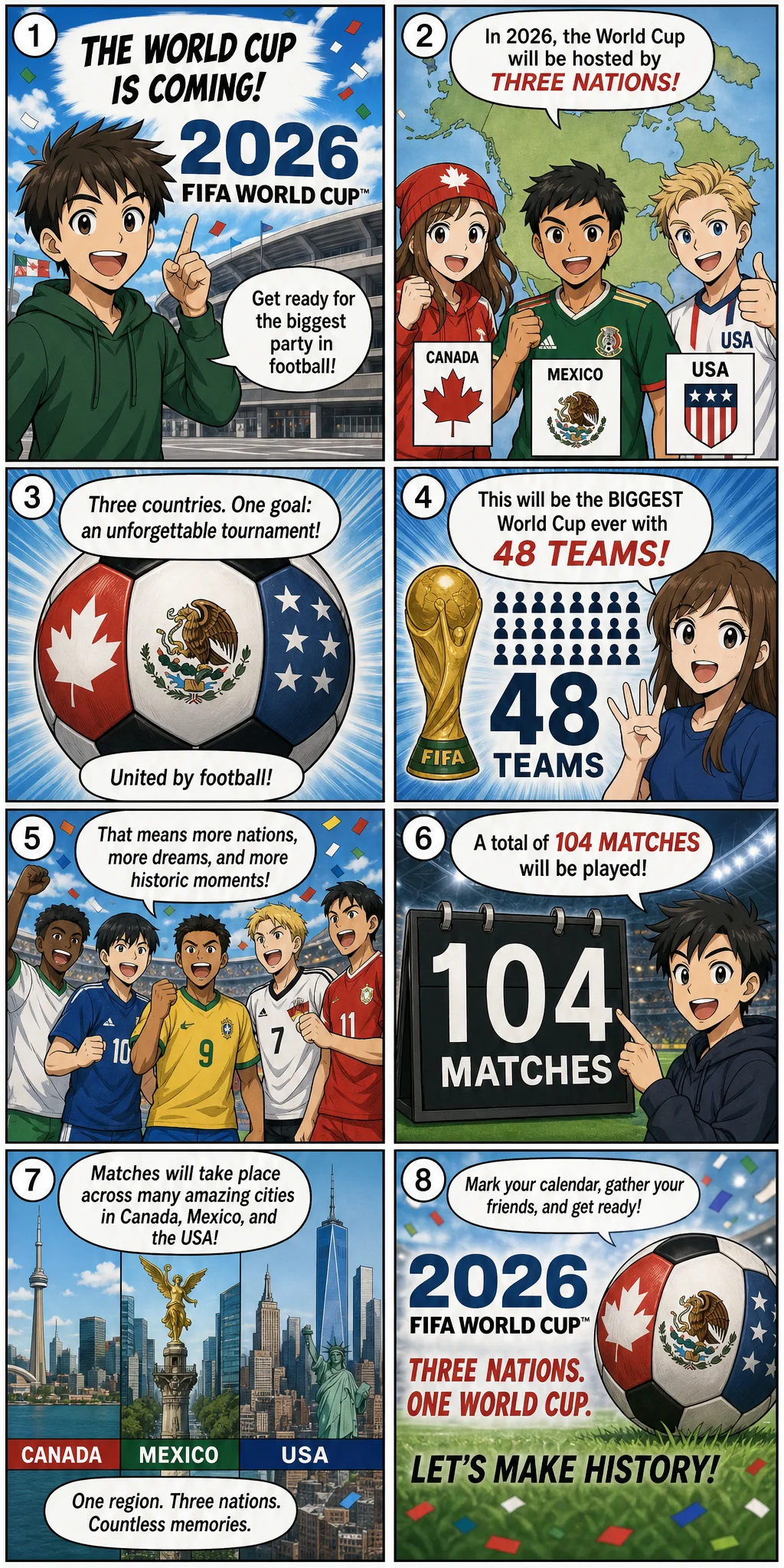
The official 2026 World Cup match ball carries three national emblems arranged across its surface, a design challenge that no previous tournament ball has faced. Since the modern era of named, branded, and meticulously marketed match balls began with the Adidas Telstar in 1970 — the iconic black-and-white panel design created specifically to improve visibility on black-and-white television broadcasts that still reached the majority of the global audience — each World Cup's ball has represented a single host nation, translating that nation's colors, iconography, and visual identity onto a spherical canvas. The 2026 ball must represent three hosts simultaneously: Canada's maple leaf, Mexico's eagle-and-serpent emblem, and the United States' stars. Three distinct national visual languages, three distinct color palettes, three distinct sets of symbolic meaning, all demanding equal visual weight and symbolic presence within the constraints of an object that is approximately twenty-two centimeters in diameter and divided into a finite number of panels.
The design solution is subtly intelligent in ways that reward close examination. The three symbols do not compete for dominance across the ball's surface or fight for position the way national emblems arranged on a shared object might if the designer had attempted symmetrical placement or equal visual area. Instead, they are arranged along the ball's structural seams — the aerodynamic grooves that define the modern panel configuration — each occupying its own panel, each given its own space, connected by a flowing line that suggests, depending on the viewer's interpretation and disposition, either shared continental borders or a shared football journey or simply the design logic of a spherical object whose surface must accommodate motion and impact alongside symbolism. The symbols are rendered in gold against the traditional white background, a color choice that connects them visually to the trophy itself and asserts their equivalence in the shared enterprise of hosting: three equal partners, none subordinate to the others, none given visual primacy over the rest. The design implicitly argues what the three-nation hosting arrangement explicitly claims: this tournament belongs to all three nations, not to one dominant partner with two guests whose participation is tolerated rather than celebrated.
The technical characteristics of the match ball represent the continuation of Adidas's decades-long evolution from the stitched leather spheres of the pre-modern era to the thermally bonded synthetic constructions of the contemporary game. The 1970 Telstar introduced the thirty-two-panel configuration of hexagons and pentagons that became the default design vocabulary for footballs across the following four decades, a pattern so universal that it appeared on football club crests and became the generic visual shorthand for the sport itself. The 2006 Teamgeist reduced the panel count to fourteen and introduced thermal bonding as an alternative to stitching, producing a ball whose surface was smoother and whose aerodynamic behavior was more predictable. The 2010 Jabulani reduced the panel count to eight and became the most controversial World Cup ball since the 1960s, its unpredictable flight path through the thin air of South African altitude venues producing goalkeeper complaints that Adidas's aerodynamic testing had failed to replicate real-world conditions. The 2014 Brazuca returned to a more conventional panel configuration and largely restored goalkeeper confidence. The 2018 Telstar 18 and 2022 Al Rihla continued the trend toward increased surface texturing and aerodynamic optimization, each iteration producing marginal improvements in the ball's consistency of flight across varying strike velocities and spin rates.
The 2026 ball incorporates connected ball technology — sensor systems embedded within the ball's structure that transmit data on position, velocity, acceleration, and impact in real time to match officials and broadcast systems. This technology, introduced experimentally in the 2022 tournament's Al Rihla ball, contributed directly to the offside decisions and goal-line determinations that defined several knockout-stage matches. The 2026 iteration refines the sensor package, improves the data transmission rate, and integrates the technology more seamlessly into the ball's structural design, reducing the weight and balance variations that early prototypes exhibited. The sensors do not affect the ball's flight characteristics. They track its movement with sufficient precision to determine, within millimeters, the exact moment of contact between boot and ball, information that the semi-automated offside system uses to determine whether an attacker was in an offside position at the moment the pass was played. This technology has eliminated a category of officiating controversy that plagued the World Cup for decades. It has also introduced a category of philosophical debate about whether a sport whose laws were written for human judgment should be officiated by systems whose precision exceeds human perception.
The design challenge of the tri-national ball extends beyond the arrangement of emblems into the color palette, the surface texture, and the visual identity that the ball projects when spinning at high velocity — the condition in which most viewers, watching on television from camera angles that emphasize movement over detail, will actually perceive it. A ball covered in three competing color schemes would read as visual noise when spinning, a chaotic blur of colors that obscures rather than communicates the tournament's identity. The design's restraint — gold emblems on white, connected by a single flowing line, avoiding the temptation to fill every panel with national symbolism — is not merely an aesthetic choice. It is a functional requirement for an object whose identity must be legible in motion, from a distance, through television cameras and smartphone screens and stadium sightlines, by audiences who will see the ball more often as a blur than as a stationary object. The ball cannot speak. If it could, it would say what the design already communicates through the arrangement of its symbols and the restraint of its palette: everyone is welcome here, no one is secondary, and the tournament belongs to all three nations equally. The football will determine whether that promise — three equal partners, hosting together, sharing the stage — survives the competitive pressure of a tournament in which nations compete for primacy by definition. The ball makes the promise. The matches will test whether it can be kept.