

104 Matches, 39 Days, and a Planet Sleeping on the Couch
The 2026 World Cup will feature 104 matches across 39 days in 16 stadiums spanning three countries and four time zones. These figures represent a complete structural reimagining of what the World Cup is, how it is consumed, and what it demands from t
Published: June 6, 2026
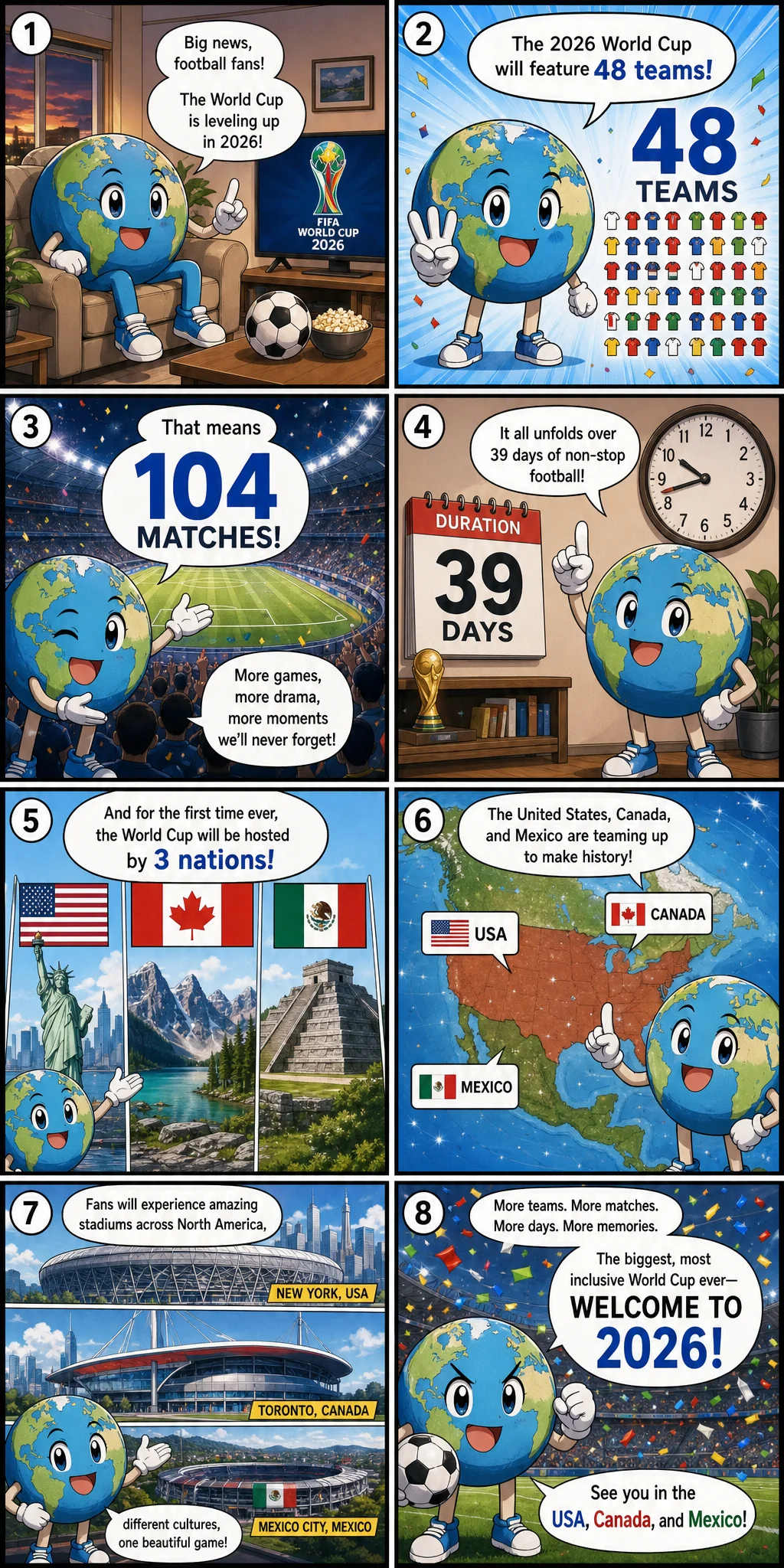
Comic content and match statistics are for entertainment purposes only and may contain inaccuracies. For Accurate Data, please refer to the reference's official website.
The 2026 World Cup will feature 104 matches across 39 days in 16 stadiums spanning three countries and four time zones. These figures represent a complete structural reimagining of what the World Cup is, how it is consumed, and what it demands from the players, coaches, and fans who participate in it. The sixty-four-match format — forty-eight group-stage fixtures, sixteen knockout matches — defined every tournament from France 1998 through Qatar 2022, seven editions across twenty-four years, embedding itself so deeply in the global football consciousness that it came to feel like a natural law, as immutable as the size of the pitch or the weight of the ball. The 104-match format breaks that law and constructs something fundamentally different in its place.
The mathematics are straightforward; the implications extend far beyond arithmetic. Forty additional matches means the group stage now stretches across three weeks instead of two, accommodating sixteen three-team groups rather than eight four-team groups. The knockout phase has expanded from sixteen teams to thirty-two, adding a round-of-thirty-two match for every group winner and runner-up that advances. The tournament's total calendar has swollen to thirty-nine days — a 22% increase over the thirty-two-day standard that Russia 2018 and Brazil 2014 established, and a full ten days longer than the compressed twenty-nine-day schedule that Qatar 2022 demanded. The viewing experience transforms fundamentally as a result. At sixty-four matches, consuming every game was theoretically possible if socially inadvisable — it required commitment but not obsession, dedication but not self-destruction. At 104 matches, watching every minute becomes actively incompatible with employment, relationships, and the basic physiological requirements of human sleep. The tournament shifts from something you consume whole to something you curate selectively — picking your matches, following specific narratives, accepting that dozens of games will unfold without your attention. This is neither good nor bad. It is simply different, and the difference will reshape how the global audience experiences the World Cup for the first time in a generation.
The football implications are equally significant. Forty additional matches means more opportunities for the specific chaos that only World Cup football generates — the underdog goals, the VAR controversies, the penalty shootouts that transform ordinary players into national legends and national legends into eternal figures. It also means more physical toll on the players who carry their teams deepest into the tournament. Eight matches to win the trophy instead of seven means an additional knockout round's worth of accumulated fatigue, yellow-card accumulation risk, and injury exposure. The 104-match schedule does not simply add more football to the existing framework. It creates a different kind of tournament — longer, deeper, more demanding, and more logistically complex — and the teams that adapt fastest to its new rhythm will inherit its rewards.
The sheer density of the match calendar transforms the daily rhythm of the tournament for players, coaches, and fans alike. Under the sixty-four-match format, the group stage typically delivered three or occasionally four matches per day across the first two weeks. Under the 104-match format, the group stage will frequently feature five or even six matches in a single day, spread across multiple kickoff slots running from early afternoon on the eastern seaboard through late evening on the Pacific coast. For broadcasters, this creates unprecedented scheduling complexity — the need to allocate production resources across simultaneous matches in different countries, the challenge of building narrative coherence when events unfold in parallel rather than sequence. For viewers, it creates a fundamentally new kind of viewing experience: the multi-screen World Cup, where following the tournament means juggling multiple streams, switching between matches as goals are scored, and constructing a personalized viewing itinerary from a menu that is simply too large to consume in its entirety.
The expansion to 104 matches also reshapes the economic architecture of the World Cup. Each additional match represents incremental broadcasting revenue, incremental ticket revenue, incremental hospitality revenue — and FIFA's financial projections for the 2026 tournament are built on this arithmetic. The 104-match format is not merely a sporting decision made in consultation with football confederations seeking greater representation. It is a commercial decision that transforms the World Cup from a sixty-four-game product into a 104-game product, a 62.5% increase in inventory that every rights holder, every sponsor, every stadium concession operator has priced into their calculations. The financial incentive to expand was enormous; the sporting justification was secondary. Understanding the 104-match format requires understanding it as a business decision that happens to produce a sporting competition, rather than a sporting decision with incidental commercial consequences.
The logistical demands on host cities are equally transformed. In a sixty-four-match tournament hosted by one or two nations, host cities typically welcome three to five matches over the course of the competition — a manageable cadence that allows for security rotations, pitch recovery between fixtures, and the gradual buildup of local enthusiasm. In the 104-match format spread across three nations, some American venues will host as many as six or seven matches, compressing the interval between fixtures and demanding more from stadium groundskeeping crews, local transportation infrastructure, and the volunteer corps that FIFA depends upon to operate matchday operations. The physical toll on stadium playing surfaces — already a concern in tournaments where NFL turf-to-grass conversions are required — becomes more acute when the interval between matches shrinks from five or six days to three or four days. The groundskeepers at venues like AT&T Stadium and MetLife Stadium will be among the most scrutinized professionals at the tournament, their work judged not by the beauty of the surface but by its durability under a schedule that no previous World Cup venue has faced.
The competitive implications of the 104-match format extend into realms that tournament organizers have only begun to consider. In a sixty-four-match tournament, a team could reach the final having played six opponents — three in the group stage, three in the knockout rounds. In a 104-match tournament, the champion will have faced seven opponents, and that additional opponent changes tactical preparation in ways that accumulate across the tournament. Scouting departments that previously needed to prepare detailed dossiers on six possible opponents must now prepare for seven. Training regimens designed around the familiar rhythm of rest days between knockout matches — typically five to six days between the quarterfinal and semifinal, four to five days between the semifinal and final — must now accommodate an additional knockout window that compresses recovery times at critical moments. The teams with the deepest analytical departments and the most sophisticated sports science operations will extract marginal advantages from the 104-match format that compound as the tournament progresses. The teams still relying on traditional scouting methods and conventional recovery protocols will find themselves stretched beyond their capacity by the tournament's expanded demands.
The fan experience under a 104-match format is not simply a quantitative expansion of the sixty-four-match experience. It is a qualitative transformation. In previous tournaments, the committed fan could construct a credible claim to having "watched the World Cup" — not every minute, perhaps, but enough to feel informed about every team, every narrative, every controversy. In a 104-match tournament, that claim becomes impossible. No single human being can watch every match. No single journalist can attend every press conference. No single analyst can track every tactical development across sixteen groups simultaneously. The World Cup fractures into a collection of parallel tournaments — the tournament you watch, the tournament your friend watches, the tournament that unfolds in a time zone you cannot reach — and the shared experience that has historically defined the World Cup's cultural power becomes harder to sustain. This is not an argument against expansion; it is a description of its consequences, and those consequences will reshape how the global public understands and engages with football's greatest competition for generations to come.