

Thirty-Nine Days: Your Couch Will Hate You, But You'll Thank It
The 2026 World Cup will span thirty-nine days — the longest men's tournament in history. Qatar 2022 was compressed into twenty-nine days. Russia 2018 spanned thirty-two. The 1970 World Cup that produced Pelé's immortal final lasted just nineteen. The
Published: June 6, 2026
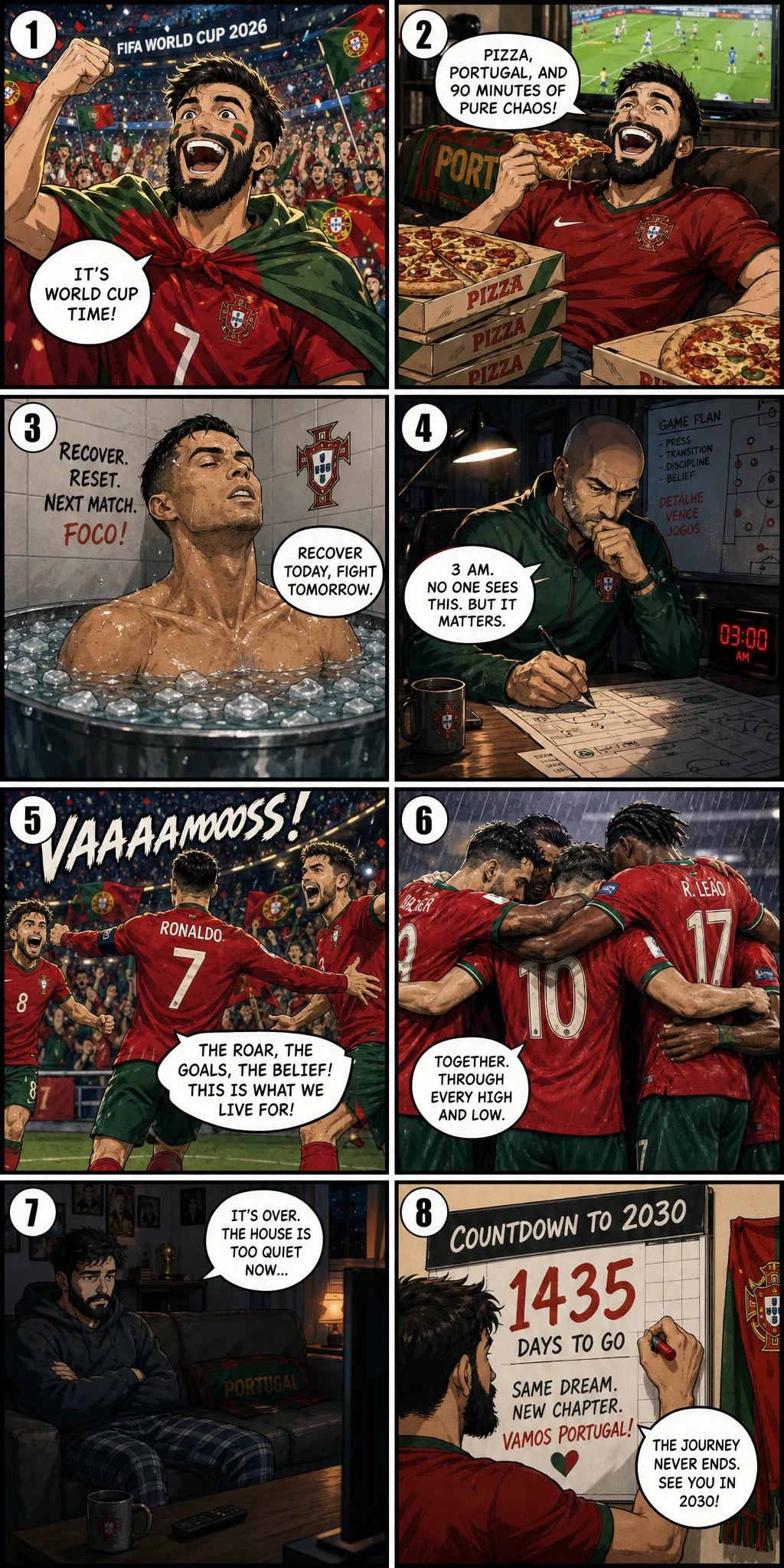
Comic content and match statistics are for entertainment purposes only and may contain inaccuracies. For Accurate Data, please refer to the reference's official website.
The 2026 World Cup will span thirty-nine days — the longest men's tournament in history. Qatar 2022 was compressed into twenty-nine days. Russia 2018 spanned thirty-two. The 1970 World Cup that produced Pelé's immortal final lasted just nineteen. The extension is not cosmetic. It accommodates twenty-four additional group-stage matches from the expansion to forty-eight teams and an entirely new knockout round. The tournament's new length fundamentally alters competitive dynamics. A thirty-nine-day tournament is a marathon disguised as a sprint, long enough for a player to arrive out of form, play into peak condition, deliver transcendent performances, and begin declining from accumulated fatigue before the final. Media narratives — the breakout star of week one, the disappointing favorite of week two, the unexpected dark horse of week three — will be written, discarded, and rewritten as the tournament passes through distinct phases. The physiological toll is measurable: elite footballers playing at World Cup intensity for thirty-nine days rather than twenty-nine accumulate fatigue in the semifinals and finals that no previous champion has experienced. The medical staffs that manage recovery most effectively — nutrition, sleep science, load management — provide an advantage as real as any tactical innovation. The 2026 champion will not simply be the best team. It will be the team that recovered best across the longest tournament in football history.
To understand what thirty-nine days means in practical terms, consider the calendar more closely. The tournament opens on June 11 with the opening match at Estadio Azteca. The group stage will consume the first seventeen days, concluding on June 27. The round of thirty-two — a knockout phase that did not exist in any previous thirty-two-team World Cup — occupies four days from June 28 through July 1. The round of sixteen follows from July 2 through July 5. The quarterfinals fall on July 8 and 9. The semifinals on July 13 and 14. The third-place match on July 18. And the final, at MetLife Stadium in East Rutherford, New Jersey, on July 19. A player who reaches the final will have spent more than five weeks in tournament conditions — training, recovering, competing, traveling — a duration that exceeds the typical preseason training camp by a full week and approaches the length of a major international cycling tour. The comparison to cycling is not frivolous: the Tour de France spans twenty-one racing days across twenty-three days total. The 2026 World Cup champion will have played eight competitive matches across thirty-nine days, and the analogy between the two events — both tests of endurance disguised as tests of skill — will become increasingly apt as the tournament reaches its final week.
The history of World Cup tournament duration reveals a competition that has been lengthening steadily since its inception, but never at the rate represented by the jump from 2022 to 2026. Uruguay 1930 was completed in eighteen days, from July 13 to July 30, with thirteen teams playing eighteen matches. The tournament expanded to twenty-four teams from 1982 through 1994, typically spanning twenty-five to thirty-one days. The thirty-two-team era from 1998 through 2022 standardized around thirty to thirty-two days, with Qatar's twenty-nine representing an anomaly dictated by the November-December scheduling that FIFA adopted to avoid the Gulf summer. The forty-eight-team, thirty-nine-day tournament of 2026 represents not simply an incremental extension of this historical trend but a step change — an expansion that places the World Cup in a category of sporting endurance that it has never previously occupied. The question that the tournament will answer is whether the football product at the end of thirty-nine days justifies the physiological cost demanded of the players producing it.
The tactical implications of a longer tournament are only beginning to be understood by the coaching staffs preparing for 2026. In a thirty-two-day tournament, a coach could reasonably plan around a core starting eleven with three or four reliable rotation options, trusting that the compressed schedule would minimize the number of occasions when fatigue forced difficult selection decisions. In a thirty-nine-day tournament, that calculation collapses. The additional week is not simply seven more days of rest between matches. It is seven more days of hard training between knockout rounds, seven more days of accumulated micro-injuries that do not prevent a player from taking the field but progressively degrade performance, seven more days during which the psychological pressure of tournament football — the isolation, the media scrutiny, the national expectation — compounds upon itself. The coaches who have planned for this — who have built their preparatory camps around peaking not for a specific date but for a sustained period, who have constructed squads with legitimate depth at every position rather than a sharp drop-off after the first eleven — will discover that preparation meets opportunity in the tournament's final week.
Medical science offers a framework for understanding what thirty-nine days of tournament football demands from the human body. Research on elite footballers during congested fixture periods has established that muscle damage markers remain elevated for seventy-two hours after a high-intensity match, that neuromuscular performance declines measurably when recovery intervals fall below ninety-six hours, and that injury risk increases approximately twenty-five percent when players compete in more than one match per week over a sustained period. A World Cup knockout match, played at the highest intensity the sport produces, with the psychological pressure of elimination adding a layer of stress that no laboratory can replicate, imposes a physiological cost that exceeds any club fixture. The medical staff that can accelerate the seventy-two-hour recovery window to sixty hours, or that can identify the specific players whose neuromuscular performance is declining before the decline becomes visible on the pitch, will provide their team with an advantage that is invisible to television cameras but decisive on the scoreboard.
The psychological dimension of a thirty-nine-day tournament is equally significant and even less well understood. Tournament football is a sustained exercise in sensory deprivation and emotional compression. Players spend weeks in hotel rooms, training grounds, and team buses, their contact with the outside world mediated through phones and carefully managed media appearances. The boredom of tournament life — the hours between training sessions, the evenings without family, the repetition of meals and meetings and tactical briefings — grinds against the intensity of match days in a rhythm that becomes harder to sustain as the tournament lengthens. In a twenty-nine-day tournament, a player can mentally "survive" the isolation by treating it as a temporary sacrifice. In a thirty-nine-day tournament, temporary sacrifice becomes a way of life, and the teams that manage this psychological dimension best — that create environments where players can sustain the mental energy required for elite performance across five and a half weeks rather than four — will extract an advantage that no tactical system can provide.
The narrative architecture of a thirty-nine-day tournament is also fundamentally different from its predecessors. In a thirty-two-day tournament, the story has three acts: the group stage introduces the characters, the knockout rounds develop the drama, and the final delivers the resolution. In a thirty-nine-day tournament, the group stage is long enough to accommodate its own internal narrative arc — early surprises, mid-group adjustments, late drama as third-place finishers jostle for qualification on the final matchday. The round of thirty-two introduces a new set of stakes that did not exist in previous tournaments: teams that survived the group stage must now survive a knockout match that, for many, will represent their first experience of World Cup elimination pressure. The round of sixteen, quarterfinals, semifinals, and final remain structurally identical to the thirty-two-team format, but they unfold against the backdrop of players who have already played five or six matches rather than four or five. The story the tournament tells — and the way the global media tells it — will reflect this elongated structure, and the journalists who adapt fastest to writing a five-week narrative rather than a four-week narrative will define how the 2026 World Cup is remembered.