

Asia's Slots Just Doubled: A Continent's Turnaround Starts at 8.5
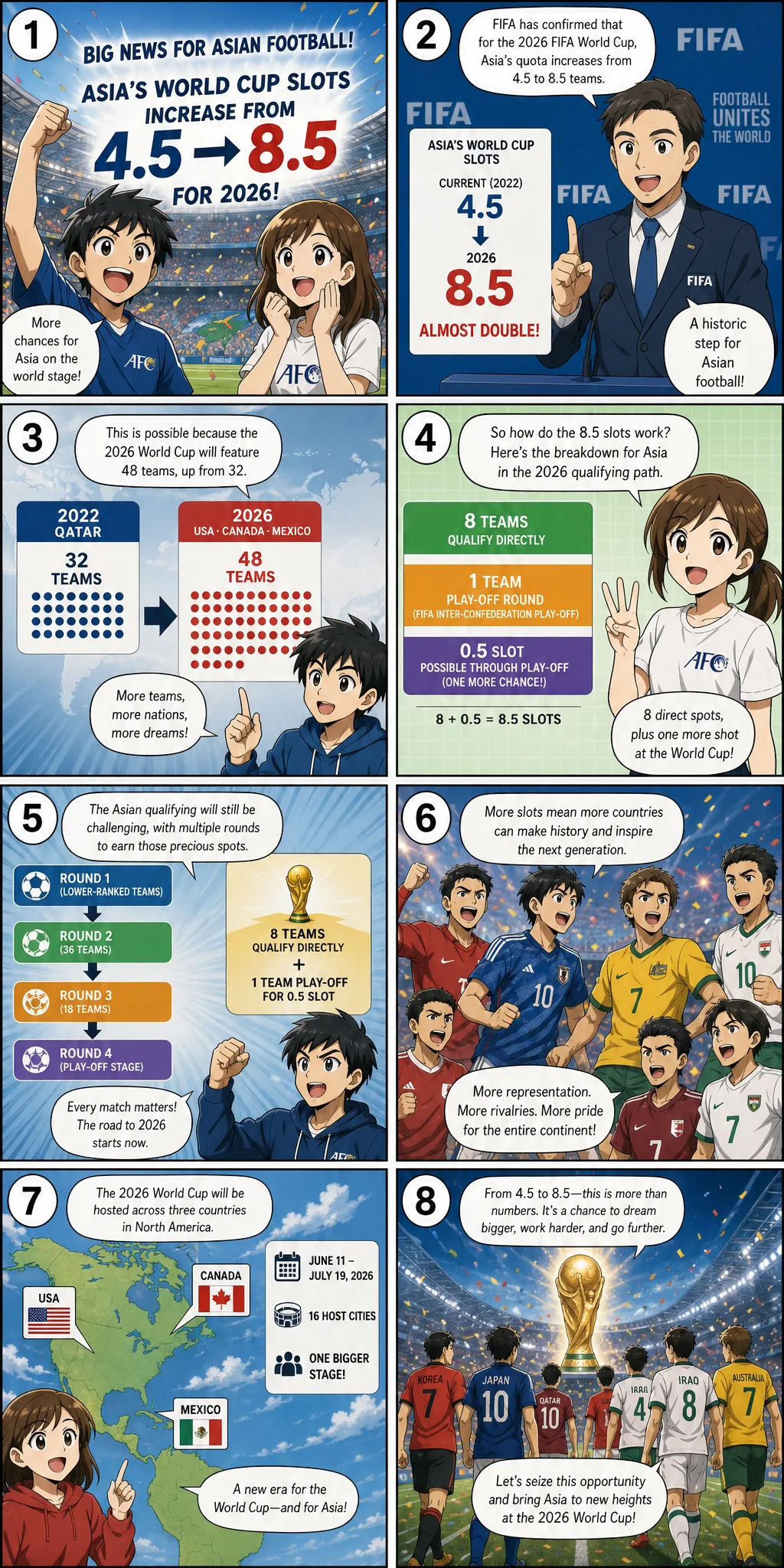
Asia's World Cup qualifying allocation expanded from four-and-a-half spots to eight-and-a-half for the 2026 tournament — the most significant single-confederation increase in World Cup history, more than doubling Asia's guaranteed presence at footbal
Published: June 6, 2026
Comic content and match statistics are for entertainment purposes only and may contain inaccuracies. For Accurate Data, please refer to the reference's official website.
Asia's World Cup qualifying allocation expanded from four-and-a-half spots to eight-and-a-half for the 2026 tournament — the most significant single-confederation increase in World Cup history, more than doubling Asia's guaranteed presence at football's most important table. The numbers represent more than a bureaucratic adjustment to qualification mathematics. They represent a fundamental rebalancing of football's global representation toward proportionality with the sport's actual population distribution, and the implications for Asian football's development, visibility, and competitive credibility will unfold across the decades following 2026 in ways that cannot be predicted but whose direction is already visible.
The arithmetic of historical underrepresentation is stark and uncomfortable for the European and South American football establishments that have dominated World Cup governance since the tournament's founding. A continent containing approximately sixty percent of the world's population was, from 1998 through 2022, represented by four or five teams per World Cup — fewer than fifteen percent of tournament participants, a figure that made a mockery of any claim that the World Cup was a genuinely global competition rather than a European and South American invitational with guest appearances from the rest of the planet. Japan, South Korea, Saudi Arabia, and Iran cycled through the qualification process every four years, the same nations rotating through the same spots, with occasional guest appearances from Australia after its 2006 move from Oceania to the Asian Football Confederation in search of a more straightforward qualification pathway. The rest of Asia watched from outside, knowing that the mathematics of four-and-a-half spots meant that even a perfect qualification campaign by a rising football nation could be undone by a single intercontinental playoff against a South American or CONCACAF opponent.
The expansion to eight guaranteed spots with a ninth available through the intercontinental playoff fundamentally changes the incentive structure for Asian football investment. Nations that previously viewed World Cup qualification as a mathematical impossibility — requiring a country to be among the top four in a confederation of forty-seven members, a success rate of under ten percent — now face odds roughly twice as favorable. The eighth-and-a-half-placed Asian team earns the right to compete, meaning the effective threshold for World Cup participation has dropped from roughly top-ten-percent to roughly top-twenty-percent of the confederation. For national federations in Central Asia, Southeast Asia, and the Middle East that have invested in football infrastructure, youth development, and professional league organization, the return on that investment is no longer theoretical. It is visible and achievable within a single generation.
The competitive quality question — will the eighth-best Asian team compete credibly against European or South American opposition — is valid, inevitable, and will be answered empirically on the pitches of North America rather than in the opinion columns of European football publications. The history of World Cup expansion has consistently followed a pattern: each increase in tournament size is met with predictions of diluted quality, and each tournament subsequently produces competitive matches, memorable moments, and the gradual elevation of previously marginal football nations whose exposure to the highest level accelerates their development. The 1982 expansion to twenty-four teams, the 1998 expansion to thirty-two, and the 2026 expansion to forty-eight all faced the same criticism from the same quarters — primarily European football voices whose confederation's oversized allocation was never subject to the same scrutiny. Asia's eight-and-a-half spots represent not a dilution of quality but a correction of a historical imbalance that the sport's traditional powers had no incentive to address.
What the allocation enables is not merely participation but transformation. A nation like Uzbekistan, with thirty-five million people and a professional league that has developed steadily since independence, can now build toward World Cup qualification as a realistic developmental goal rather than a distant fantasy. Vietnam, whose football culture is among the most passionate in Asia and whose youth teams have achieved regional success disproportionate to the country's football infrastructure, can now imagine a pathway to the world stage. Iraq, whose football history has been periodically interrupted by political catastrophe but whose talent production persists regardless, can plan for a future in which World Cup participation is not dependent on a once-in-a-generation alignment of circumstances. The psychological shift from impossibility to possibility is not measurable in qualification statistics, but it determines whether national federations invest in youth academies or in short-term results, whether corporate sponsors commit to long-term football development or to one-off marketing activations, whether children in the streets of Tashkent or Hanoi or Baghdad see football as a viable career or a recreational dead end.
The qualification pathway itself has been restructured to accommodate the expanded allocation. The AFC's multi-round qualification format — preliminary joint qualification rounds feeding into a final stage that determines the eight direct qualifiers and the intercontinental playoff representative — has been redesigned to maximize competitive matches while providing a manageable schedule across Asia's enormous geographic spread. The AFC Champions League, the confederation's club competition, provides the competitive intensity that national team players require to develop, and the expanded World Cup allocation provides the incentive for clubs to invest in the player development that the continental club competition rewards. The virtuous cycle — club competition drives player development, which drives national team performance, which drives World Cup participation, which drives investment in club competition — has operated in Europe and South America for a century. It is now being built in Asia, and the eight-and-a-half spots are the foundation on which that cycle rests.
The Asian teams that qualify for 2026 will face enormous competitive challenges. They will encounter opponents whose players compete weekly in the world's best leagues, whose tactical sophistication has been refined across decades of tournament experience, whose physical and psychological preparation has been optimized by sports science institutions that Asian federations are only beginning to replicate. Many will lose. Some will be outclassed. The scorelines will provide ammunition for those who argue that Asia's expanded allocation has diluted the tournament's competitive quality. But the photographs of Asian supporters filling North American stadiums, the broadcasts reaching billions of viewers across a continent that has loved football for generations without proportional representation, and the children who will watch their nations play in a World Cup for the first time will tell a different story. The allocation is not about the 2026 tournament's competitive quality. It is about the tournament's claim to be a world championship — and a world championship that excludes sixty percent of the world's population from meaningful participation is not a world championship at all. Asia's eight-and-a-half spots correct a historical error. The football will determine whether the correction produces better matches or merely more representative ones. Both outcomes are preferable to the alternative.