

The Countries You Have Never Heard Of
The forty-eight-team World Cup brings nations to the tournament whose flags most football fans cannot identify, whose players will walk unrecognized through the arrival halls of North American airports, and whose participation in the world's most-wat
Published: June 6, 2026
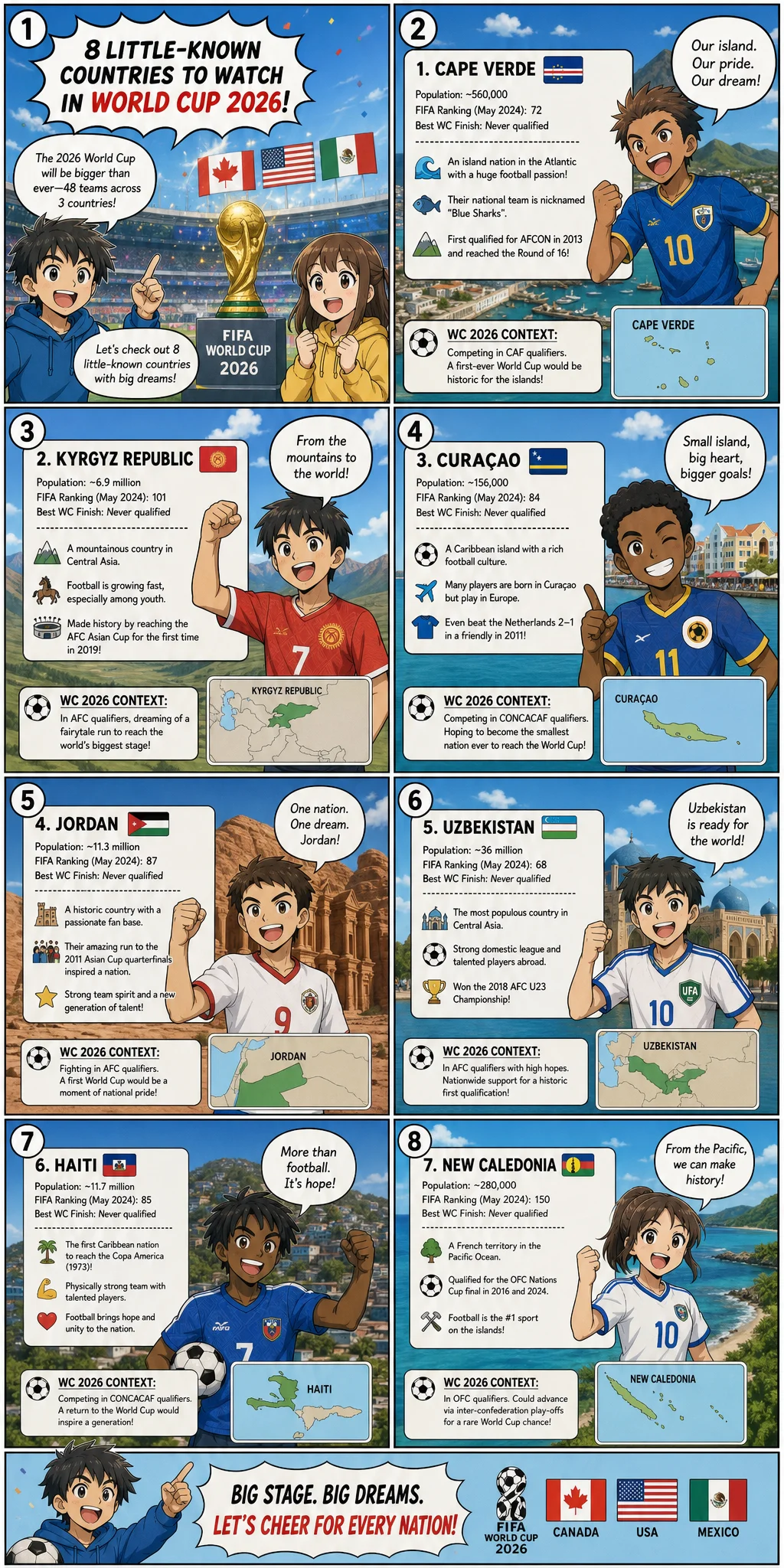
Comic content and match statistics are for entertainment purposes only and may contain inaccuracies. For Accurate Data, please refer to the reference's official website.
The forty-eight-team World Cup brings nations to the tournament whose flags most football fans cannot identify, whose players will walk unrecognized through the arrival halls of North American airports, and whose participation in the world's most-watched sporting event represents the culmination of decades of invisible labor by coaches, administrators, and players whose names will never appear in European transfer rumor columns. For every Brazil or Germany or France that qualifies as an expectation — a procedural step in a calendar that has included World Cup participation for so long that it has ceased to feel remarkable — there is a debutant nation that has been building toward this moment for a generation, invisible to the global football audience, sustained by the specific faith that one day their flag would fly alongside the flags of the sport's established powers. The 2026 newcomers arrive carrying something the traditional powers cannot manufacture, cannot purchase, and cannot simulate: the specific hunger of a nation experiencing its first World Cup, where every group-stage match is a cup final, every goal scored is a national holiday, and every minute on the pitch is captured in photographs that will hang in federation headquarters for the next fifty years.
What happens on the pitch for these debutants is almost secondary to what happens off it, because the pitch outcomes are largely predetermined by the competitive mathematics of a tournament in which a nation playing its first World Cup match faces opponents whose players have accumulated more tournament experience in a single qualifying campaign than the debutant's entire squad has accumulated in its collective history. The debutants will not win the 2026 World Cup. Most will not survive the group stage. Several will concede goals in the opening minutes, their players frozen by the occasion while established opponents execute practiced routines with the calm of professionals who have played on this stage before and will play on it again. A few will be beaten by scorelines that become trivia answers in future World Cup editions, the way Zaire's nine-goal defeat to Yugoslavia in 1974 persists in tournament lore long after the players and the context and the geopolitical circumstances of that result have been forgotten. The competitive outcomes are not the point. The point is that they are there — on the pitch, in the tournament, their national anthem played before a global television audience, their players' faces broadcast to homes in countries that had never heard of their nation until this moment.
The economic dimension matters and is rarely discussed with the specificity it deserves. FIFA's development payments to participating federations — the prize money distributed to every qualified nation regardless of tournament performance — represent sums that transform the operational capacity of smaller football federations. A single World Cup qualification can generate more revenue for a developing football nation than a decade of domestic league operations, more than the federation's annual budget multiplied by an order of magnitude, more than any corporate sponsorship or government allocation the sport has ever received. That money builds training facilities, funds youth academies, hires qualified coaches, organizes competitions, and creates the institutional infrastructure that converts a single tournament appearance into sustainable football development. The federation that qualifies for its first World Cup in 2026 will not become a football power overnight. But it will receive the resources to begin the process that takes decades — the process that Germany and Brazil and Argentina began a century ago and that the World Cup's traditional powers have completed so long ago that they have forgotten it ever needed to be done.
The cultural dimension matters equally and is harder to quantify. The children who watch their nation walk onto a World Cup pitch for the first time — in their living rooms, in public screenings in city squares, in the stadiums themselves if their families can afford it — will make decisions in that moment that shape the football landscape of the 2040s and 2050s. Some will decide to become footballers. Some will persuade their parents to enroll them in youth academies. Some will simply understand, for the first time, that the sport they play in the streets and the parks and the empty lots of their neighborhoods is connected to a global culture that includes them. The photographs of their national team at the World Cup — the team photo before the first match, the goalkeeper's despairing dive, the striker's disbelieving celebration if a goal is scored — become part of the national visual vocabulary, reproduced on posters and billboards and school textbooks, shaping a generation's relationship with football in ways that statistics cannot capture. The 1990 World Cup debut of Costa Rica, which reached the round of sixteen; the 2002 debut of Senegal, which defeated France in the opening match and reached the quarterfinals; the 2018 debut of Panama, which scored its first World Cup goal against England and celebrated as if it had won the tournament — these moments produced football infrastructure and popular enthusiasm that endured long after the tournaments ended.
The expanded tournament format creates space for debutants that the thirty-two-team format systematically excluded. When the World Cup admitted thirty-two teams, the allocation was zero-sum: every debutant's qualification required an established nation's failure, and the political economy of confederation allocation ensured that the established nations' spots were protected by governance structures they controlled. The forty-eight-team format expands the tournament's capacity without reducing the established powers' participation, creating space for debutants without requiring the kind of confederation-level political battles that the old format made necessary. Whether this is inclusion through generosity or inclusion through dilution is a philosophical question whose answer depends on whether one believes the World Cup's primary purpose is competitive excellence or global representation. FIFA has never resolved this tension. The 2026 format picks a side — inclusion — and dares the competition to prove that representation and excellence can coexist. The debutant nations, walking onto World Cup pitches for the first time, will not settle this argument. They will embody it.