

The Man Carrying the Trophy Into 2026
The World Cup trophy arrives at the opening ceremony in the arms of a representative of Argentina, the defending champion, the nation that claimed the golden statuette in Qatar on December 18, 2022, in what is widely and reasonably considered the gre
Published: June 6, 2026
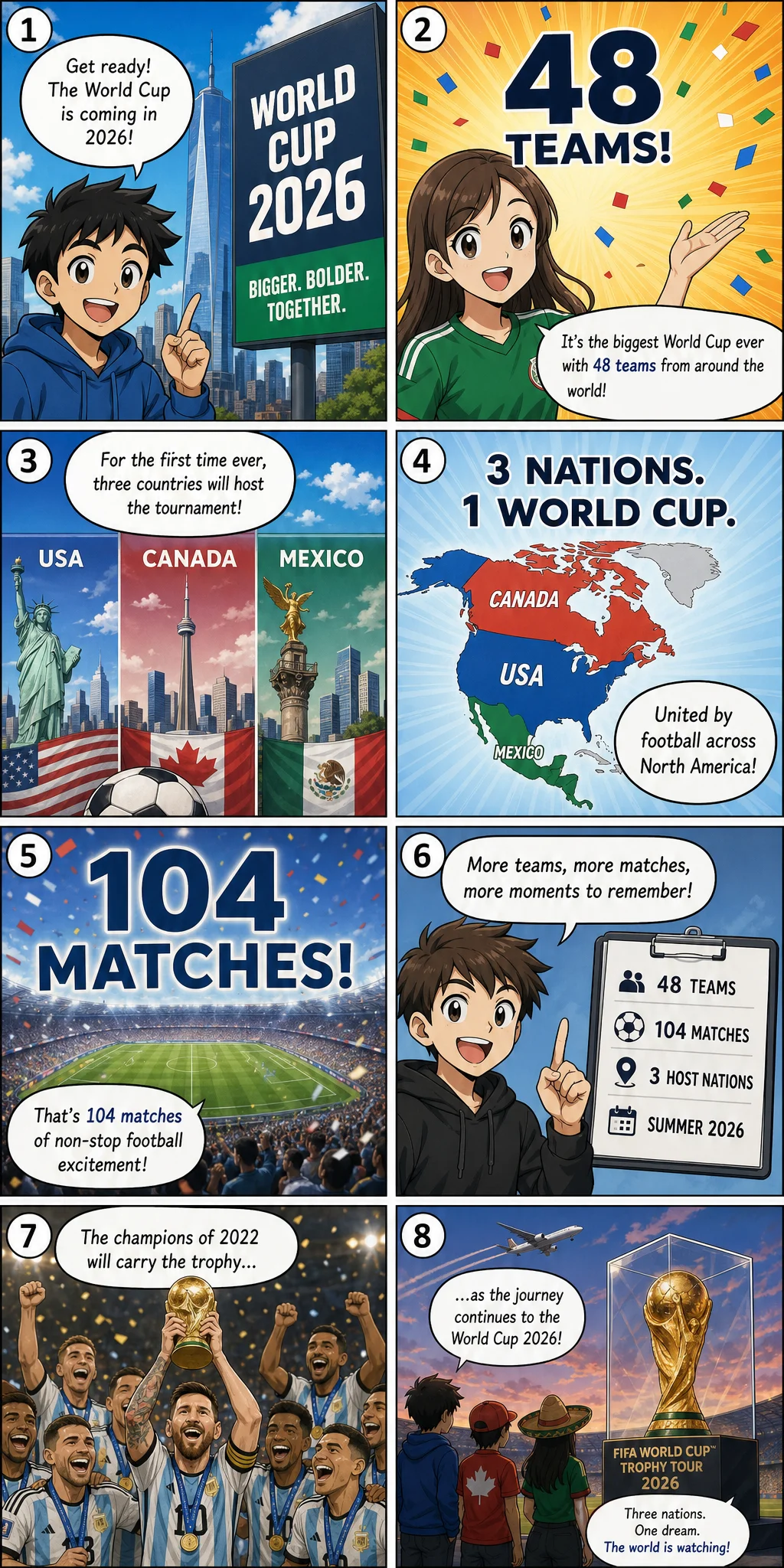
Comic content and match statistics are for entertainment purposes only and may contain inaccuracies. For Accurate Data, please refer to the reference's official website.
The World Cup trophy arrives at the opening ceremony in the arms of a representative of Argentina, the defending champion, the nation that claimed the golden statuette in Qatar on December 18, 2022, in what is widely and reasonably considered the greatest World Cup final ever played. The player chosen for this honor will walk onto the Estadio Azteca pitch — the same stadium where Pelé lifted the Jules Rimet trophy in 1970 and where Maradona's Argentina lifted the current trophy in 1986 — and present the prize to the world before handing it to FIFA for safekeeping until the final match on July 19. The message of the ceremony is explicit, ancient, and universally understood across every culture that has ever produced a champion defending a title: this is still ours. Come and take it if you can. The message is delivered with the confidence of a nation that conquered the world and with the knowledge, buried beneath the ceremony's pageantry, that defending a World Cup is among the hardest achievements in sport — a feat accomplished only twice since the Second World War.
The defending champion's burden is unique in global sport because the World Cup cycle operates on a four-year rhythm that is fundamentally different from the annual rhythms of club competition or the biennial rhythms of continental championships. Four years is long enough for an opponent's tactical preparation to be exhaustive, for every match from the champion's previous campaign to be analyzed frame by frame by performance analysts in federation offices across the football world, for the specific patterns that produced victory to be understood, counter-strategized, and neutralized before the champion even begins its defense. Every opponent Argentina faces in 2026 will have spent four years studying exactly how Scaloni's team won in Qatar — the midfield rotations, the wide overloads, the specific moments when a match that could have been lost was instead survived through competitive suffering more than aesthetic brilliance. The 2022 Argentina team was not the most talented squad in that tournament. Brazil and France could each claim superior individual quality across a starting eleven. Argentina was the most connected squad — a group forged through a Copa America victory in 2021, a Finalissima against European champion Italy at Wembley, and the specific trauma of opening-match defeat to Saudi Arabia that hardened the survivors into a collective whose resilience exceeded the sum of its parts. By the time Argentina reached the final against France, they had been tested in ways no simulation could replicate and had passed every test through a combination of Messi's genius, the midfield's industry, and the defense's refusal to collapse when collapse seemed inevitable.
The historical record on defending champions is unforgiving and has become more so in the modern era. Brazil won back-to-back titles in 1958 and 1962, the only nation to successfully defend the World Cup in the tournament's near-century of competition. Italy won in 1934 and 1938, a double that spans the pre-war era and feels, in retrospect, like a different competition played under different rules by a different sport. Since 1962, no nation has defended the World Cup. The pattern of recent tournaments is particularly ominous for Argentina: France won in 1998 and exited in the group stage in 2002 without scoring a goal. Italy won in 2006 and exited in the group stage in 2010, finishing bottom of a group containing Paraguay, Slovakia, and New Zealand. Germany won in 2014 and exited in the group stage in 2018, defeated by South Korea in a match that will haunt German football for generations. Spain, the dominant international team of the 2008-2012 era, exited in the group stage in 2014, dispatched five goals to one by the Netherlands in a match that exposed every vulnerability that four years of opposition analysis had identified. The defending champion's curse is not a superstition. It is a structural feature of a tournament cycle that gives opponents four years to study the champion while the champion's own squad ages, its cohesion erodes, and the hunger that drove it to victory becomes the complacency that prevents its defense.
Argentina's 2026 iteration has evolved, and the evolution is Scaloni's most impressive achievement since the triumph in Qatar. The team that arrives in North America is less Messi-dependent, more structurally coherent, built around a midfield trio of Enzo Fernandez, Alexis Mac Allister, and Rodrigo De Paul that controls matches through positional intelligence and collective pressing rather than through individual genius or the moments of transcendence that a thirty-eight-year-old Messi, should he play, can still provide but cannot provide reliably across seven matches in thirty-nine days. The evolution from dependency to independence has been the most significant tactical arc of any national team since Qatar, and it was undertaken with the full awareness that Messi's presence — whether he starts, whether he is available, whether the tournament becomes his final act — cannot be the plan. The plan must function without him, and must be enhanced by him, rather than depending on him. That Argentina has achieved this evolution while retaining its competitive identity — the street-fighting intensity, the game-management intelligence, the capacity to suffer without breaking — is a tribute to Scaloni's coaching and to the player group's understanding that defending a title requires becoming a different team than the one that won it.
Whether Argentina can become the first nation to defend the World Cup in sixty-four years is the question that the opening ceremony's trophy presentation poses, and the five weeks that follow in stadiums across North America will answer it. The tournament's format demands seven victories from seven matches. The continent's geography demands travel across more kilometers than any previous champion has endured in a single tournament. The opposition demands performance levels that no defending champion has sustained since 1962. The burden of the defending champion is not merely the pressure of expectation. It is the accumulated weight of every opponent's four-year preparation, every tactical adjustment designed specifically for you, every match in which the opponent raises its level because you are the champion and beating the champion means more than beating anyone else. The trophy arrives in Mexico City in Argentine hands. Whether it leaves in the same hands, or whether the cycle of four-year turnover claims another defending champion, is the question around which the 2026 tournament's narrative will organize itself from the opening kick. The Azteca has seen Argentina lift the trophy before. Whether it sees them lift it again depends on a generation of Argentine footballers who were not yet born in 1986. The cathedral will witness either a coronation or a handover. The football will decide which.