

The Designer Who Put the Trophy Right On the Logo
The 2026 World Cup logo is the most literal visual identity in tournament history, a design decision so straightforward that it became controversial precisely because of its refusal to be interesting. The logo features the actual World Cup trophy — p
Published: June 6, 2026
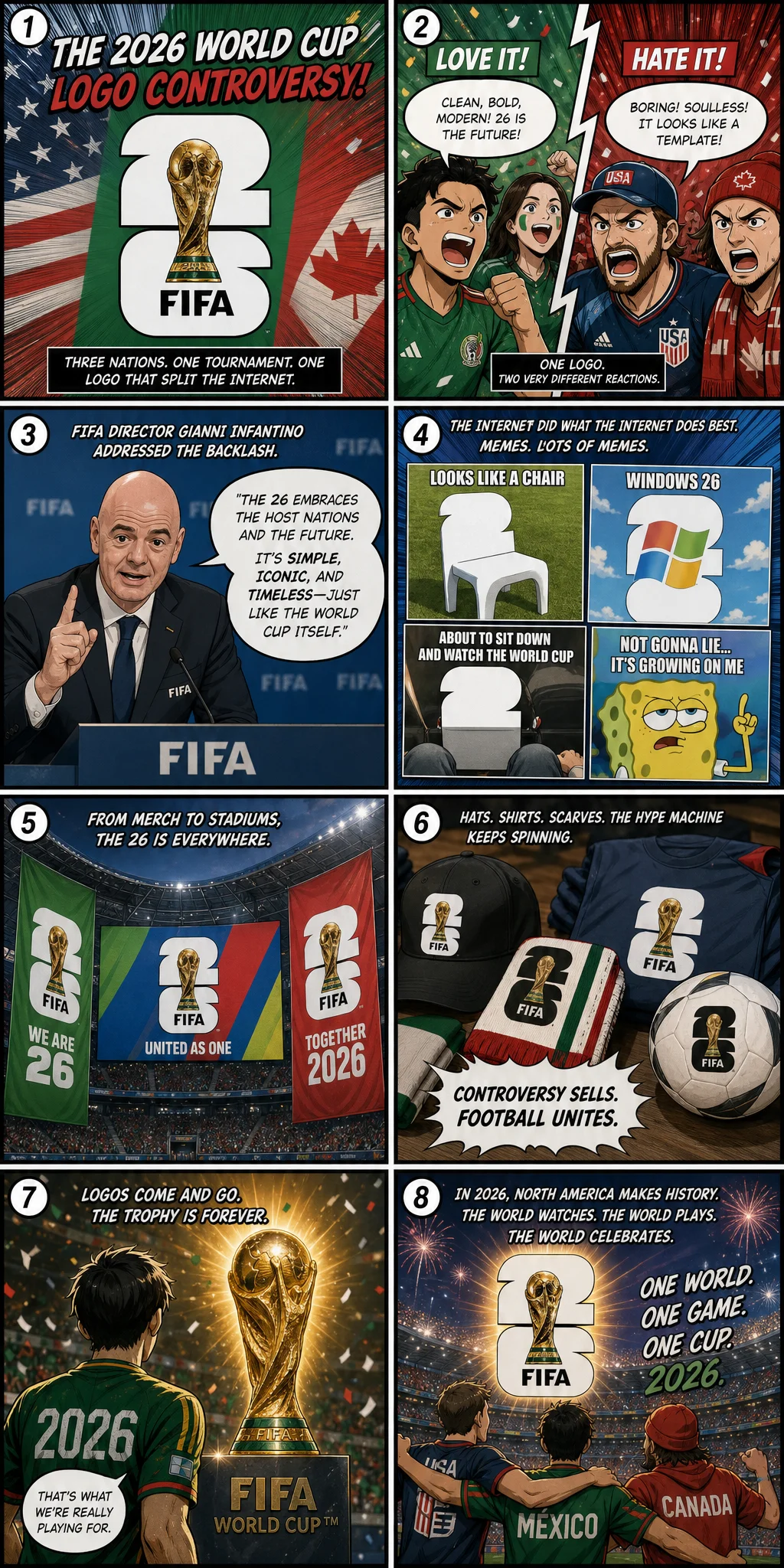
Comic content and match statistics are for entertainment purposes only and may contain inaccuracies. For Accurate Data, please refer to the reference's official website.
The 2026 World Cup logo is the most literal visual identity in tournament history, a design decision so straightforward that it became controversial precisely because of its refusal to be interesting. The logo features the actual World Cup trophy — photographed at high resolution, isolated against a dark background, placed below the year "2026" and beside the words "FIFA WORLD CUP" in a restrained sans-serif typeface that appears to have been selected for legibility rather than personality. There is no abstraction. No stylized representation. No swirling multicolor graphic designed by a global branding agency over eighteen months of focus groups, stakeholder consultations, and the iterative dilution that transforms an interesting concept into a committee-approved compromise. The trophy itself, rendered with photographic fidelity and unmistakable authority, serves as the logo. The design's argument is implicit but powerful: this object needs no interpretation. Its silhouette is the most recognizable single shape in global sport. Drawing a version of it would be less effective than showing it.
The design community's reaction divided along predictable lines that reveal more about the relationship between professional design culture and popular sporting culture than about the logo itself. Professional designers — particularly those who practice brand identity design as a discipline with its own history, canon, and standards of creative achievement — criticized the approach as lazy, a surrender of the designer's fundamental obligation to interpret, transform, and create meaning through visual language. The criticism was that the 2026 logo is the visual equivalent of a placeholder that the agency forgot to replace before the client presentation deadline, that any moderately competent design student could have produced it in an afternoon, that it represents the abdication of creative ambition in favor of the safest possible choice. The criticism was not incorrect in a technical sense, but it missed the point in a way that revealed the gap between what designers value and what sporting audiences need.
Football fans largely embraced the logo, and their embrace was equally revealing. The World Cup trophy's silhouette — the two stylized human figures holding up a globe, rendered in gold, created by the Italian sculptor Silvio Gazzaniga in 1974 to replace the Jules Rimet trophy that Brazil had retired permanently — is arguably the most recognizable single object in global sport. Its silhouette is universal across languages, cultures, and levels of football literacy. A child in rural Senegal, a supporter in a Buenos Aires bar, a casual viewer in Tokyo who has never watched a full match — all recognize the trophy, and all understand the institution it represents. Any attempt to abstract or stylize this object would necessarily produce something less iconic than the original, something that required explanation rather than instant recognition, something that prioritized the designer's creative expression over the audience's immediate comprehension. The 2026 logo's argument is that some symbols do not require reinterpretation because their meaning is already complete.
The contrast with previous World Cup logos is instructive and places the 2026 design within the evolution of FIFA's visual identity philosophy across decades. The 2014 Brazil World Cup logo depicted three hands — green, yellow, and blue — lifting the trophy in a gesture that combined national colors with the universal image of triumph, a design that communicated joy and inclusivity while retaining the trophy as a visual anchor. The 2018 Russia logo placed the trophy atop a stylized representation of the Russian space program's achievements, with a radial pattern suggesting both a football and a cosmonaut's helmet, an ambitious conceptual fusion that required significant explanation but rewarded attentive viewing. The 2022 Qatar logo rendered the trophy in abstract flowing lines inspired by the number eight — the number of stadiums — and the infinity symbol, with maroon and gold coloring drawn from Qatari cultural motifs, a design that was elegant, conceptually sophisticated, and almost entirely incomprehensible to anyone who had not read the accompanying press release. The 2026 logo represents a reaction against this trajectory of increasing abstraction — a return to literalism that the North American market, with its preference for direct communication over conceptual subtlety, almost certainly demanded.
The designer whose name was attached to the project — commissioned through FIFA's branding agency rather than selected through an open competition, as has been FIFA's practice for several tournament cycles — defended the decision in a single interview that became the definitive statement on the controversy: "Everyone knows what the World Cup trophy looks like. Why would we draw a version of it when we can show the actual thing?" The argument is disarmingly simple and difficult to refute on its own terms. It prioritizes recognition over expression, universality over originality, and the audience's understanding over the designer's creativity. These priorities are the opposite of what design education teaches and what design culture rewards. They are also, arguably, the correct priorities for a visual identity that must function across two hundred countries, dozens of languages, and every conceivable form of media from stadium banners to mobile phone notifications.
The question the logo raises — whether literalism is a design failure or a design strategy — has no objective answer, and the debate itself is the design's most interesting feature. What is certain is that the 2026 logo will be recognized instantly by every person who sees it, in every country where it appears, without explanation or cultural translation. Whether that recognition constitutes good design or merely effective communication is a question that will occupy design critics long after the tournament ends. The logo does not care about the answer. It shows the trophy. It says the year. It names the event. It communicates everything it needs to communicate and nothing more. The design community's frustration with this approach is understandable. The approach's effectiveness is undeniable. The gap between those two statements is the space where the 2026 World Cup logo lives, unbothered by the controversy, showing the trophy to the world, and waiting for the football to begin.