

Germany 8-0 Saudi Arabia: Klose's Head and a Goalkeeper's Tears
The 2002 World Cup opened with a mismatch that became the defining image of group-stage inequality in the modern tournament era. Germany 8, Saudi Arabia 0. Sapporo Dome, Japan. June 1, 2002. Miroslav Klose scored a hat-trick — all three goals with hi
Published: June 6, 2026
Comic content and match statistics are for entertainment purposes only and may contain inaccuracies. For Accurate Data, please refer to the reference's official website.
# Germany 8-0 Saudi Arabia: Klose's Headers and the Photograph That Changed Asian Football
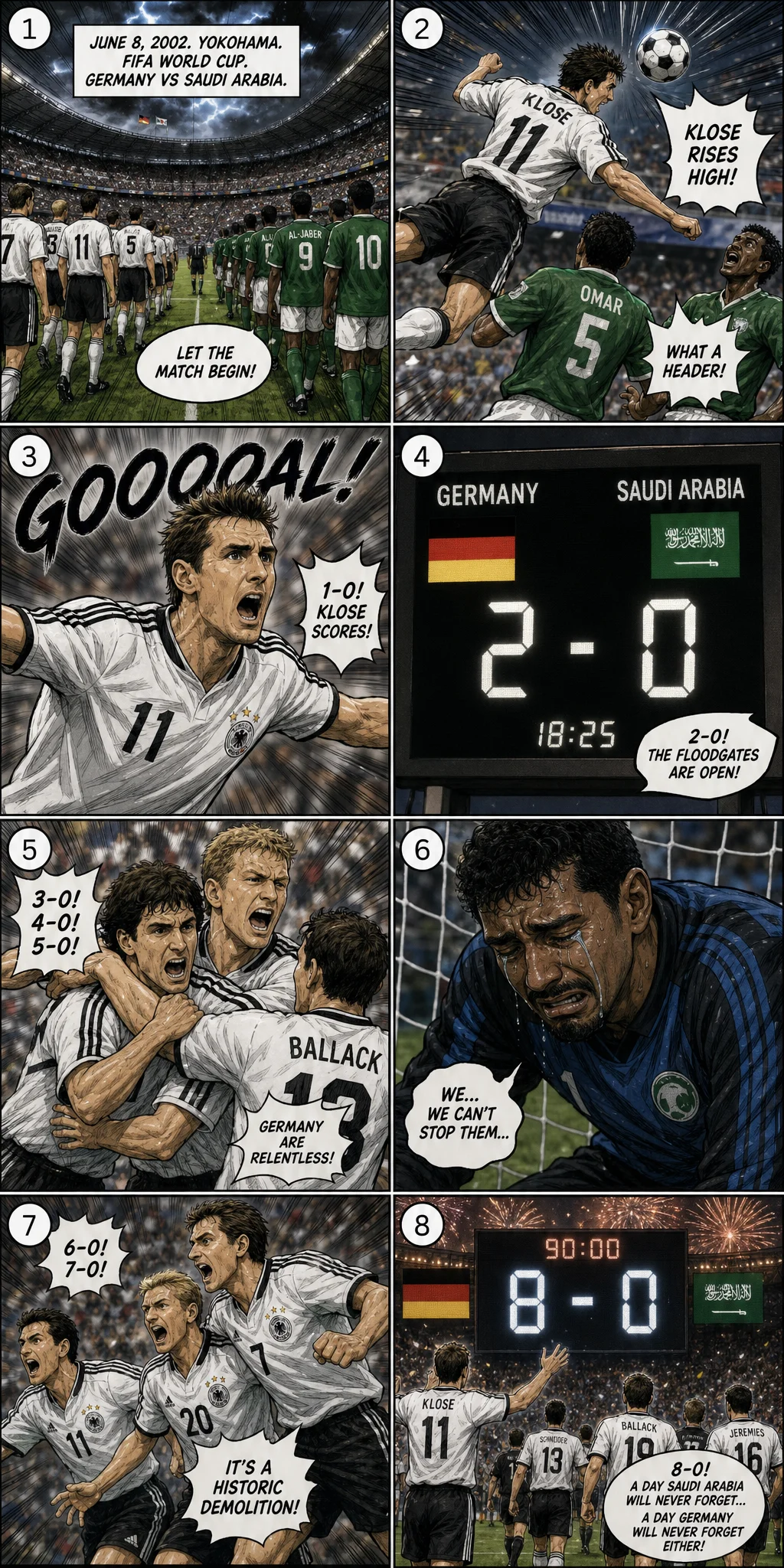
The 2002 World Cup opened with a mismatch that became the defining image of group-stage inequality in the modern tournament era. Germany 8, Saudi Arabia 0. Sapporo Dome, Japan. June 1, 2002. Miroslav Klose scored a hat-trick — all three goals with his head, the aerial dominance that would eventually make him the World Cup's all-time leading scorer, the specific attacking weapon that German football had refined across generations of tournament competition. Saudi Arabia's goalkeeper, Mohammed Al-Deayea, was photographed in tears after the final whistle, the image transmitted globally within minutes of the match ending. That photograph became the iconic image of the 2002 group stage, and it captured something about football's capacity for cruelty that statistics alone could never convey.
The match exposed the physical dimension of modern tournament football in its most brutal form. Saudi Arabia's players were technically proficient — several would go on to respectable careers in Asian and Middle Eastern leagues, and their technical quality had been sufficient to navigate Asian qualification and reach the World Cup. But they were physically overwhelmed by a German team constructed from a fundamentally different athletic tradition. Klose's aerial dominance, the set-piece threat of Carsten Jancker, the sheer physical imposition of a European side built around the Bundesliga's athletic standards — none of this could be countered by technical quality alone. The Saudi defenders knew what was coming. They had watched the video analysis. They understood the aerial threat that Klose represented, the specific danger of German set pieces, the physical battle that awaited them. Knowing what was coming and being able to stop it are fundamentally different challenges when the athletic gap between the opponents is measured in generations of sports science rather than weeks of tactical preparation.
The 8-0 was not the worst defeat in World Cup history — Hungary's 9-0 and 10-1 victories occupy those positions. But it was the most visible, arriving on the opening day of a tournament broadcast globally, featuring the three-time champion against an Asian representative, and producing the photograph of Al-Deayea in tears that the world's media immediately recognized as the image that would define the tournament's opening narrative. The German goals accumulated with a rhythm that suggested inevitability rather than brilliance — Klose's headers, Michael Ballack's contributions from midfield, the sense that Saudi Arabia's resistance was measured not in whether they could prevent goals but in how many they would concede.
The defeat catalyzed two decades of Asian football investment. In its immediate aftermath, the Saudi Arabian Football Federation committed unprecedented resources to sports science programs, youth development infrastructure, and the creation of pathways for Saudi players into European academies where they could develop the physical attributes that the Germany match had exposed as systematically deficient. The broader Asian Football Confederation accelerated its own development initiatives, recognizing that the physical dimension exposed in Sapporo represented a structural competitive gap rather than merely a bad day against superior opposition. Saudi Arabia invested in the infrastructure — training facilities, sports medicine, nutritional science, the entire apparatus of modern athletic development — that European and South American football had been constructing for decades. The 8-0 was humiliating. The humiliation was educational in ways that no comfortable defeat could have been. The photograph of Al-Deayea in tears is reportedly displayed in the lobby of the Saudi federation's headquarters in Riyadh — not as an accusation but as a reminder. Reminders of this specific quality have a way of producing results that complacency, no matter how comfortable, never does.
The Germany team that inflicted this defeat deserves its own contextualization because it was not, by German standards, a particularly great German team. The 2002 Germany squad was widely regarded as the weakest German team to reach a World Cup final, a team that had navigated a favorable draw — Paraguay, the United States, and South Korea in the knockout rounds, opponents that a stronger German generation would have been expected to defeat — and lost to Brazil in the final thanks to Ronaldo's two goals. The squad lacked the creative midfield quality that had defined the 1990 champions and would define the 2014 champions. Oliver Kahn in goal was transcendent, the best goalkeeper in the world at the peak of his powers, the single player whose individual excellence transformed an adequate team into a finalist. The outfield players were competent rather than exceptional: Klose announced himself to the world with the Saudi Arabia hat-trick but would not become the complete striker of later tournaments for another four years; Ballack was suspended for the final after receiving a yellow card in the semifinal, the specific cruelty of a player whose tournament ended on the sideline rather than the pitch. The 8-0 scoreline suggests German dominance; the team that produced it was dominant only against opponents who could not compete physically, and the subsequent German performances in the tournament — narrow victories, penalty shootout triumphs, the specific grind of a team that knew its limitations and compensated through organization and resilience — revealed the 8-0 for what it was: an athletic mismatch rather than a footballing masterclass.
Klose's hat-trick in this match is the foundational moment of his World Cup legend, and its specific character — all three goals scored with his head, the aerial dominance that became his trademark — established the template for his tournament career. Klose would go on to score sixteen World Cup goals across four tournaments, surpassing Ronaldo's record of fifteen to become the World Cup's all-time leading scorer, the most prolific goal-scorer in the history of the competition. The record was built on specific qualities — aerial timing, penalty-box positioning, the anticipation that allowed a striker without extraordinary pace or dribbling ability to consistently arrive in the right place at the right moment — and those qualities were first demonstrated, in their most concentrated form, against Saudi Arabia in Sapporo. The hat-trick was not, in itself, a great achievement — the German team was physically dominant and the Saudi defense was physically overwhelmed, and Klose's goals were products of a mismatch rather than individual brilliance. But the hat-trick was the beginning of a journey whose endpoint — the all-time World Cup scoring record, established twelve years later in Brazil — no one watching in Sapporo could have anticipated. The twenty-three-year-old who scored three headed goals against a physically overmatched Asian opponent would become, across four tournaments and twelve years, the most prolific goal-scorer the World Cup has ever seen. The Saudi Arabia match was not Klose's finest moment. It was his first moment, and the first moments of great careers deserve to be remembered even when the opposition they were achieved against diminishes their competitive significance.
The long-term consequences of the 8-0 for Saudi Arabian football are more complex than the simple narrative of humiliation and reform would suggest. The investment in sports science and youth development that the defeat catalyzed was genuine and substantial — the Saudi federation committed resources that would have been politically impossible without the specific trauma of the Sapporo defeat to motivate them. But the broader structural challenges that the 8-0 exposed — the absence of a domestic league that could develop players to European physical standards, the cultural and institutional barriers that prevented Saudi players from pursuing careers in European leagues, the specific isolation of Saudi football from the global football ecosystem — were not solved by sports science investment alone. Saudi Arabia would not win another World Cup match until 2022, when the victory over Argentina in the group stage — arguably the greatest upset in World Cup history — demonstrated that the two decades of investment had produced a genuinely competitive football program. The success was not attributable solely to sports science. It was attributable to a holistic development program that addressed the structural deficiencies that the 8-0 had exposed, and the specific satisfaction of the Argentina victory — a Saudi team defeating the eventual world champions, on the world's biggest stage, two decades after the photograph of Al-Deayea in tears had defined Saudi football's relationship with the World Cup — was the satisfaction of a long-term project finally bearing fruit. The 8-0 is remembered as humiliation. It should also be remembered as the moment when Saudi football began the process — slow, incomplete, but ultimately transformative — of becoming the competitive force that the Argentina victory would eventually confirm.