

Brazil 7-1 Sweden: The Massacre That Made a Nation Believe It Had Won
The 1950 Maracanazo — Brazil's 2-1 loss to Uruguay before nearly 200,000 spectators at the Maracana, the most devastating defeat in football history — haunted Brazilian football for eight years. The white shirts worn that afternoon were permanently r
Published: June 6, 2026
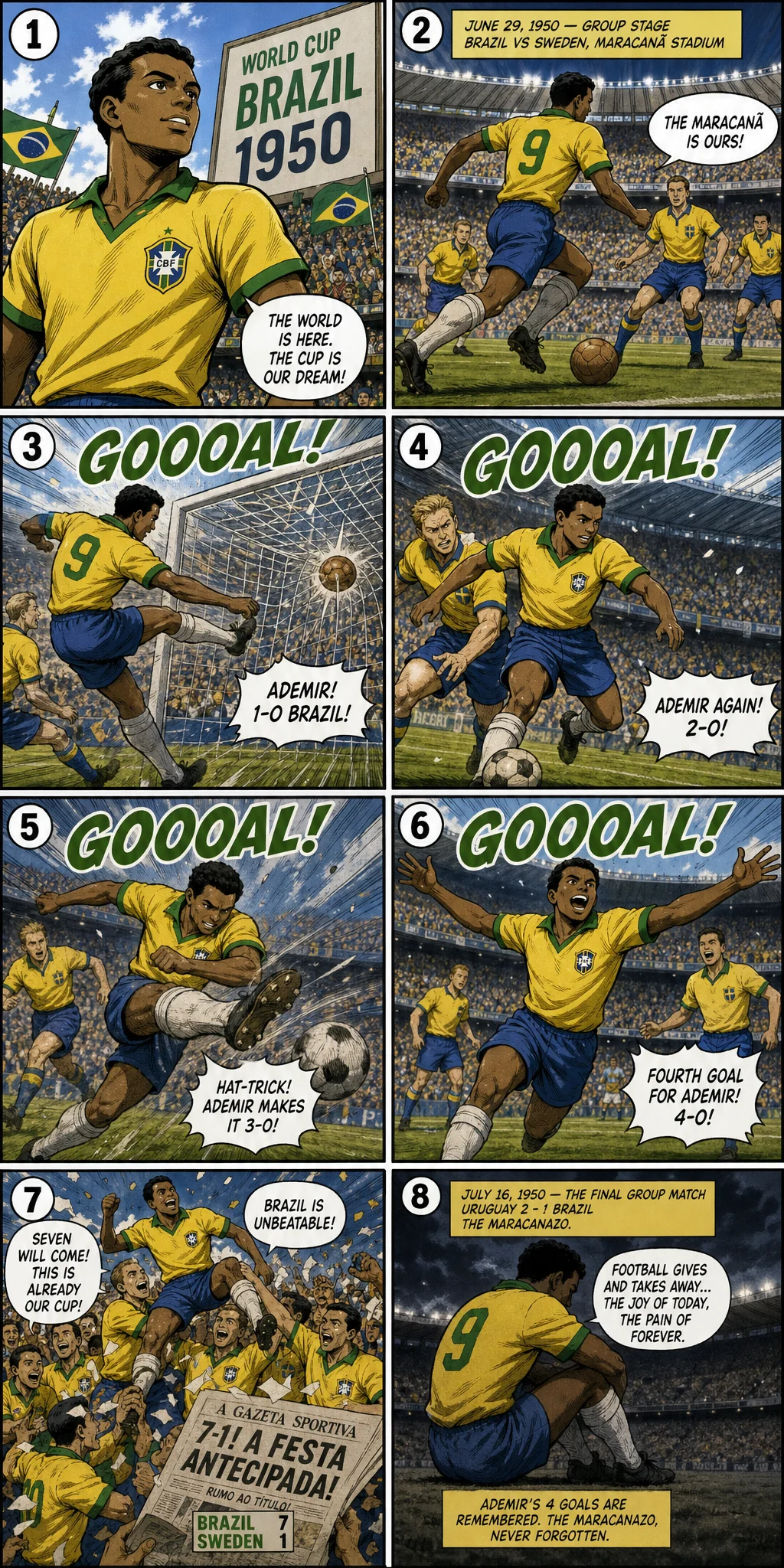
Comic content and match statistics are for entertainment purposes only and may contain inaccuracies. For Accurate Data, please refer to the reference's official website.
# Brazil 5-2 Sweden: The Semifinal That Exorcised the Maracanazo
The 1950 Maracanazo — Brazil's 2-1 loss to Uruguay before nearly 200,000 spectators at the Maracana, the most devastating defeat in football history — haunted Brazilian football for eight years. The white shirts worn that afternoon were permanently retired, deemed cursed by a nation that could not separate the trauma of defeat from the clothing its players had worn while experiencing it. The nation that had invented the jogo bonito, the beautiful game that was already becoming shorthand for Brazilian football's aesthetic identity, had never won a World Cup. The psychological weight of this failure, compounded by the specific trauma of losing the de facto final on home soil before the largest crowd ever assembled, became the defining feature of Brazilian football identity — the wound that every subsequent Brazilian team carried onto the pitch. Then came 1958, and the semifinal against Sweden.
Brazil 5, Sweden 2. The match was not simply a victory, though the scoreline records a comprehensive victory against the host nation. The match was an exorcism — performed in public, in the team's new yellow-blue-green shirts, before a global audience, against the nation that had organized the tournament. The shirts were the winning entry from a national design competition, created by a nineteen-year-old newspaper illustrator named Aldyr Garcia Schlee, the colors chosen to incorporate all four elements of the Brazilian flag. The shirts had no history. They carried no trauma. They were new, and new was exactly what Brazilian football needed.
Pele was seventeen years old — still growing into a body that would eventually carry the weight of being the most famous athlete on earth, still developing the physical attributes that would make him unplayable, already demonstrating the spatial intelligence that no amount of physical development could replicate. His semifinal hat-trick against France had announced his arrival. The final against Sweden would confirm his permanence. But the semifinal was the match that established the template: the teenager from Bauru, the player the team psychologist had recommended against selecting, operating at a level that made the established stars around him look like supporting actors.
Garrincha was unplayable. The little bird with bent legs — the physical description is not derogatory but anatomically accurate, Garrincha's legs were bent in a way that should have made elite athletic performance impossible and instead made him one of the most devastating dribblers in football history — had also been deemed psychologically unfit by Brazil's team psychologist. The two players the psychologist had rejected formed the attacking spine that destroyed the host nation. The Swedish defenders spent the match chasing shadows wearing yellow shirts, shadows that changed direction with a suddenness that Swedish football had never encountered, shadows that seemed to exist in a different temporal dimension from the defenders assigned to track them.
The 5-2 semifinal victory was the bridge between trauma and triumph. Brazil had proven, in the most public forum available, that the Maracanazo was not destiny. That the white shirts had not been cursed but simply unlucky. That Brazilian football's capacity for brilliance was not diminished by a single defeat, no matter how devastating. The final, also against Sweden — the 1958 tournament's unusual format paired the same teams in the semifinal and final — produced another 5-2 victory, the coronation confirming what the exorcism had established. Pele scored twice in the final, the teenager becoming a champion. The yellow shirts became permanent, their association with victory erasing the memory of the white shirts and their association with trauma. The 1958 semifinal was not a football match. It was Brazilian football reclaiming its future from the ghost of its past. The exorcism worked. The ghost of 1950 has never fully departed — no Brazilian football trauma ever fully departs — but it has been living in the shadow of 1958 ever since.
The psychological preparation — or, more accurately, the psychological revolution — that preceded Brazil's 1958 campaign deserves recognition as one of the most significant institutional innovations in football history. The Brazilian Football Confederation, traumatized by the 1950 Maracanazo and by the disappointing quarterfinal exit in 1954, commissioned a psychological assessment of the entire squad by Dr. Joao Carvalhaes, a pioneer of sports psychology whose methodology was decades ahead of its time. Carvalhaes administered a battery of tests — intelligence assessments, personality inventories, motor-skills evaluations — to every player under consideration for the national team, and his recommendations were stark. Pele, he concluded, was too immature, too emotionally undeveloped, too psychologically fragile to handle the pressure of a World Cup. Garrincha was worse: aggressive, impulsive, incapable of the disciplined decision-making that tournament football demanded. Carvalhaes recommended against selecting both players. The Brazilian coaching staff, led by Vicente Feola, overruled him — a decision that shaped the subsequent seventy years of football history. The two players deemed psychologically unfit for World Cup competition became the foundations upon which Brazil's first World Cup triumph was built, and the psychologist who recommended against their selection has been remembered, gently and unfairly, as the man who nearly prevented Brazil from discovering its footballing destiny.
The Swedish team that Brazil dismantled in the semifinal deserves its own contextualization because it was not, as the scoreline might suggest, a weak opponent that any decent team would have defeated. Sweden in 1958 was the host nation, playing on home soil before a partisan crowd at the Ullevi Stadium in Gothenburg, carrying the specific momentum of a team that had navigated the group stage and defeated the defending champions West Germany to reach the semifinal. The Swedish squad featured players who had been professionals in Italy's Serie A — the most competitive league in the world at the time — including Nils Liedholm, who would score Sweden's opening goal in the final, and Gunnar Gren, who formed one-third of the legendary Gre-No-Li attacking trio at AC Milan. Sweden was a legitimate football power, a team that had earned its place in the semifinal through competitive performances rather than favorable draws, and the expectation — in Sweden, certainly, and to a lesser extent globally — was that the host nation would compete seriously for the championship. The 5-2 scoreline was not a mismatch between a great team and a weak team. It was a mismatch between a great team operating at an unprecedented level and a very good team that had no answer for the specific brilliance it was facing. The Swedish players were not humiliated; they were beaten by a team that would have beaten any opponent on that afternoon, playing football that no opponent of the era could have contained.
The specific brilliance of Garrincha in this match — and throughout the 1958 tournament — deserves to be described in detail because the written record and the limited footage available cannot fully capture what contemporaries reported witnessing. Garrincha's dribbling was not the modern trickery of step-overs and feints, the choreographed sequence of movements that contemporary wingers have refined into a science. It was something more fundamental and more unsettling: a change of direction that appeared to violate the physics of human movement, a capacity to shift his body weight instantaneously from one direction to the opposite direction without the transitional movement that defenders rely upon to track attackers. The Swedish defenders — professional footballers playing at the highest level the sport offered — were not incompetent. They were facing an athlete whose movement patterns they could not process, whose physical capabilities did not correspond to any opponent they had previously encountered. The bent legs that had caused Carvalhaes to question Garrincha's psychological fitness were not a disability; they were a competitive advantage, producing a biomechanical profile that made Garrincha's movement literally unpredictable. Defenders could not anticipate his direction because his body did not telegraph direction in the way that normal human bodies telegraph direction. The 1958 semifinal was the match where the world discovered this, and the discovery transformed the tactical assumptions upon which international football had been organized.
The significance of the 1958 semifinal extends far beyond the specific result it produced. It established a template — the Brazilian team as the aesthetic standard-bearer of world football, the beautiful game as Brazil's gift to the sport — that has defined Brazilian football identity for seven decades. Every Brazilian team since 1958 has been measured against the standard established in Sweden: the creativity, the joy, the specific capacity to produce football that is simultaneously effective and beautiful. The burden of that standard is enormous, and the Brazilian teams that have failed to meet it — the physically imposing but aesthetically limited 1974 team, the defensively organized but creatively constrained 1994 team, the 2014 team that suffered its own national trauma with the 7-1 defeat to Germany — have been criticized not for failing to win but for failing to win beautifully. The 1958 semifinal created this expectation. The 5-2 victory over Sweden demonstrated that Brazilian football could be simultaneously triumphant and transcendent, and the specific combination of victory and beauty has been the standard to which every subsequent Brazilian generation has been held. The 1958 semifinal was an exorcism. It was also the creation of a standard that no subsequent team — not even the 1970 team that is widely regarded as the greatest in football history — has been able to meet in full. The ghost of 1950 was banished. The ghost of 1958 — the expectation of perfection, the demand for beauty, the specific burden of being the team that defines what football can be — has haunted Brazilian football ever since.