

Uruguay 7-0 Scotland: The Champions Teach a Lesson
The 1954 World Cup group match between defending champion Uruguay and debutant Scotland was not a competitive football fixture in any meaningful sense. It was a lecture — delivered by a football culture that had evolved beyond British assumptions abo
Published: June 6, 2026
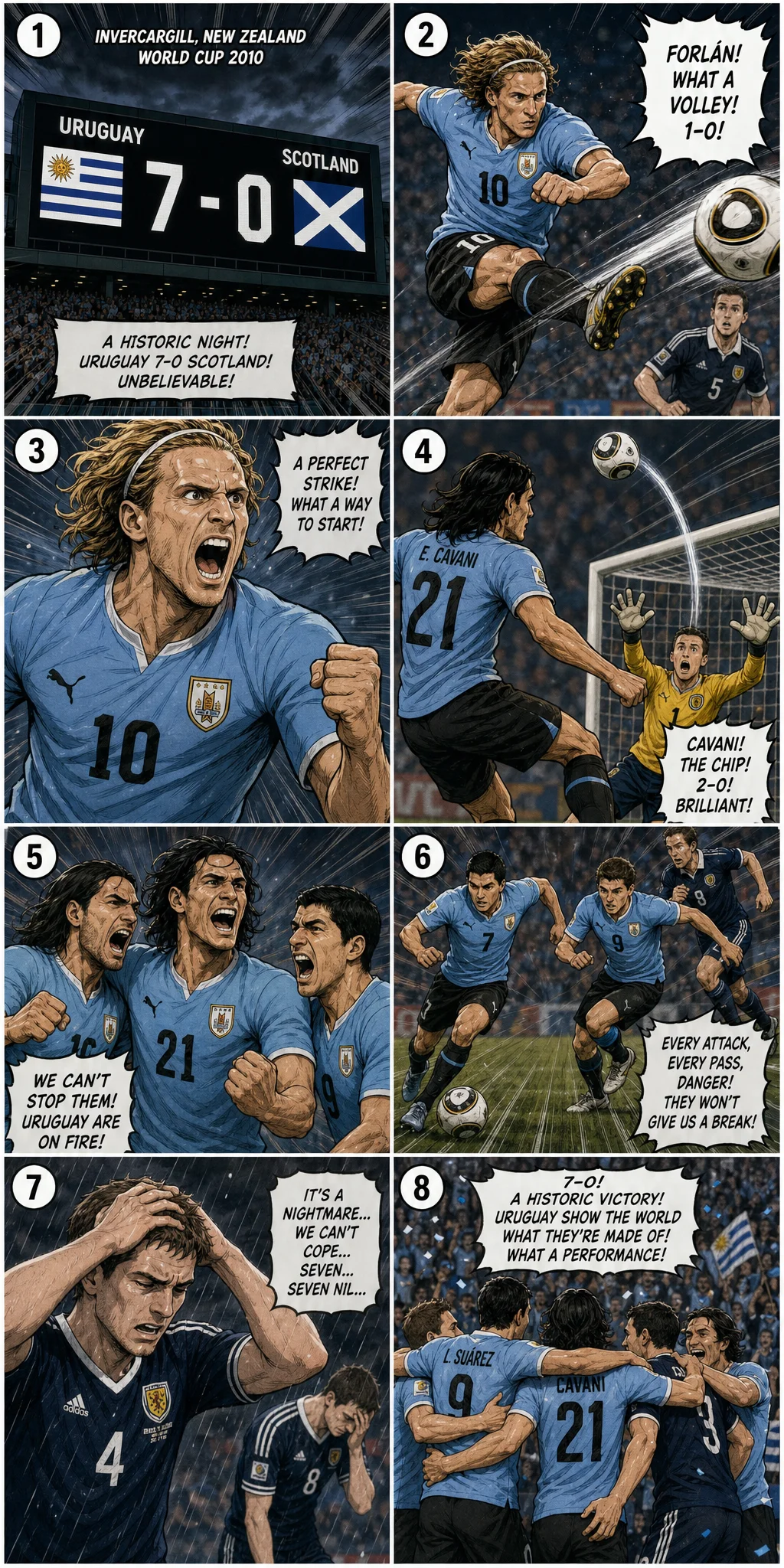
Comic content and match statistics are for entertainment purposes only and may contain inaccuracies. For Accurate Data, please refer to the reference's official website.
# Uruguay 7-0 Scotland: The Day South America Taught Britain How Football Had Changed
The 1954 World Cup group match between defending champion Uruguay and debutant Scotland was not a competitive football fixture in any meaningful sense. It was a lecture — delivered by a football culture that had evolved beyond British assumptions about how the sport should be played, to an audience that had assumed, for the better part of a century, that British football's methods represented the sport's natural and permanent apex. Uruguay won 7-0. The scoreline, remarkable as it was, represents only the surface of a match whose implications radiated through British football for the next two decades and fundamentally altered the relationship between European and South American football.
Scotland arrived in Switzerland as the inheritors of the game's oldest professional tradition — the nation that had invented the passing game, that had exported football's infrastructure to South America through British railway engineers and expatriate communities in the late nineteenth century, that considered itself, not unreasonably given the historical record, to be among the sport's intellectual and competitive elite. The British approach to football in 1954 was built on the 2-3-5 formation — the WM variant that had been the tactical orthodoxy in British football since the 1920s, the system that prioritized physical confrontation and direct attacking over the positional sophistication that continental and South American football had been developing. The Scottish players were talented, the Scottish tradition was rich, and the Scottish tactical understanding of football was approximately thirty years out of date.
Uruguay arrived as the inheritors of a quite different tradition. The South American variant of the WM formation, known as the "metodo," had been developed by Argentine and Uruguayan coaches through the 1930s and 1940s, adapting the British formation to South American conditions and South American players. The metodo provided defensive solidity through a withdrawn centre-half — the position that would eventually evolve into the modern defensive midfielder — while allowing the forward line a freedom of movement and positional interchange that the rigid British 2-3-5 could neither replicate nor counter. The tactical gap between the two teams was not measured in individual talent. It was measured in generations of tactical evolution that Scottish football had simply not experienced.
Uruguay's players moved in patterns that the Scottish defenders had never encountered in competitive football. The forward line interchanged positions with a fluidity that made marking assignments impossible — a Scottish full-back assigned to track the Uruguayan left winger would discover, moments later, that the left winger was now operating as a centre forward and the centre forward was now on the left wing. The midfield controlled possession with a patience that British football culture had not yet learned to value, circulating the ball until spaces appeared rather than forcing the direct attacks that British teams had been programmed to attempt. The goals accumulated not through individual brilliance — though Uruguay had individual brilliance in abundance — but through systematic tactical superiority, the specific advantage of a team that understood football differently from its opponent.
Scottish players, to their enduring credit, recognized what was happening. Contemporary reports from the match indicate that several Scottish players approached their Uruguayan counterparts after the final whistle to ask, with genuine professional curiosity, how they had achieved what they had just demonstrated. The 7-0 was recorded in the Scottish press as a humiliation, and it was. But it was also an education — the moment when British football received, in the most public forum available, evidence that the sport had evolved beyond the tactical vocabulary that British football had developed and that British football was now the student rather than the teacher. The education took two decades to fully process. The 7-0 in 1954 was the beginning of British football's long, reluctant acknowledgment that the game it had invented was now being played better by the nations it had taught.
The Scottish football tradition that arrived in Switzerland in 1954 was not simply tactically outdated; it was culturally oriented in a way that made recognizing its obsolescence almost impossible. British football in the 1950s was built on a specific set of assumptions about what constituted proper football: physical commitment, direct attacking, the prioritizing of effort over elegance, the conviction that the British way of playing was the correct way of playing and that deviations from that model represented decadence rather than evolution. These assumptions were not held cynically; they were held sincerely, by people who had been raised within a football culture that treated its own traditions as universal truths. The Scottish players who faced Uruguay in 1954 were not arrogant in the pejorative sense. They were products of a system that had taught them, implicitly and explicitly, that British football was the standard against which all other football should be measured. The 7-0 was not simply a defeat. It was the collapse of a worldview — the specific trauma of discovering that the tradition you have inherited and the assumptions you have internalized are not universal truths but local customs that the rest of the world has moved beyond. The Scottish players who experienced this collapse did not have the vocabulary to process it — the vocabulary for understanding football as a global evolutionary system rather than a British invention with international imitators did not yet exist in British football culture. But they had the professional integrity to recognize that they had been taught something important, and the recognition, however painful, was the beginning of British football's long educational journey.
Uruguay's football tradition deserves contextualization because it represents, alongside Argentina and Brazil, one of the three foundational football cultures of South America, and its specific characteristics — the emphasis on collective organization, the tactical intelligence, the capacity to compete against physically superior opponents through positional discipline — were precisely the qualities that the metodo system maximized. Uruguay had won the 1930 World Cup on home soil, defeating Argentina in the final. They had won the 1950 World Cup in Brazil, defeating the hosts in the Maracanazo, the most devastating defeat in football history. The team that arrived in Switzerland in 1954 was the defending champion, and the championship had been earned through the specific qualities that would dismantle Scotland: tactical sophistication, collective organization, and the capacity to execute a game plan that opponents could not process. The Scottish players who lost 7-0 were not defeated by individual brilliance alone — though Uruguay had Juan Alberto Schiaffino, one of the great creative midfielders of the era, whose passing range and spatial intelligence would be recognizable to any modern analyst. They were defeated by a football system that operated according to principles that British football had not yet learned to recognize as principles. The tactical vocabulary that Uruguay deployed — positional interchange, collective pressing, the patient buildup that created rather than forced opportunities — is now standard across global football. In 1954, it was revolutionary, and the Scottish team that encountered it was experiencing something that British football did not yet have the concepts to understand.
The long-term consequences of the 7-0 for British football were gradual rather than immediate, institutional rather than personal. The defeat did not, on its own, transform British tactical thinking. The British football establishment was too deeply invested in its own traditions, too institutionally resistant to external influence, too culturally convinced of its own superiority to be transformed by a single result, no matter how devastating. But the defeat contributed to an accumulation of evidence — the 1953 Wembley defeat to Hungary, the 6-3 that had announced the Mighty Magyars; the 1954 Budapest return match, the 7-1 that confirmed Wembley was not a fluke; the broader pattern of British teams struggling against technically and tactically superior continental opposition — that eventually, across two decades of painful accumulation, forced British football to acknowledge that the game it had invented had evolved beyond its control. The 7-0 in 1954 was one data point in this accumulation, and its specific significance was that it demonstrated that the tactical revolution was not limited to Hungary — that South American football, which British football culture had traditionally dismissed as technically gifted but tactically naive, had developed a systematic sophistication that British football could neither replicate nor counter. The lesson took decades to absorb, and the absorption was never complete. But the 7-0 was the moment when the lesson was first delivered, in the most public forum available, with a clarity that no amount of institutional resistance could entirely obscure.
The Uruguay team of 1954, for all its tactical sophistication, would not retain the World Cup. The semifinal defeat to Hungary — a 4-2 loss in extra time, a match that is remembered as one of the great contests in World Cup history, the meeting of the two most tactically advanced teams in the tournament — ended Uruguay's reign as champion. The Miracle of Bern followed, West Germany's victory over Hungary in the final, and the 1954 tournament entered football mythology as the competition that simultaneously demonstrated the death of the British tactical tradition and the emergence of a new global football order. Uruguay's 7-0 victory over Scotland was the opening statement of this new order — the moment when the nation that had been a British football colony, that had learned the game from British railway engineers and expatriate teachers, demonstrated that the student had surpassed the teacher in ways that the teacher could not yet understand. The relationship between British and South American football would never be the same. The 7-0 scoreline records a football result. The transformation it catalyzed records the evolution of the global game, and the evolution continues to this day.