

Portugal 7-0 North Korea: The Massacre on National Television
The 2010 World Cup group match between Portugal and North Korea carried political dimensions that overwhelmed the football. The scoreline — Portugal 7, North Korea 0 — records a comprehensive victory by a technically superior European side over an As
Published: June 6, 2026
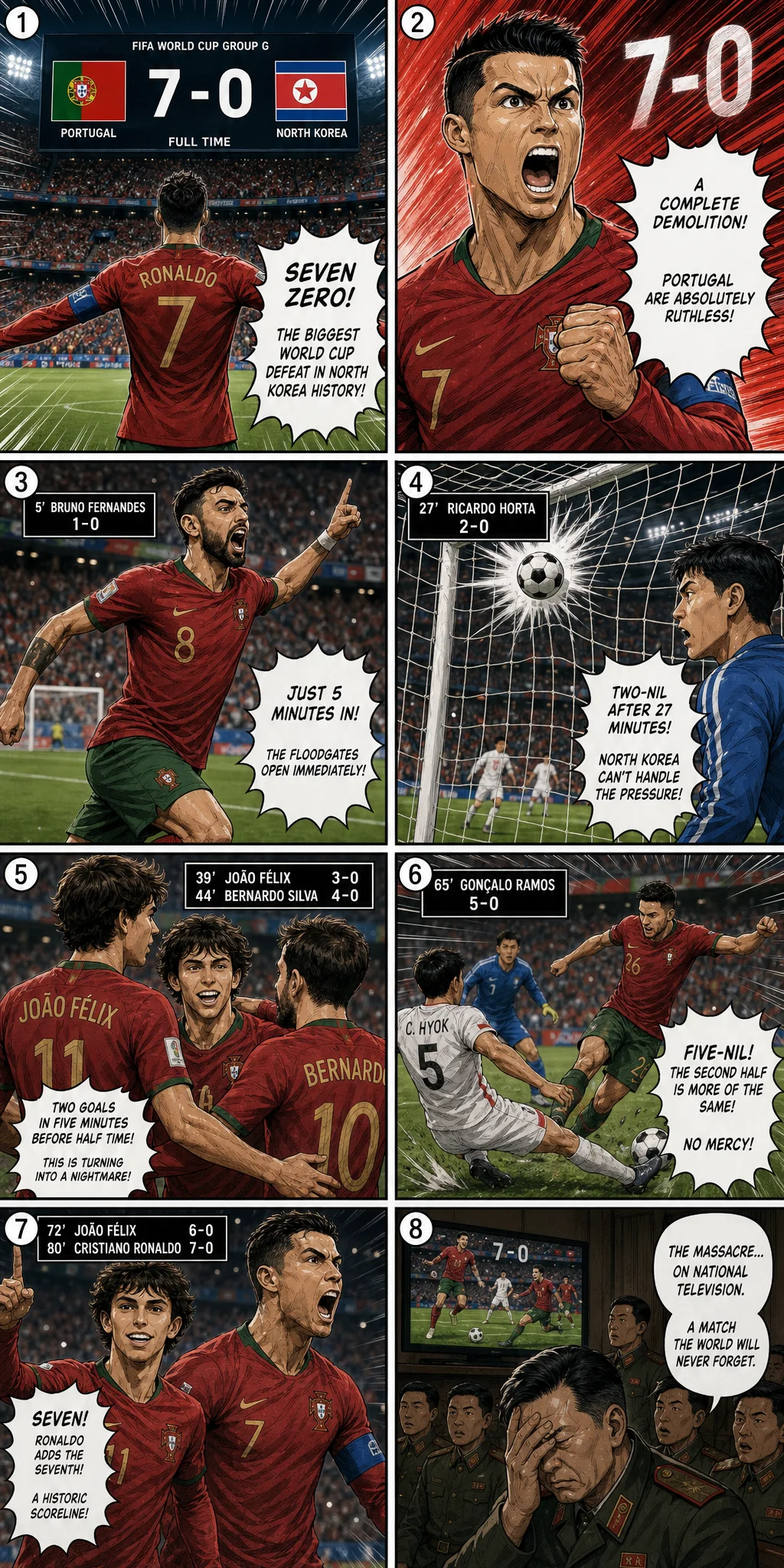
Comic content and match statistics are for entertainment purposes only and may contain inaccuracies. For Accurate Data, please refer to the reference's official website.
# Portugal 7-0 North Korea: A Football System Meets Total Isolation
The 2010 World Cup group match between Portugal and North Korea carried political dimensions that overwhelmed the football. The scoreline — Portugal 7, North Korea 0 — records a comprehensive victory by a technically superior European side over an Asian opponent. The context records something far more significant: the moment when a football system developed in conditions of near-total isolation from global football encountered the empirical reality of how the sport had evolved in the interconnected global network that produced every other participant in the tournament.
North Korea's participation in the 2010 World Cup was itself extraordinary. Their only previous World Cup appearance, in 1966, had produced one of the tournament's most enduring upsets — the 1-0 victory over Italy at Ayresome Park, Middlesbrough, that eliminated the Azzurri and sent the North Koreans to the quarterfinals. The 1966 team had captured the imagination of the English public, the mysterious Asian team defeating one of football's established powers, the players whose lives outside the tournament were almost entirely unknown. The 2010 squad arrived forty-four years later, selected and developed in conditions of isolation from global football that had, if anything, intensified rather than relaxed during the intervening decades. North Korean footballers played in a domestic league with minimal international exposure, against opponents whose tactical development lagged behind global standards by a margin that was impossible to measure because the system provided no external benchmarks. The players who arrived in South Africa were talented — the athleticism and technical quality that had carried them through Asian qualification were genuine — but they had been developed within a closed system whose assumptions about how football worked had not been tested against external competition.
The match was broadcast live in North Korea — reportedly the first live international sports broadcast in the nation's history. The significance of this fact cannot be overstated. For the first time, North Korean citizens were watching their national team compete on the global stage in real time, observing the gap between their footballers and the world's elite as it unfolded, moment by moment. The state broadcaster had prepared for a competitive match, or at least a match whose scoreline would not expose the systematic competitive inadequacy that decades of isolation had produced.
Portugal scored seven. Cristiano Ronaldo, in his absolute prime at twenty-five, led an attacking unit that clicked into devastating gear in the second half. The first half was competitive — 1-0 at the break, North Korea's defensive organization holding against a Portuguese team that was struggling to find rhythm. The second half was an exposure. Six goals in forty-five minutes, the North Korean defensive structure disintegrating as the accumulated pressure of Portuguese technical superiority overwhelmed a system that had been designed to resist opponents who attacked in patterns that North Korean defenders had been trained to anticipate. Portugal attacked in patterns that North Korean defenders had never encountered, because the patterns were products of tactical evolution that North Korean football's isolation had prevented it from experiencing.
The North Korean broadcast feed, according to multiple reports, was terminated before the final whistle. The state broadcaster, confronted with the most lopsided scoreline of the 2010 tournament and the systematic exposure of its football system's competitive inadequacy, chose silence over the documentation of failure. The 7-0 was not simply a football result. It was an encounter between two fundamentally different relationships with information — one open to global tactical evolution, one closed — and the scoreline recorded, with the unforgiving precision that only football scorelines can provide, what happens when a closed information system meets empirical reality. The football was straightforward. The politics were devastating.
The North Korean football system that produced the 2010 World Cup squad deserves analysis on its own terms, because its strengths and limitations are both products of the same structural conditions. The North Korean domestic league — the DPR Korea Premier Football League — operates under conditions of isolation that make comparison with any other national league essentially impossible. The players train full-time, receiving state support for their athletic development in a way that many developing football nations cannot provide. The athletic standards are reportedly high — North Korean footballers are known for their physical fitness, their discipline, their capacity to execute tactical instructions with the precision that a centralized training system can produce. The technical standards are harder to assess because the competition that would reveal them — regular fixtures against international opponents, the specific benchmarking that global football provides — is almost entirely absent. The North Korean players who arrived in South Africa in 2010 were not, by the standards of athletic preparation, inferior to their opponents. They were fit, disciplined, and organized. What they lacked was not athletic quality but competitive context — the specific experience of playing against opponents who had been developed in the interconnected global football ecosystem, who had faced every variety of tactical approach, who had learned to adapt in real time to opponents whose patterns were unfamiliar. The 7-0 was not evidence that North Korean footballers were inferior athletes. It was evidence that the system that produced them had denied them the competitive experience necessary to compete at the global level, and the denial was structural rather than incidental.
Portugal's performance in this match deserves recognition because it was, in its second-half iteration, the most complete attacking display of the 2010 tournament. Carlos Queiroz's Portugal had struggled in the group stage — a goalless draw with Côte d'Ivoire in the opener, a 1-0 victory over Brazil's reserve side in the final group match — and the team that entered the North Korea fixture was under pressure to demonstrate that it could produce the attacking output that its individual talent suggested was possible. The second half delivered that demonstration. Ronaldo, who had been criticized for his tournament performances to that point, scored one goal and created several more — the specific quality of a player operating at a level that an isolated opponent could not match. Tiago scored twice from midfield. Liedson, Simao, and Hugo Almeida contributed to a collective attacking performance that was more than the sum of its individual parts, the specific synergy of a team whose attacking patterns had finally synchronized after two matches of disjointed performance. The 7-0 was, in a sense, misleading — Portugal would score only one more goal in the remainder of the tournament, a 1-0 round-of-sixteen defeat to Spain. But the performance against North Korea demonstrated what Portuguese attacking football was capable of when the opponent's defensive organization crumbled, and the specific contrast between the first-half struggle and the second-half deluge revealed the psychological dimension that separates competitive matches from routs.
The North Korean broadcast termination is the detail that transforms this match from a football result into a political event. The decision to cut the live feed — to substitute the documentary reality of a 7-0 defeat with programming that did not document the defeat — was a decision about information control that reflects the specific political logic of the North Korean state. The state broadcaster had permission to show the national team competing on the global stage because the expectation — cultivated by a domestic propaganda apparatus that systematically exaggerates North Korean achievements and systematically suppresses evidence of North Korean inadequacy — was that the team would compete, would demonstrate the specific quality that the state's narrative of national excellence required. When the second half revealed the gap between propaganda and reality, the broadcast was terminated — not because the defeat was unbearable, but because the evidence it provided contradicted the narrative that the state had constructed about its own capabilities. The players on the pitch continued competing. The audience that had been watching them was denied the opportunity to continue doing so. The 7-0 was a football result. The termination of its broadcast was an act of political control, and the gap between the two — the football and the politics, the reality and the narrative — encapsulates the specific dysfunction that defines North Korean sport.
The aftermath of the 7-0 for North Korean football is, by definition, difficult to document because the system that produced the defeat is also the system that controls information about its consequences. Reports from defectors and limited external sources suggest that the players who participated in the 2010 World Cup faced consequences that ranged from public criticism to re-education — the specific mechanisms of a political system that treats athletic failure as political failure, that holds individual athletes responsible for the deficiencies of the system that produced them. The specific fate of the North Korean players who conceded seven goals to Portugal in Cape Town is unknown, and the unknowability is itself the point: a system that controls information about its athletes as comprehensively as it controls information about everything else does not permit the documentation of failure. The 7-0 records a football result. The silence that followed it records the specific conditions under which North Korean football operates, and the silence is more damning than any scoreline could be.