

Brazil 6-5 Poland: 1938 World Cup Eleven-Goal Battle in Mud
The rain in Strasbourg in June 1938 was not the gentle, romantic rain of French cinema. It was the kind of rain that makes you question why anyone ever thought building a city here was a good idea. Days of it. Relentless, heavy, remorseless rain that
Published: June 6, 2026
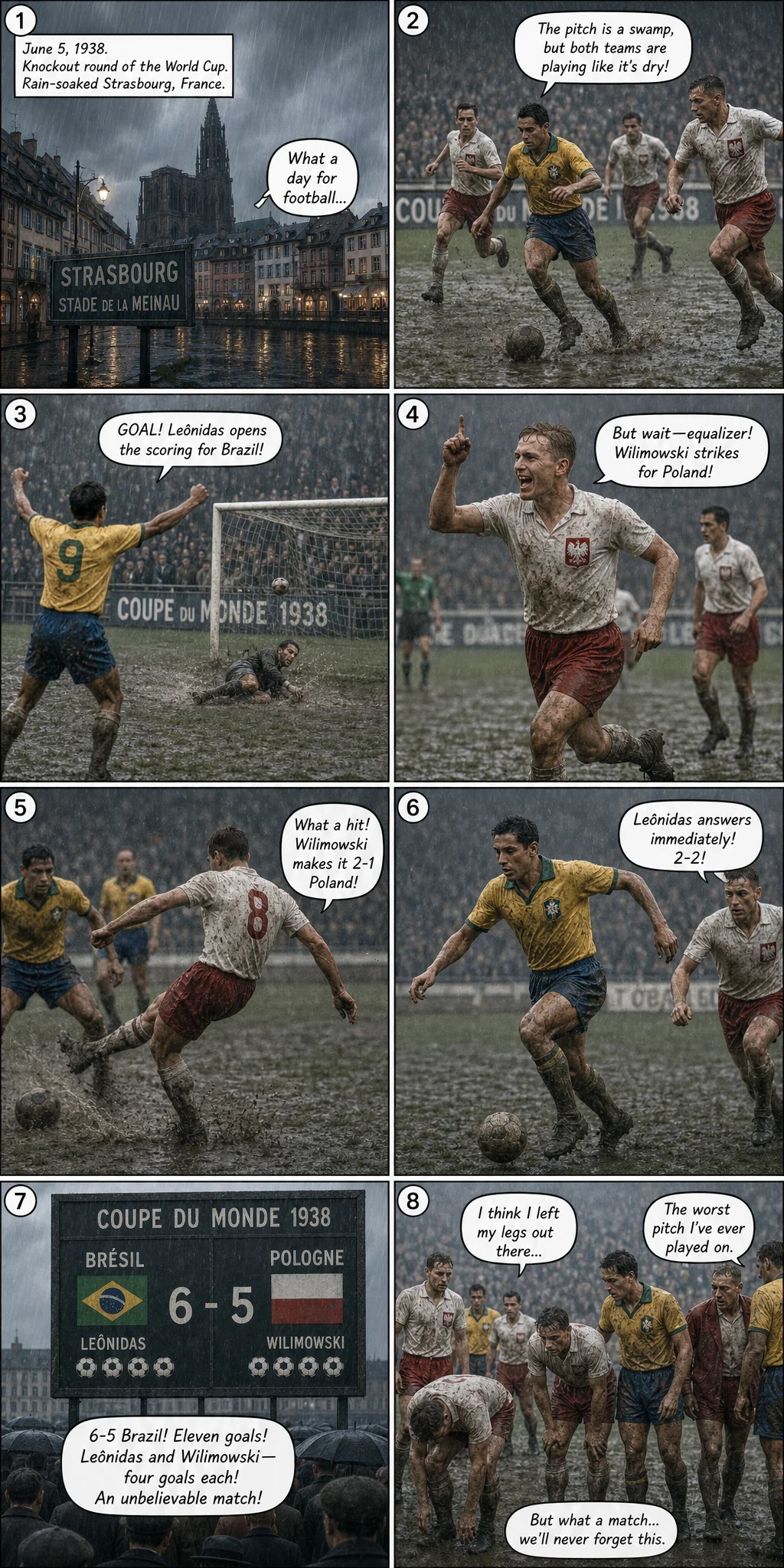
Comic content and match statistics are for entertainment purposes only and may contain inaccuracies. For Accurate Data, please refer to the reference's official website.
The rain in Strasbourg in June 1938 was not the gentle, romantic rain of French cinema. It was the kind of rain that makes you question why anyone ever thought building a city here was a good idea. Days of it. Relentless, heavy, remorseless rain that turned the Stade de la Meinau pitch into something closer to a rice paddy than a football surface. I have tried to imagine what stepping onto that pitch must have felt like. The squelch of boots on sodden turf. The weight of a ball that had absorbed so much water it felt like kicking a medicine ball. The knowledge that you were about to play a World Cup knockout match in conditions that would be rejected by a park Sunday league.
Brazil versus Poland, 1938 World Cup round of sixteen. Eleven goals. Six to Brazil, five to Poland. It is, without question, one of the greatest matches in the tournament's history, and I mean that in the old sense of the word — not great as in "tactically sophisticated" or "technically excellent," but great as in "I cannot believe this actually happened." In the mud. In the rain. For 120 minutes.
Brazil in 1938 was not the Brazil we know. The selecao had not yet become the spiritual home of beautiful football. The five World Cup titles, the yellow shirts, the samba-inflected mythology — none of this existed yet. What existed was a talented, disorganized, wonderfully chaotic team of players who approached football the way Italian grandmothers approach cooking: by instinct, by feel, by some ineffable sense of what felt right in the moment. They had a star, though. His name was Leônidas da Silva, and he was already becoming a legend. The "Black Diamond," they called him. The man who would be credited — probably incorrectly, but that's not the point — with inventing the bicycle kick. He played with a freedom that seemed to belong to a different sport entirely, a sport where gravity was optional and the rules were whatever Leônidas decided they were.
Poland had Ernst Willimowski. If the name is not familiar, let me correct that. Willimowski — "Ezi" to his teammates — was one of the great forgotten strikers of pre-war football. Born in the German Empire to Polish parents, he had already represented Poland at the 1936 Olympics and scored prolifically for Ruch Chorzów. He was quick, clinical, and playing with the quiet fury of a man who knew his nation's footballing reputation depended largely on his right foot.
The match began, and I use the word "began" loosely, because football in those conditions barely qualified as the same sport. The ball would not roll. It would splat. Players would run and then slide, their momentum carrying them two or three metres beyond where they intended to stop. Every tackle produced a tidal wave of mud that covered everyone within a three-metre radius. The Brazilian players, accustomed to the firm, dry pitches of Rio de Janeiro and Sao Paulo, looked initially as if they were being asked to play underwater. The Poles, more familiar with the frozen mud of Eastern European winters, adapted slightly better.
Leônidas scored first. Of course he did. A shot through a forest of legs, the ball squirming through the mud like a frightened animal. 1-0 Brazil. Then came the famous moment — the one that has passed into World Cup folklore and is still told in Brazilian bars when the caipirinhas have been flowing for a few hours. Leônidas's left boot split. It simply gave up, unable to cope with the combination of water, mud, and the force of a man who kicked a football as if it had personally insulted his family. In 1938, there were no substitutions. No spare boots waiting on the touchline. You played in what you had or you played in nothing. Leônidas kicked off the ruined boot and played on in his bare feet.
I have spent years thinking about this image. The best player on the pitch, the tournament's eventual top scorer, playing a World Cup knockout match barefoot. In the mud. Against grown men wearing boots. And still scoring. It is the kind of detail that would be rejected by a Hollywood screenwriter for being too implausible, and yet the match reports from Strasbourg confirm it. The referee told him to put his boot back on. Leônidas, presumably, shrugged in that particularly Brazilian way — a gesture that says everything and nothing simultaneously — and carried on.
The goals kept coming. Willimowski scored for Poland. Leônidas scored again. Willimowski scored again. By halftime it was 3-1 Brazil, and the players retreated to the dressing rooms looking like mud monsters from a children's horror story. The second half was a blur of goals so relentless that the scoreboard operator must have developed repetitive strain injury. Willimowski scored twice more — four goals in a World Cup knockout match, the first player in history to achieve that, and he ended up on the losing side. Read that last sentence again. Four goals. Losing side. It is the kind of statistical cruelty that makes football the sport it is.
Romeu and Perácio scored for Brazil. The score was 4-4 at full time, an absurdity of attacking football and defensive indifference. Extra time was required because, in 1938, the concept of penalty shootouts had not been invented. Players who had been running in mud for ninety minutes had to run for thirty more. In those conditions, an additional half hour of football was not sport. It was punishment.
Leônidas scored again. His third. A hat-trick in a World Cup knockout match, barefoot for part of it, in conditions that would be rejected by a hippopotamus. Brazil won 6-5. Eleven goals. The match report in the Brazilian press the next day — I have read a translation, sitting in a café in São Paulo while researching a book on Brazilian football history — described it as "a victory for the Brazilian spirit over European conditions." The Polish press was less poetic, focusing mainly on the referee and the weather, in that order. Neither was entirely fair. The weather was not the referee's fault. The referee was not the weather's fault. The match was simply a product of an era when football had not yet decided what it wanted to be: sport, entertainment, or gladiatorial endurance contest.
Leônidas would go on to be the tournament's top scorer with seven goals. Brazil would be eliminated by Italy in the semifinal, a match that Brazilian mythology still claims was thrown by the manager — Adhemar Pimenta rested Leônidas for the final, a decision so baffling that conspiracy theories about Italian interference have survived for nearly a century. Willimowski would later represent Germany during the war years, a choice that made him a complicated figure in Polish football history. The match in Strasbourg, the 6-5 in the mud, the barefoot hat-trick — it belongs now to a different world.
I think about Leônidas sometimes when I watch modern footballers change their boots at halftime because the studs "don't feel quite right." The Black Diamond played in the mud with no boots at all and scored a hat-trick in a World Cup knockout match. Progress is a funny thing. We have better pitches, better equipment, better nutrition, better everything. What we don't have is Leônidas da Silva, barefoot in the Strasbourg rain, doing things that no coaching manual could explain and no modern footballer could replicate. Some legends are not transferable. Some stories belong only to their moment, and their moment alone.