

West Germany 7-2 Turkey: 1954 Goal Fest
Let me tell you about the World Cup format of 1954. It was, and I choose this word carefully, insane. The sixteen teams were divided into four groups of four, but — and this is where it gets properly strange — the two seeded teams in each group did n
Published: June 6, 2026
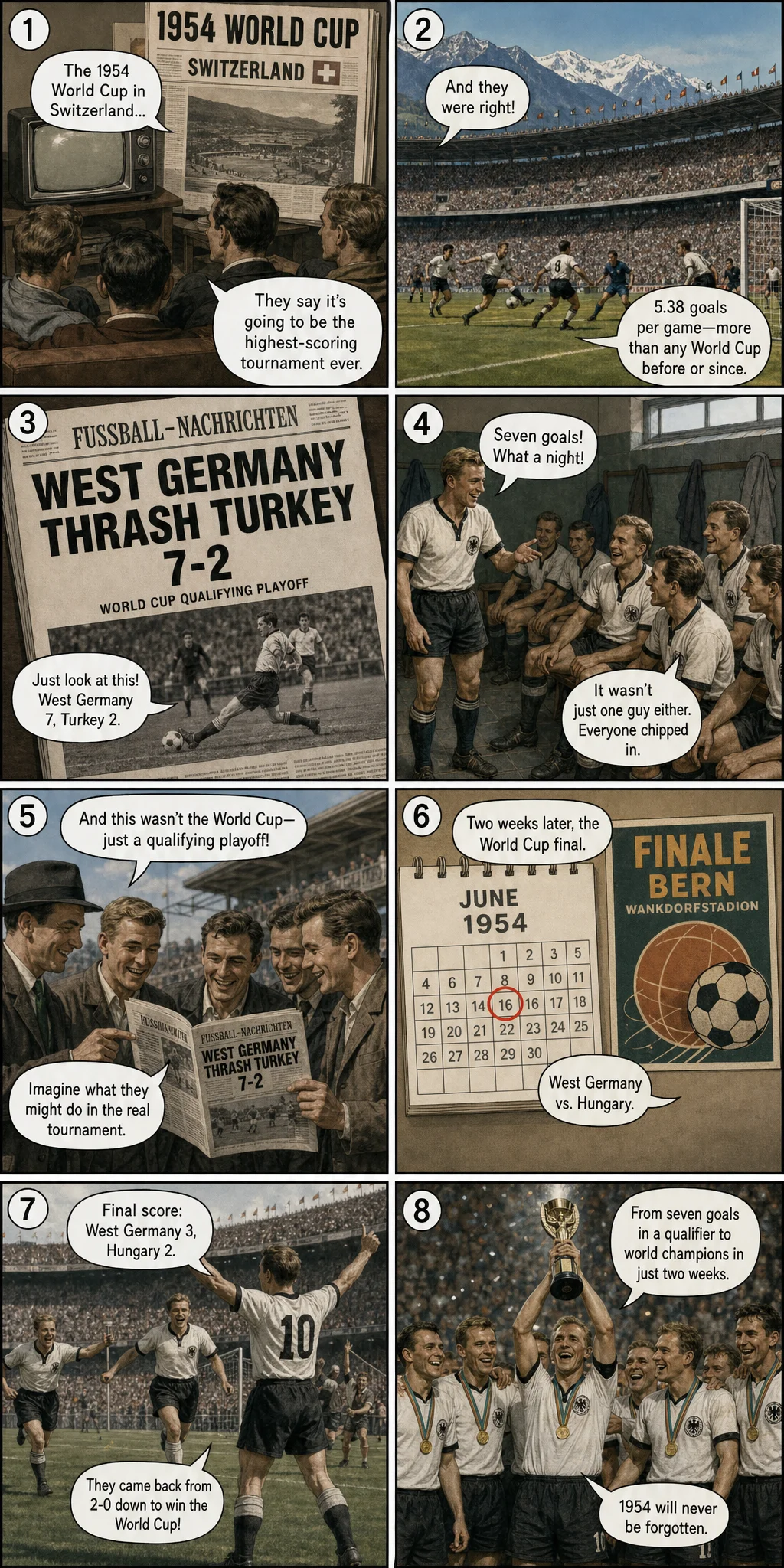
Comic content and match statistics are for entertainment purposes only and may contain inaccuracies. For Accurate Data, please refer to the reference's official website.
Let me tell you about the World Cup format of 1954. It was, and I choose this word carefully, insane. The sixteen teams were divided into four groups of four, but — and this is where it gets properly strange — the two seeded teams in each group did not play each other, and the two unseeded teams did not play each other. Each team played exactly two group matches. The result was a tournament structure that seemed designed by someone who had been told what a football competition looked like but had never actually seen one. Half the scheduled matches simply did not exist. And into this administrative fever dream walked Turkey, making their World Cup debut with a squad of players who had never experienced anything like this level of competition.
I learned the story of that 7-2 match from a Turkish journalist I met in Istanbul a few years ago. We were sitting in a tea garden in Kadikoy, on the Asian side of the Bosphorus, watching ferries shuttle between continents. He was old enough to remember Turkish football's wilderness years — the decades before Galatasaray's UEFA Cup triumph, before the Third Star, before Turkish football became something the world took seriously. "We were not ready," he said, stirring his çay with a tiny spoon. "We were not ready for any of it."
West Germany versus Turkey, June 20th, 1954, in Basel. The Hardturm Stadium, a venue that no longer exists — demolished in 2007, replaced by apartments and a shopping centre, because that is what modernity does to cathedral grounds. The Germans arrived at their first World Cup since 1938, their first since the war. The national team had been banned from the 1950 tournament in Brazil, a punishment for the sins of a regime the players had mostly not chosen but could not escape. The 1954 World Cup was West Germany's return to the international community, played out in the country where FIFA was headquartered, a tournament heavy with symbolism that most participants preferred not to discuss.
The German team that took the field was not the machine we would later recognize. This was before the footballing Wirtschaftswunder, before the relentless efficiency, before German football became synonymous with tournament success. This was a team still finding itself, still rebuilding, still figuring out what post-war German football was supposed to look like. Sepp Herberger, the manager, was a chain-smoking disciplinarian with a tactical mind that operated on frequencies most people could not perceive. He had kept the national team alive during the war years through sheer force of will, organizing friendlies when international football barely existed. His 1954 squad was a collection of part-timers and semi-professionals from the Oberliga Süd and Oberliga West, the regional leagues that had replaced the old Reichsliga. They were, by the standards of what was to come, nobodies.
Turkey arrived with even less pedigree. The Turkish football federation had only been founded in 1923, the same year as the Republic itself. Domestic football existed, passionately supported, chaotically organized. The players who traveled to Switzerland were amateurs in every sense — teachers, civil servants, students, men who played football because they loved it and who had never been paid to do anything of the sort. Their manager was an Italian named Sandro Puppo — a name that always makes me smile, because the image of an Italian trying to impose tactical discipline on a group of Turkish amateurs in 1954 feels like the setup for a comedy film that someone should have made. Puppo had played for Venezia and managed in Turkey before. He knew the limitations. He also knew they were insurmountable.
The match began and almost immediately stopped being a match. Germany scored through Hans Schäfer in the 2nd minute. Schäfer, a left winger from Cologne with a cannon of a left foot and a moustache that deserved its own passport, was the closest thing Germany had to a star. His goal was simple — a shot from distance that the Turkish goalkeeper, Turgay Sener, watched fly past with the helpless expression of a man who had just realized what the next eighty-eight minutes were going to feel like.
What followed was not football in any competitive sense. It was a demonstration. Bernhard Klodt scored. Schäfer scored again. Ottmar Walter — the younger brother of Fritz Walter, the captain and spiritual leader of the team — added a fourth. Max Morlock, a centre-forward with the build of a blacksmith, made it five. By halftime the score was 5-1, and the Turkish players walked off with the thousand-yard stare of soldiers who had seen things they would never be able to describe.
The second half was, if anything, worse. Schäfer completed his hat-trick. Helmut Rahn — the man who would score the winning goal in the World Cup final three weeks later, the "Boss" as his teammates called him — added a seventh. The goals were distributed across six different German scorers, a collective statement that the German football machine was emerging from its post-war hibernation and stretching muscles that had atrophied during the years of isolation.
Turkey scored twice — Suat Mamat in the 52nd minute and Lefter Küçükandonyadis in the 82nd. Let me pause on Lefter, because he deserves more than a parenthetical mention. Lefter was Turkish football's first genuine star, a player of such talent that his nickname — "Ordinaryüs," a title normally reserved for the most distinguished professors in Turkish academia — felt entirely appropriate. He had played briefly for Fiorentina in Italy, becoming one of the first Turkish footballers to play abroad, and his goal against West Germany was celebrated in Istanbul as if Turkey had won the tournament. In a sense, they had. Every Turkish touch was a victory. Every pass completed was a triumph. The final score — 7-2 — was recorded in the official statistics. The unofficial score — hope versus reality, ambition versus experience — was harder to quantify but easier to understand.
The match tells us something about what the World Cup was in 1954, and what it has become since. The tournament in Switzerland was not the global, meritocratic competition we recognize today. It was a European invitational with a few South American guests, governed by rules that protected the strong and exposed the weak. Turkey had qualified through a process that would be unrecognizable to modern fans — a single playoff match against Spain, which they lost, followed by a drawing of lots, which they won. Yes, you read that correctly. Turkey's first World Cup qualification was decided not on the pitch but by a blind boy drawing names from a bowl. The football gods have a sense of humour, but it is not always a kind one.
The 7-2 was not a competitive match. It was a demonstration of what happens when a well-organized, well-funded European side faces a tournament newcomer with no experience at this level, playing a format designed to minimize competitive risk for the favoured nations. The World Cup's expansion and professionalization since 1954 — the rigorous qualifying processes, the development programmes, the narrowing of the gap between football's haves and have-nots — has largely eliminated scorelines like this from the tournament. You still get the occasional rout, of course. Germany 7, Brazil 1 in 2014. Portugal 7, North Korea 0 in 2010. But these are exceptions that prove the rule, statistical outliers in a tournament that has become steadily more competitive with each passing cycle.
The 1954 World Cup group stage, by contrast, was full of them. Hungary 9, South Korea 0. Uruguay 7, Scotland 0. Turkey 7, South Korea 0 — the match that gave Turkey their first World Cup victory, their first taste of tournament success, their first moment of genuine international relevance. The 7-2 defeat to Germany was the other side of that coin: the lesson, the education, the demonstration of how far Turkish football still had to travel.
I finished my tea in Kadikoy as the sun set over the Bosphorus, painting the water in shades of orange and gold. My Turkish friend was still talking, telling me about the years that followed — the decades of near-misses and almost-qualifications, the breakthrough in 2002 when Turkey reached the World Cup semifinal in Japan and Korea, the third-place finish that remains the nation's greatest footballing achievement. "That 7-2," he said, "that was where it started. You have to lose badly before you learn how to win." He was right. Every great football nation has a humiliation in its past. Turkey's came in Basel, on a June afternoon in 1954, at the hands of a German team that was itself still learning how to be German again. The scoreline records a defeat. The history records something more complicated: the first chapter of a story that was always going to take decades to finish.