

France 7-3 Paraguay: 1958 World Cup Fontaine Hat-Trick Debut
France's 7-3 demolition of Paraguay at the 1958 World Cup remains one of football's most extraordinary scorelines — a ten-goal quarterfinal where a 24-year-old Just Fontaine announced himself with a hat-trick that launched his single-tournament record of 13 goals. This historical feature relives the tactical chaos, the legendary names on both sides, and the scoring record nobody has approached since.
Published: June 6, 2026
Comic content and match statistics are for entertainment purposes only and may contain inaccuracies. For Accurate Data, please refer to the reference's official website.
France 7-3 Paraguay: The Night Just Fontaine Announced Himself
It began with a misunderstanding, which is how the most beautiful things in football sometimes begin. Just Fontaine was not supposed to start the 1958 World Cup. He was the third-choice centre-forward for France, a rangy Moroccan-born striker from Stade de Reims who had scored plenty of goals in Ligue 1 but had never convinced the national team's hierarchy that he belonged among the elite. When Raymond Kopa, the reigning European Footballer of the Year, returned from Real Madrid to join the squad, the plan was clear: Kopa would supply the bullets and either Rene Bliard or Stephane Bruey would fire them. Fontaine was insurance. A spare part. The kid from Marrakech who chain-smoked Gauloises between training sessions and ran with a gait that suggested he was perpetually trying to avoid low doorframes.
Then Bliard injured his ankle in training. Then Bruey picked up a knock. And so on the eighth of June 1958, at the Idrottsparken in Norrkoping, Sweden, a third-choice striker who nearly missed the tournament altogether walked onto the pitch wearing the number 17 shirt and proceeded to score the first three goals of what would become the most prolific individual World Cup campaign in history. Thirteen goals in six matches. A record that has stood for nearly seventy years and has survived every great striker the game has produced since.
This is the story of France 7-3 Paraguay, a match that belongs to a different geological era of football. It was the era of the 2-3-5 formation, when teams played five forwards and defending was something that happened to other people. The 1958 tournament produced 126 goals in 35 matches, an average of 3.6 per game that remains unmatched in World Cup history. Matches like France-Paraguay explain why: nobody seemed terribly interested in preventing goals, only in scoring them. It was football played with the abandon of a schoolyard game, and the scorelines reflected a kind of innocence that the tactical revolution would eventually extinguish.
Paraguay entered the tournament with a respectable South American pedigree. They had qualified by beating Uruguay, no small feat for a nation with a fraction of its neighbour's population and resources. The Guaranies arrived in Sweden with a team built around the attacking talents of Juan Aguero and Jose Parodi, and they carried the hopes of a country that had been absent from the World Cup since 1950. The eight-year gap had changed the tournament in ways Paraguay could not anticipate. The European nations had become more athletic, more organised, more clinical. France, in particular, had assembled a generation of attacking talent that would define the next decade of French football.
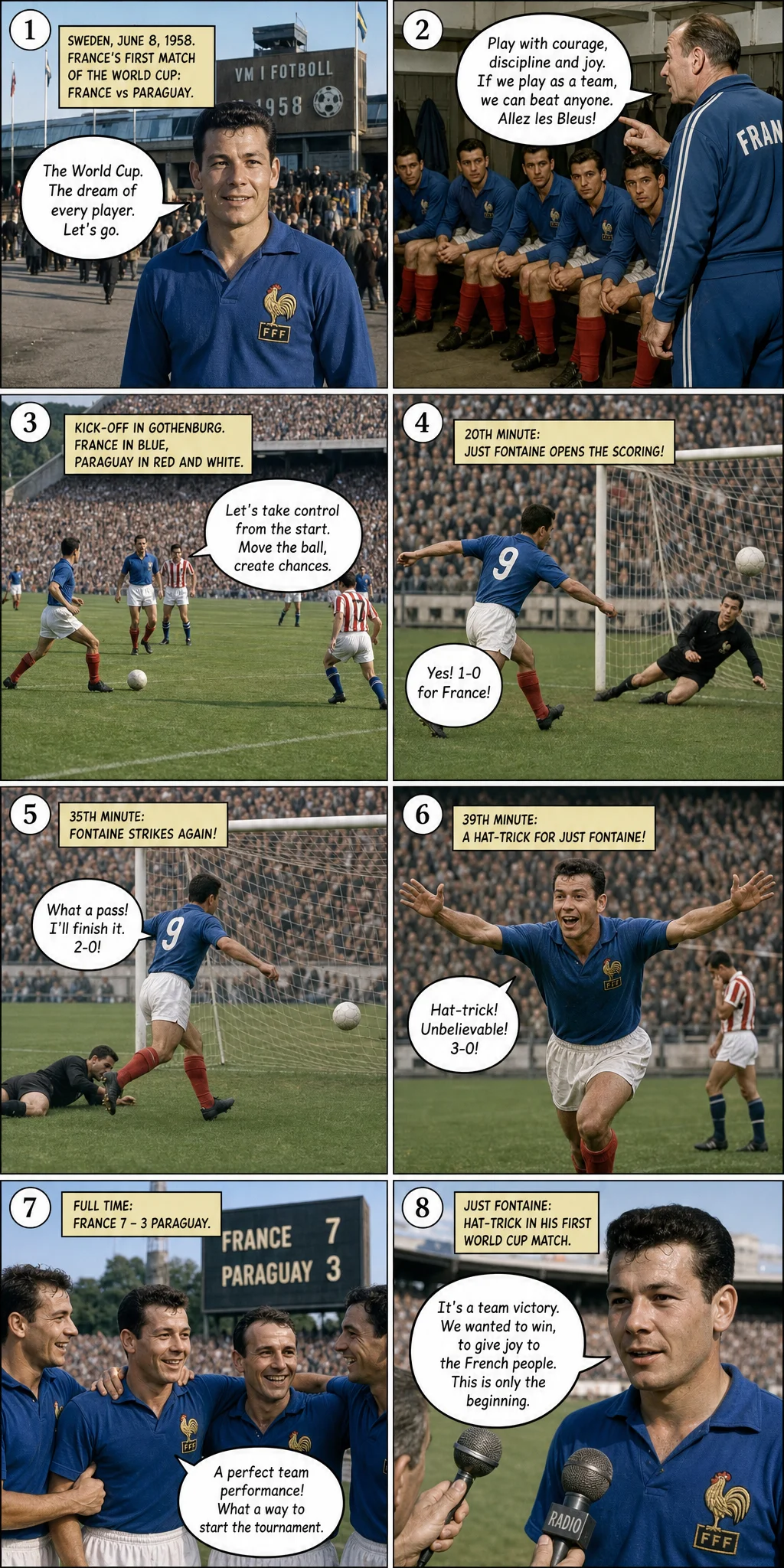
The rout began early, but not immediately. The first twenty minutes were cagey, both sides probing, feeling for weaknesses. Then, in the 24th minute, everything changed. Kopa, floating between Paraguay's midfield and defence with the effortless menace of a shark in shallow water, slipped a pass through to Fontaine. The finish was simple — a side-foot into the corner, the kind of goal that looks easy only because the movement that created it was so intelligent. 1-0 France. Fontaine's first World Cup goal, and there is something poignant about watching footage of it now, knowing what came next. Fontaine does not celebrate wildly. He jogs back to the centre circle with the expression of a man who expected to score and expects to score again.
Within six minutes, he had his second. A cross from the right wing, Fontaine rising between two Paraguayan defenders, the ball glancing off his forehead and looping over the goalkeeper Ramon Mayeregger. He was not tall, Fontaine. Not physically imposing in any conventional sense. But his leap — that strange, hinged, almost mechanical leap — seemed to add six inches to his frame whenever he left the ground. It was a gift that could not be taught, the product of timing and instinct rather than physical superiority. 2-0 France.
Paraguay, to their enduring credit, refused to capitulate. Juan Aguero — no relation to the Sergio Aguero who would torment Premier League defences half a century later, but carrying the same instinct for goal — pulled one back with a shot that skidded off the wet Swedish grass. 2-1. For a brief, shimmering moment, the match became a genuine contest. The Paraguayan supporters, a small contingent who had made the long journey from Asuncion, allowed themselves to believe. It was a mistake.
In the 40th minute, France won a penalty, and Fontaine stepped up. The Paraguayan goalkeeper dove in the opposite direction while the ball nestling in the corner. Hat-trick complete, three goals, three different finishes — one driven, one headed, one from the spot. The third-choice striker had announced himself to the world, and the announcement had taken exactly forty minutes.
But this match was never just about Fontaine, as tempting as it is to frame it that way. What makes it one of the great curiosities of World Cup history is that it was, by any measure, an absurd spectacle. Paraguay scored three goals of their own, matching what the eventual champions Brazil managed against France in the semi-final. Nelson Amarilla, the Guaranies' inside-left, scored twice in the first half, briefly threatening to turn the game into a genuine shootout. Jorge Romero added a third in the second half. On another day, against another opponent, three goals might have been enough for a draw, even a win. But this was not another day, and France were not another opponent.
France's other goals came from a variety of sources, testament to a team that was more than a one-man show. Roger Piantoni, the elegant Nancy inside-left who had been one of the architects of Reims' European Cup final run two years earlier, scored a fourth for France in the 52nd minute. His left foot was a weapon of surgical precision, a cannon disguised as a paintbrush. Maryan Wisnieski, the striker whose injury had opened the door for Fontaine's selection, came off the bench and scored the fifth, a poignant coda to the misfortune that had rearranged the team's hierarchy. Jean Vincent added the seventh late on, a goal that barely registered on the scoreboard but completed a demolition that was as comprehensive as it was entertaining.
Fontaine's hat-trick was the headline, but the significance was larger than one match. He would go on to score four more goals in the group stage — two against Scotland in a 2-1 win, another against Yugoslavia — before adding four more in the knockout rounds: two against Northern Ireland in the quarter-finals, one against Brazil in the semi-final, and four against West Germany in the third-place match. He scored in every single match France played. Six matches, thirteen goals. Even Pele, the greatest World Cup player of all time, could not claim that kind of consistency across a single tournament.
The pathos of Fontaine's story is that his World Cup career lasted precisely those six matches. In 1960, at the age of twenty-six, he suffered a double leg fracture playing for Reims against Sochaux. The injury ended his playing career before he ever got the chance to return to the World Cup stage. Twenty-six. The same age at which many modern strikers are entering their prime, Fontaine was finished. His entire international career consisted of twenty-one matches and thirty goals. His World Cup career was six matches and thirteen goals. The brevity of it is almost unbearable. All those goals, all that genius, compressed into a single tournament, a single summer, a single moment in time that would never come again.
There is another detail worth dwelling on, because it adds a layer of romance to an already romantic story. Fontaine played the entire tournament in borrowed boots. His own were stolen before the competition began, and he spent the month of June 1958 wearing a pair lent to him by a teammate. Thirteen World Cup goals, and none of them scored with his own footwear. The story is confirmed, not apocryphal, and it has become one of those football facts that sound too perfect to be true but are, in fact, absolutely true.
The France-Paraguay match also matters for what it represents in the broader arc of the French national team's history. In 1958, France were not yet the footballing superpower they would become. They had finished third in 1954 but were still considered second-tier compared to Hungary, Brazil, and the emerging Soviet side. The 7-3 demolition of Paraguay was a statement of intent, a declaration that French football had arrived with attacking verve and individual brilliance that could compete with anyone. It was the beginning of a golden generation that would culminate, forty years later, in the World Cup triumph of 1998 — the same tournament, incidentally, in which a Moroccan-born striker named David Trezeguet would score the golden goal that eliminated Italy in the quarter-finals. There is a direct line from Fontaine to Trezeguet, from 1958 to 1998, from borrowed boots to golden goals.
Paraguay's tournament ended in the group stage. They lost to Scotland and Yugoslavia, their three goals against France remaining a statistical curiosity rather than a platform for progress. They would not return to the World Cup until 1986, a gap of 28 years, and would not win a World Cup knockout match until 2010. But their willingness to trade punches with a superior opponent, to score three goals in a losing cause, earned them a strange kind of admiration. There are no moral victories in World Cup football, but there are performances that age better than their results, and Paraguay's contribution to this ten-goal thriller falls squarely into that category. They lost, but they lost beautifully.
The match ended 7-3, a scoreline that reads like a typographical error but was in fact a perfectly logical outcome of the collision between French attacking brilliance and Paraguayan defensive frailty. It was the highest-scoring match of the 1958 tournament, and it launched the legend of Just Fontaine — the accidental striker, the borrowed-boots wonder, the chain-smoking kid from Marrakech who scored thirteen World Cup goals and then vanished from the stage as suddenly as he had appeared.
I have a theory about third-choice strikers. They play differently because they know they are not supposed to be there. They take risks that first-choice strikers cannot afford to take. They shoot from angles that established players would be criticised for attempting. They play with the freedom of men who have already exceeded expectations simply by being on the pitch. Fontaine, in the summer of 1958, played like a man who had been given a gift he did not deserve and was determined to make the most of it before someone realised there had been a mistake. The mistake was never noticed. The record still stands.
If you went looking for the Idrottsparken in Norrkoping today, you would find a modern stadium that bears no resemblance to the modest ground where those ten goals were scored. The stands are larger now, the pitch more manicured, the broadcast facilities more sophisticated. But if you stood in the centre circle and listened carefully on the right kind of June evening, you might still hear the echo of a crowd roaring as a third-choice striker from Reims scored the first three goals of a record that no one has touched in nearly seventy years. And you might imagine the smell of Gauloises drifting from the tunnel, and a man in borrowed boots jogging onto the pitch, ready to score again.