

Argentina 5-0 Jamaica: Batistuta Hat-Trick in 10 Minutes 1998
I was in Paris for the 1998 World Cup, a young journalist with more enthusiasm than experience, and I remember the Jamaica match for two reasons. The first was the Jamaican fans. The second was Gabriel Batistuta. Everything else — the result, the oth
Published: June 6, 2026
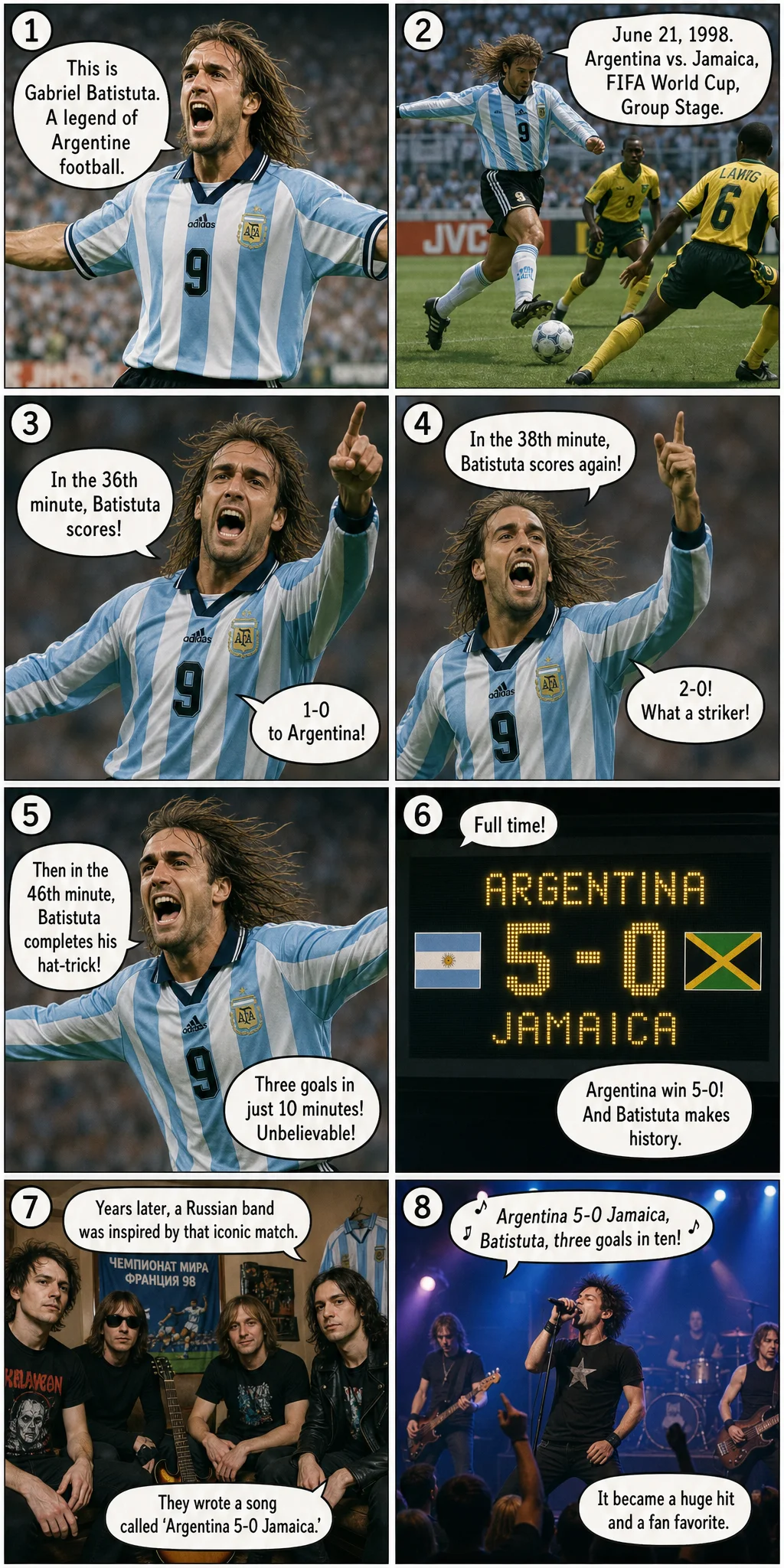
Comic content and match statistics are for entertainment purposes only and may contain inaccuracies. For Accurate Data, please refer to the reference's official website.
I was in Paris for the 1998 World Cup, a young journalist with more enthusiasm than experience, and I remember the Jamaica match for two reasons. The first was the Jamaican fans. The second was Gabriel Batistuta. Everything else — the result, the other goals, the tactical details that now fill Wikipedia pages — was secondary. The match belonged to those two things: a fanbase that had traveled to France to celebrate qualification, and a striker who treated the penalty area like a personal fiefdom where trespassers would be punished by goals.
Argentina versus Jamaica, June 21st, 1998. Parc des Princes, Paris. The stadium that had witnessed Pelé, Platini, and Weah was about to witness something different: the fastest hat-trick in World Cup history, at that point. Ten minutes. Three goals. Gabriel Omar Batistuta, the man they called Batigol, reducing the beautiful game to its simplest, most devastating form: ball, net, roar, repeat.
But let me start with Jamaica, because any account of this match that does not start with Jamaica misses the entire point. The Reggae Boyz were making their World Cup debut, the first Caribbean nation to qualify for the tournament since Cuba's improbable journey in 1938. Sixty years. That is how long the Caribbean had waited for another representative at football's highest table. The Jamaican qualification campaign had been a miracle in its own right — a team of players largely based in the English lower leagues, coached by a Brazilian named René Simões who had introduced samba rhythms to Kingston and convinced his players that they belonged on this stage. They had beaten Mexico. They had survived CONCACAF qualifying. They had arrived in France not as tourists but as participants, and their supporters were determined to treat every moment like a carnival.
I walked through Paris on the morning of the match and the city had been colonized by yellow, green, and black. Jamaican flags hung from apartment windows. Reggae music spilled from cafés that normally played moody French jazz. The Jamaican supporters — thousands of them, far more than anyone had expected — had turned the area around the Parc des Princes into a street party that made the Brazilian fan zones look like funeral gatherings. They were not there to win. They were there to be present, to be seen, to announce to the world that Caribbean football had arrived and was not leaving quietly. In the stadium, their drums never stopped. Their singing never stopped. When Jamaica's goalkeeper, Aaron Lawrence, made a routine save in the first five minutes, they celebrated as if the World Cup had been won. It was glorious. It was also, in purely competitive terms, completely irrelevant.
Argentina were Argentina. Daniel Passarella's side had reached the quarterfinals in 1990 and were expected to do at least as well in 1998. Their squad read like a roll call of 1990s footballing excellence: Batistuta up front, Ariel Ortega providing the creative spark behind him, Juan Sebastián Verón pulling strings in midfield, Roberto Ayala anchoring the defence. They had beaten Japan 1-0 in their opening match — an underwhelming performance that had drawn criticism from the Argentine press, which treats group stage victories the way Italian grandmothers treat shop-bought pasta: with deep suspicion.
Batistuta needed a response. He was twenty-nine years old, at the absolute peak of his powers. Nine seasons at Fiorentina had made him a legend in Florence — the city where a statue of David stands as a monument to masculine perfection, and where Batistuta was worshipped with a devotion that bordered on the religious. He had scored 168 goals in 269 appearances for La Viola, a rate of production that made him the most feared striker in Serie A. His hair — long, flowing, the kind of hair that would have made Renaissance painters weep — and his celebration — standing motionless, arms crossed, face expressionless — had become iconic. He was not just a goalscorer. He was an aesthetic statement.
The first goal came in the 73rd minute. Verón, with that deceptively casual delivery that made his crosses look like afterthoughts, floated a ball to the near post. Batistuta arrived — not fast, because Batistuta was never fast, but relentless, like a natural disaster that had been predicted but could not be prevented — and headed the ball past Lawrence. 1-0. The header was not spectacular. It was correct. The right run, the right timing, the right contact. Batistuta's genius was not that he scored beautiful goals, though occasionally he did. It was that he scored the right goals — the goals that were available, the goals that the situation demanded, the goals that separated winning from drawing.
The second goal came three minutes later. A penalty. Ortega, dancing through the Jamaican box with the jittery intensity of a man who had consumed too much caffeine, was brought down. Batistuta, as always, took the ball. His penalties were not placed. They were struck. He approached the ball the way a lumberjack approaches a tree — with the specific, focused violence of a man who considered finesse a form of weakness. The ball flew into the top corner. Lawrence, to his credit, dove in approximately the right direction. It would not have mattered if he had guessed correctly, started early, and grown three inches in the half-second between contact and arrival. The penalty was unstoppable. 2-0.
The third goal. The 83rd minute. Ten minutes, three goals. A cross from the left — I forget who delivered it, and the match reports disagree, which tells you something about how much the provider mattered compared to the finisher — and Batistuta was there, six yards out, the ball arriving at his feet like a guest who knew they were expected. Tap-in. 3-0. The most unremarkable goal of the three, and somehow the most Batistuta. He was always there. That was his gift. In a sport where being in the right place at the right time is considered a skill, Batistuta was the most skillful player of his generation. His movement was not spectacular. It was inevitable.
Argentina added two more goals through Ortega — a brilliant individual effort — and the final score was 5-0. Jamaica were eliminated. Their World Cup adventure, which had been defined by the qualification rather than the participation, ended with three defeats and a sense of achievement that no scoreline could diminish. The Reggae Boyz had been overmatched, outclassed, outscored. They had also been magnificent — not in football terms, but in human ones. Their fans sang until the final whistle and long after it. Their players swapped shirts with the Argentines as if exchanging relics. Their manager, Simões, would later say that the 1998 World Cup was the greatest experience of his professional life. He had been on the losing side of a 5-0. That is what the World Cup can do, when it is working properly.
Batistuta would score ten World Cup goals in his career — four in 1994, five in 1998, one in 2002. Thirty percent of his tournament goals came in ten minutes against a debutant who had already won simply by being there. That is not a criticism. That is a World Cup. The greatest strikers feast on the weakest opponents because that is what great strikers do — they score the goals that are available, against whatever defence is placed in front of them, in whatever context the tournament creates. Batistuta's hat-trick was not cruel. It was professional. The cruelty was in the fixture list, not the goalscorer.
I left the Parc des Princes that night and walked back toward central Paris. The Jamaican fans were still singing. Their party had not been interrupted by the result — it had been enhanced by it, because every goal conceded was evidence that they were here, that they were participating, that the World Cup was no longer a closed shop for the footballing establishment. Argentina advanced. Jamaica went home. But in the memory of everyone who was in Paris that night, the scoreline was not the story. The story was the noise. The story was the joy. The story was Gabriel Batistuta, arms crossed, face blank, standing in the Parisian June heat while ten minutes of his career redefined what it meant to be a number nine. Batigol. Grande.