

Argentina 6-0 Serbia: 25-Pass Move & Messi's World Cup Debut (2006)
Let me tell you about the 25-pass goal. I know you have seen it. Everyone has seen it. It is the goal that coaching courses show to their students, the goal that YouTube compilations title "The Greatest Team Goal Ever" without fear of contradiction
Published: June 6, 2026
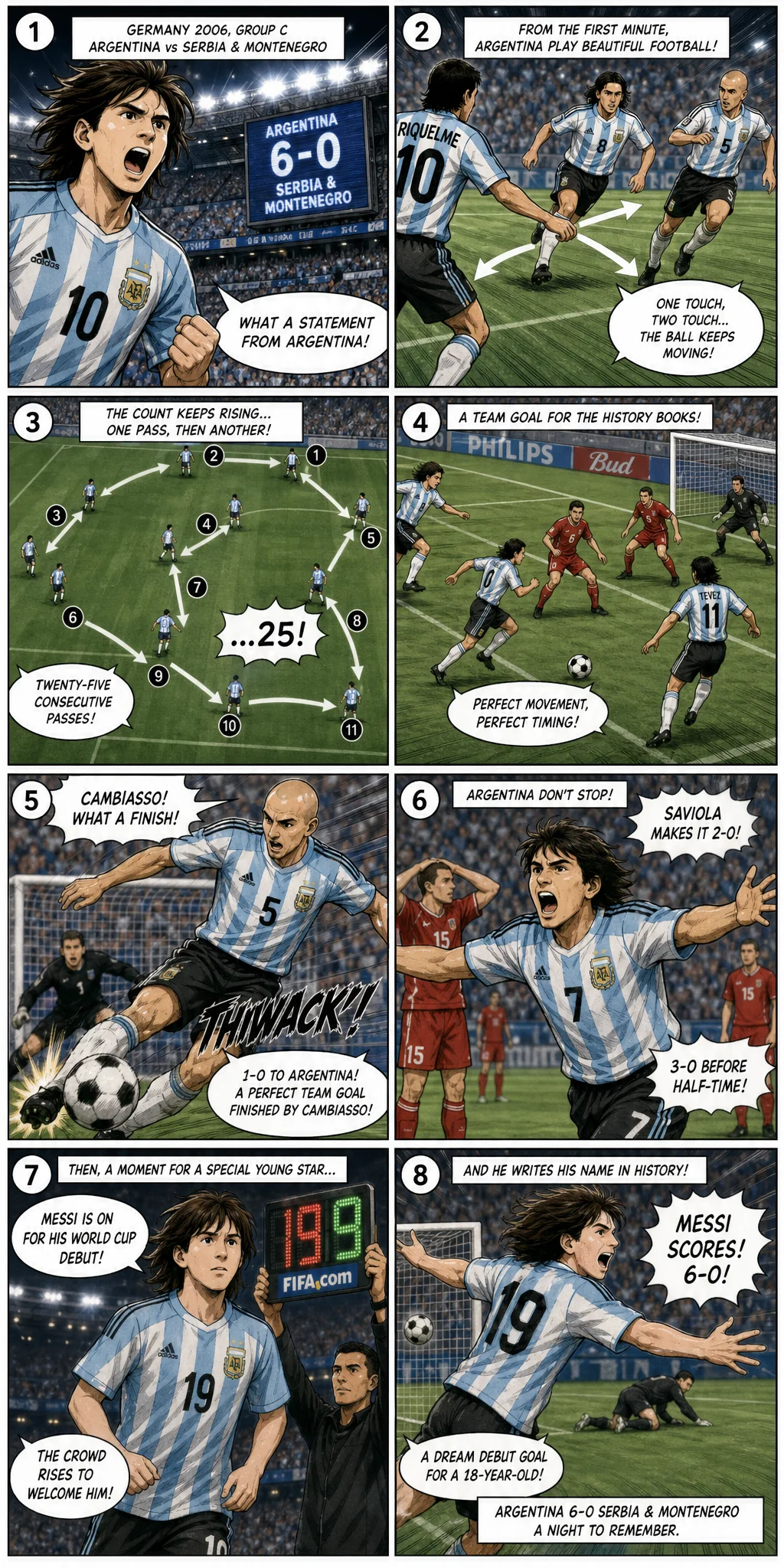
Comic content and match statistics are for entertainment purposes only and may contain inaccuracies. For Accurate Data, please refer to the reference's official website.
Let me tell you about the 25-pass goal. I know you have seen it. Everyone has seen it. It is the goal that coaching courses show to their students, the goal that YouTube compilations title "The Greatest Team Goal Ever" without fear of contradiction, the goal that made Esteban Cambiasso — a defensive midfielder whose job was to destroy, not create — the scorer of the most beautiful team goal in World Cup history. But watching it on a screen does not tell you what it felt like to be in the stadium when it happened. I was there. I was in the Olympiastadion in Gelsenkirchen on June 16th, 2006, and I am here to tell you that the 25-pass goal was not just a goal. It was a religious experience.
Argentina versus Serbia and Montenegro. Group stage. The match that would produce a 6-0 scoreline, Lionel Messi's World Cup debut, and the goal that redefined what collective football could look like. But let me start with the context, because the context matters. Argentina had arrived in Germany with a squad that looked, on paper, like a tournament winner. José Pekerman, the professorial manager who wore glasses and spoke in complete paragraphs, had built a team around Juan Román Riquelme — the last of the great enganches, a playmaker who treated the ball like a precious object that he was merely borrowing. Up front, Hernán Crespo and Javier Saviola. In midfield, Cambiasso and Maxi Rodríguez and Lucho González. In defence, Roberto Ayala and Gabriel Heinze and Juan Pablo Sorín. It was a team of serious footballers playing serious football, and they had opened their campaign with a workmanlike 2-1 victory over Ivory Coast that had not quite satisfied the Argentine press — which, like the Italian press, treats anything less than perfection as evidence of systemic failure.
Serbia and Montenegro were a team in name only. The country that had sent them no longer existed — Montenegro had voted for independence three weeks before the tournament began — and the squad was playing for a flag that was already obsolete. Their qualification campaign had been extraordinary — they had conceded only one goal in ten matches, the best defensive record in European qualifying. But they had arrived in Germany fractured, demoralized, a political entity playing football for a nation that had dissolved beneath their feet. Their opening match, a 1-0 defeat to the Netherlands, had been competitive. The Argentina match would not be.
The first half was a 3-0 procession. Maxi Rodríguez scored early. Cambiasso added a second — but not the second, not the goal, not yet. Crespo scored a third after Riquelme's pass had dissected the Serbian defence with the precision of a surgeon's scalpel. Serbia were reduced to ten men. The match was over as a contest. And then came the 31st minute of the second half, and the goal that changed everything.
It started with Riquelme, because everything started with Riquelme. He received the ball in midfield, turned away from pressure with that languid, almost sleepy movement that defined his game — Riquelme never hurried, he only arrived — and played a simple pass to Sorín on the left. The pass was nothing special. But the pass was the first of twenty-five, and the first of anything is always special, even if you do not know it yet.
Sorín to Cambiasso. Cambiasso back to Riquelme. Riquelme to Heinze. Heinze to Ayala. Ayala to Sorín. Each pass was simple. Each pass was correct. Each pass was a single note in a symphony that no one in the stadium yet recognized as music. The Serbian players — exhausted, demoralized, reduced to ten men — chased shadows. The ball moved like a rumor through a small town. You could hear it from everywhere, but you could never quite see who was spreading it.
Riquelme to Cambiasso again. The pass was slightly behind him, as if Riquelme was checking whether his teammate was paying attention. Cambiasso controlled it with his left foot, turned, and found Saviola. Saviola — the little rabbit, as he was known, all quick feet and quicker thoughts — played a one-touch pass to Riquelme. We were at perhaps fifteen passes now. The crowd was beginning to murmur, that low, expectant hum that fills a stadium when the spectators realize something extraordinary is happening and no one wants to be the first to say it aloud.
Riquelme to Crespo. Crespo's backheel. This is the moment, if you watch the replay — which I assume you will, because you are human and the goal is beautiful — where the move shifts from a passing sequence to a work of art. Crespo received the ball with his back to goal, a central defender draped over him like a heavy coat, and backheeled it into the space behind him without looking, without thinking, without any apparent effort at all. The pass was delivered with the casual elegance of a man passing salt at a dinner table. It was not a pass. It was a statement about what football could be.
Cambiasso arrived. The ball was there, exactly where Crespo's backheel had said it would be, and Cambiasso struck it first time. A left-footed shot, clean, true, unstoppable. It flew past Dragoslav Jevric in the Serbian goal before Jevric had even registered that a shot was possible. The net billowed. The stadium — which had been holding its breath, collectively, for the entire duration of those twenty-five passes — exhaled. 4-0. The goal. The goal.
I have watched the video of that goal more times than I can count, and what strikes me every time is not the finish. Cambiasso's shot was excellent, but excellent shots happen every weekend. What strikes me is the geometry of it. The way the passes moved the Serbian defence from side to side, stretching them, pulling them apart, creating a gap that was not there before and would not be there again. The 25-pass goal was not improvisation. It was architecture. Pekerman's Argentina had built a structure, pass by pass, that the Serbians could not perceive and could not prevent. The goal was the inevitable conclusion of a process that had been designed to produce exactly this outcome.
The scoring was not finished. The scoring was never going to be finished. Carlos Tévez, who had come on as a substitute, scored Argentina's fifth with a solo run that would have been the highlight of any other match. And then — and this is where the historical significance of the match truly lives — a nineteen-year-old named Lionel Messi came off the bench for his World Cup debut. He wore the number 19 shirt. His hair was longer then, his shoulders narrower, his face still carrying the softness of adolescence. He played twenty minutes. He scored Argentina's sixth goal — a tap-in from a Tévez cross, not a goal anyone would remember if the scorer had been anyone else. He was booked for handball. A goal, a yellow card, and the first chapter of the most significant World Cup career in the history of the sport. Not a bad twenty minutes' work.
The final score was 6-0. Serbia and Montenegro walked off the pitch having been dismantled — not defeated, dismantled — by a team playing football from a different dimension. The country they represented formally ceased to exist two weeks later, when Montenegro's independence took full effect. The match was their last as a unified nation. It was not the farewell they wanted. It was the farewell football, in its infinite capacity for cruelty and beauty, gave them.
I walked out of the Olympiastadion that night into the German summer twilight, my head still full of that goal, still replaying the passes, still trying to understand how twenty-five separate moments of contact could combine into something that felt like a single continuous motion. The Argentine fans were celebrating in the streets, their blue and white shirts luminous in the fading light. Somewhere, a drum was playing. Somewhere, the 25-pass goal was already becoming legend.
Argentina would be eliminated by Germany in the quarterfinals, on penalties, after Pekerman made substitutions that have been debated ever since. Messi would watch from the bench — that same bench from which he had risen to score his first World Cup goal — as his team went out. The 2006 World Cup was not Argentina's tournament. But it was the tournament that gave us the greatest team goal ever scored, and the first glimpse of the player who would, sixteen years later, finally deliver the trophy that had eluded him for so long. The 25 passes were beautiful. The teenager was prophecy.