

Spain 7-0 Costa Rica: 2022 World Cup, 1,000 Passes Zero Shots
A thousand passes. Let that number sit with you for a moment. One thousand completed passes in ninety minutes of World Cup football. I have spent more than a decade covering this sport — in stadiums, press boxes, and the kind of Italian bars where th
Published: June 6, 2026
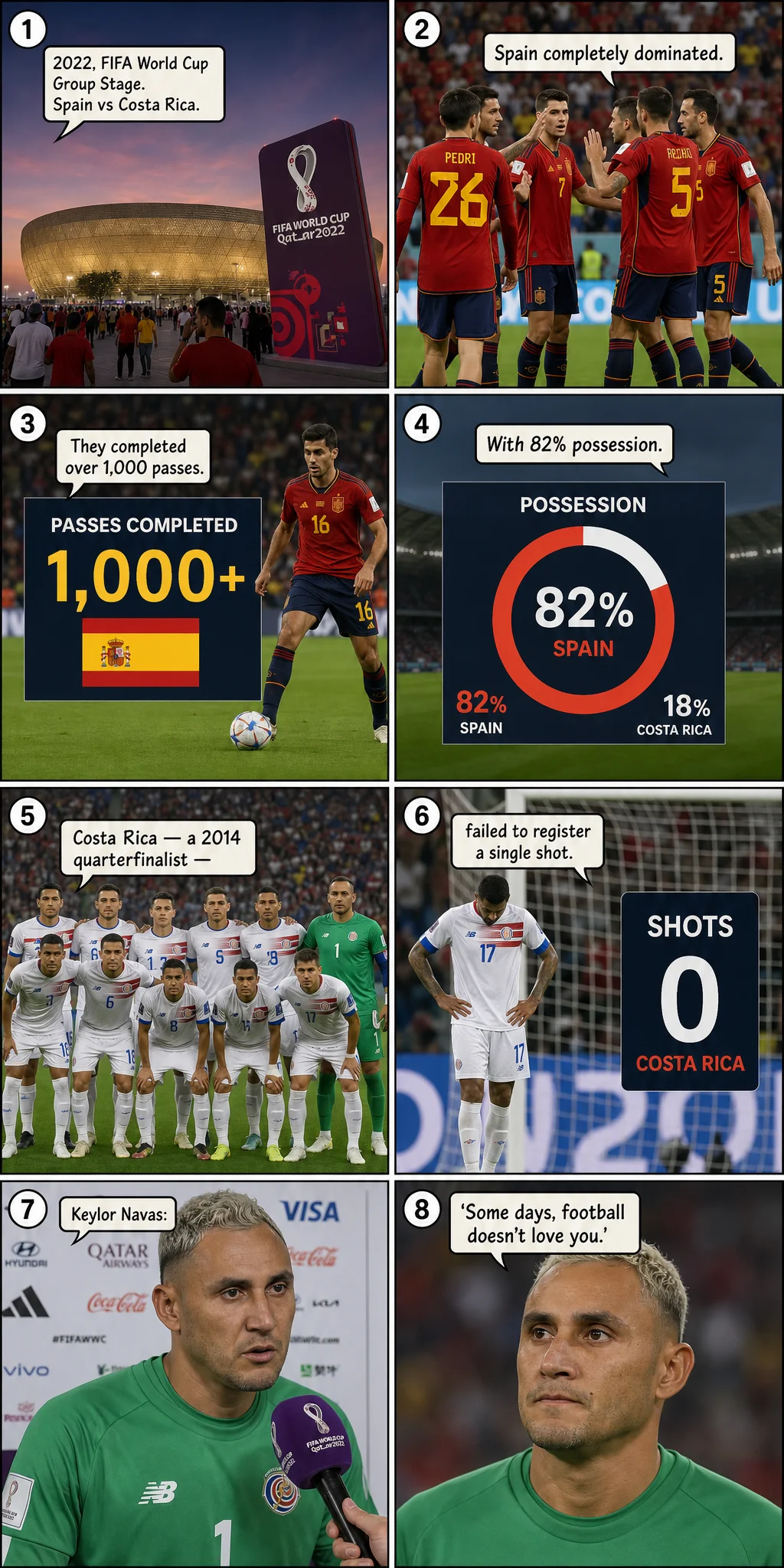
Comic content and match statistics are for entertainment purposes only and may contain inaccuracies. For Accurate Data, please refer to the reference's official website.
A thousand passes. Let that number sit with you for a moment. One thousand completed passes in ninety minutes of World Cup football. I have spent more than a decade covering this sport — in stadiums, press boxes, and the kind of Italian bars where the barman argues about 4-3-3 versus 4-2-3-1 as if the fate of the republic depended on it — and I have never seen anything like Spain's 7-0 demolition of Costa Rica at the 2022 World Cup. It was not a match. It was a lecture. A masterclass. A demonstration of possession football so complete, so total, so absurdly one-sided that by the final whistle the Costa Rican players looked less like defeated opponents and more like students who had just sat through the longest seminar of their lives.
I watched this match in a hotel bar in Doha, surrounded by journalists from a dozen different countries, all of us scribbling notes that kept circling back to the same impossible number. A thousand passes. Costa Rica had zero shots. Not one. No attempts on goal. No wayward efforts from thirty yards. No headers over the bar from set pieces. Nothing. Zero. The null set. In a World Cup match, at the highest level of the sport, one team had the ball for seventy-five percent of the match and the other team — they never threatened once.
The context matters, as it always does. Spain arrived in Qatar carrying the weight of recent disappointments. The 2018 World Cup had been a disaster — Julen Lopetegui sacked on the eve of the tournament, the federation in chaos, elimination by Russia on penalties in the round of sixteen. Euro 2020 had been better but not triumphant — a semifinal exit to Italy on penalties, the cruel lottery that Spain seemed perpetually destined to lose. Luis Enrique, the manager, had spent the intervening years trying to rebuild while fending off questions about his tactics, his personality, and his decision to stream on Twitch during the tournament. He was the most interesting manager at the World Cup — a man who treated press conferences as performance art — and his team reflected his personality: intense, uncompromising, occasionally baffling.
Costa Rica arrived as the last team anyone expected to make a World Cup. They had qualified through the intercontinental playoff, beating New Zealand 1-0 in a match that might as well have been played on a different planet from this one. Keylor Navas, their goalkeeper, was thirty-five years old and still carrying the glow of three Champions League titles with Real Madrid. He was the last surviving link to the 2014 team that had reached the quarterfinals — the team of Bryan Ruiz and Celso Borges and the miracle of Fortaleza. This Costa Rica was not that Costa Rica. This Costa Rica was old, slow, and fatally exposed to the kind of football Spain were about to unleash.
The match began, and within ten minutes the pattern was established: Spain had the ball, Costa Rica did not, and this arrangement would continue for the next eighty minutes without interruption. The Spanish midfield — Sergio Busquets, Pedri, Gavi — passed the ball among themselves with the relaxed confidence of friends sharing gossip. Busquets, at thirty-four, was the old master, the man who had been doing this since 2010, the last active member of the golden generation. Pedri was nineteen. Gavi was eighteen. Together, the three of them formed a generational sandwich — past, present, and future occupying the same midfield, playing the same patterns, connected by a philosophy that had been passed down like a family recipe.
The first goal came in the 11th minute. Dani Olmo, the RB Leipzig forward who plays with the jittery intensity of a man who has consumed too much coffee, collected a pass from Gavi, turned, and finished past Navas with a shot that was more precise than powerful. 1-0. The second goal came ten minutes later. Marco Asensio, the Real Madrid enigma who has spent his career being described as "promising" until the word lost all meaning, scored from a Jordi Alba cross. 2-0. Ferran Torres scored a penalty. 3-0. Torres scored again. 4-0. The goals came at intervals so regular they felt like train departures.
And still the passes accumulated. Busquets to Pedri. Pedri to Gavi. Gavi back to Busquets. The ball moved in triangles, diamonds, patterns that seemed to exist in four dimensions. Costa Rica chased shadows. Their midfielders — Celso Borges, Yeltsin Tejeda, names that had carried them through CONCACAF qualification — looked like men who had been asked to catch smoke with their bare hands. Every time a Costa Rican player thought the ball was within reach, it had already gone somewhere else.
Gavi scored the fifth goal, a volley from the edge of the box that flew past Navas like a small meteor. He was eighteen years and 110 days old, the youngest World Cup goalscorer since Pelé in 1958. Let that comparison breathe for a moment. Gavi is not Pelé. No one is Pelé. But there was something about the way he celebrated that goal — the unself-conscious joy, the sprint to the corner flag, the arms spread wide — that reminded you football is still, at its core, a game played by young people who love it. The cynicism comes later. The contracts, the agents, the Instagram posts. At eighteen, it is still just joy.
Carlos Soler, a substitute, scored the sixth. Álvaro Morata — another substitute, another player who has spent his career being described in terms of what he is not rather than what he is — scored the seventh. The goals were almost beside the point by then. The point was the passes. The point was the possession. The point was the zero in Costa Rica's shots column, a zero so complete it felt like a philosophical statement. In a sport where even the weakest teams usually manage an optimistic effort from distance, a hopeful header from a set piece, Costa Rica had produced nothing. Null.
The final statistics were absurd. Spain: 1,043 passes completed. Costa Rica: 165 passes attempted. Spain: 81.3 percent possession. Costa Rica: zero shots on target. Zero shots off target. Zero shots of any description. The Spanish goalkeeper, Unai Simón, could have brought a deckchair and a novel. He touched the ball fewer times than the ball boys.
I sat in that Doha hotel bar after the final whistle and listened to the arguments that always follow a performance like this. Was it beautiful or boring? Dominance or tedium? Possession as art or possession as neurosis? A journalist from Argentina — where football is treated as an extension of the national soul rather than a sporting competition — declared that Spain had "sterilised" the match. A German colleague countered that it was the purest expression of a footballing philosophy he had ever witnessed. I said nothing. I was still thinking about the zero.
Here is the thing about Spain's 7-0 that the post-match analysis mostly missed. It was not a statement of intent. It was a statement of identity. Luis Enrique's Spain knew exactly what they were — a possession team in an era that had supposedly rendered possession obsolete. The 2014 demolition by the Netherlands, the 2018 chaos against Russia, the 2021 semifinal defeat to Italy — all of those results had been used as evidence that tiki-taka was dead, that the future belonged to transition, to pressing, to verticality. And yet here was Spain, in 2022, passing the ball a thousand times in a World Cup match and daring the rest of the world to do something about it.
Of course, the story has a second act, and the second act matters. Spain were eliminated by Morocco in the round of sixteen, on penalties, after 120 minutes of possession that produced exactly zero goals. The same system that completed 1,043 passes against Costa Rica was rendered harmless by Morocco's counter-attacking organization. The 7-0 was the peak. The Morocco defeat was the valley. And the two results, considered together, tell you something important about football: possession without penetration is the most beautiful form of failure the sport has to offer. You can pass a team into submission, but you cannot pass a team into elimination. Sooner or later, you have to score. Spain forgot that against Morocco. They remembered it against Costa Rica. The tragedy — and the beauty — of Luis Enrique's Spain is that they could not decide which version of themselves they wanted to be.