

Scotland 1-0 Haiti: McGinn Ends Thirty-Year Wait
Scotland won their first World Cup match in 30 years, beating Haiti 1-0 at Gillette Stadium. John McGinn scored the only goal in the 28th minute, sweeping home after Che Adams shot was deflected. Scotland controlled through a disciplined mid-block, holding Haiti to 0.8 xG.
Published: June 14, 2026
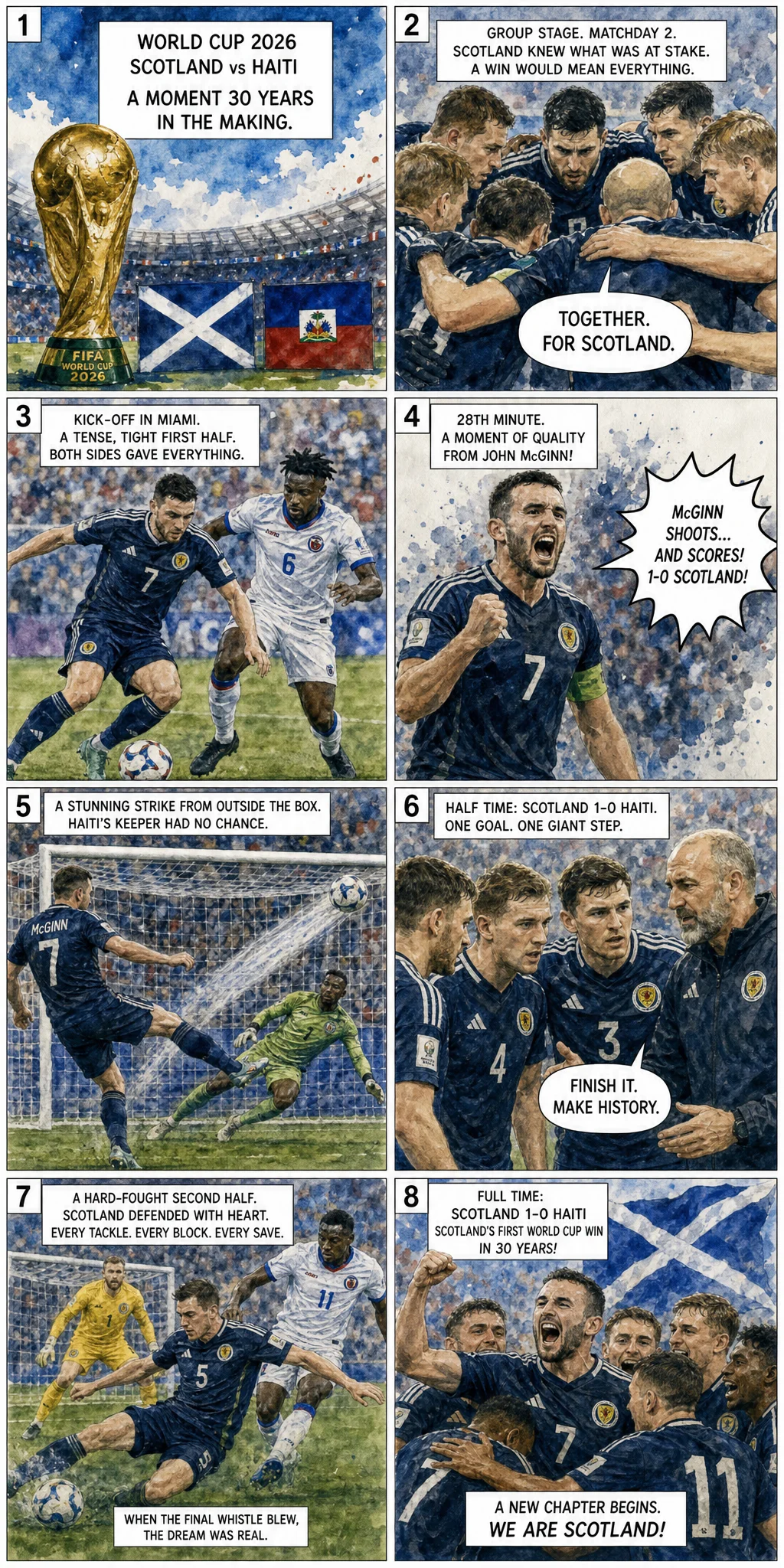
Comic content and match statistics are for entertainment purposes only and may contain inaccuracies. For Accurate Data, please refer to the reference's official website.
Scotland 1-0 Haiti: McGinn's Finish, Clarke's Foundation, and a Thirty-Year Wait Ended
The most instructive moment at Gillette Stadium was not John McGinn's 28th-minute goal — a bundled finish from a Che Adams shot that struck a defender and fell kindly — but the 15 minutes that preceded it. Haiti, ranked 87th in the world and making their first World Cup appearance since 1974, opened the match not with deference to their European opponents but with a structured pressing sequence that forced Scotland into three turnovers in their own defensive third inside the opening five minutes. The message was clear: Scotland's thirty-year absence from this stage would not end with a gentle reintroduction.
Steve Clarke's side survived that opening barrage. More importantly, they absorbed its tactical lesson. What followed was a performance that will not feature in any coaching manual's chapter on aesthetic football, but which deserves careful study in its chapter on tournament pragmatism — the art of winning a match you cannot afford to lose, against an opponent whose weaknesses are more structural than individual.
Haiti's Press and Its Structural Cost
Haiti's coach, Sebastien Migne, had clearly identified Scotland's build-up as vulnerable. Clarke's preferred 3-4-2-1 shape relies on the wide centre-backs — Kieran Tierney on the left, in particular — to progress the ball into midfield. Haiti's front two of Frantzdy Pierrot and Duckens Nazon were instructed to split their pressing angles: Pierrot would arc his run to block the pass to Tierney, while Nazon would press the ball-side centre-back directly. The system was designed to funnel Scotland's build-up toward the centre, where Haiti's midfield three could compress and win the ball.
For 15 minutes, it worked precisely as designed. Scotland completed only 62% of their passes in that opening period. Grant Hanley, the central centre-back, was forced into five clearances — an unusually high number that reflected not aerial bombardment but the absence of safe passing options. Haiti won the ball in Scotland's half four times. They converted none of those regains into shots on target, and therein lay the fundamental problem: their pressing structure was of a higher tactical quality than their attacking execution. Haiti could disrupt Scotland. They could not hurt them.
Scotland's Adjustment: The Long Diagonal as Escape Valve
Clarke's response to Haiti's press was not to change shape — the 3-4-2-1 remained — but to change the primary means of progression. From the 20th minute onward, Scotland's centre-backs began bypassing Haiti's midfield press entirely, launching diagonals toward the wing-backs — particularly Andy Robertson on the left — who were positioned high and wide against Haiti's back four.
The shift was simple but effective. By receiving the ball 40 yards from goal rather than 70, Robertson and Anthony Ralston eliminated Haiti's midfield from the defensive equation. Scotland's pass completion rate rose from 62% in the opening 20 minutes to 78% for the remainder of the half. The goal, when it came, followed this pattern: a diagonal to Robertson, a cut-back to the edge of the area, Che Adams' shot deflected, and McGinn — arriving late into the box with the timing of a player who has scored 16 international goals by being in the right place at the right time — swept the rebound home.
The finish was scrappy. The pattern that produced it was not.
Scotland's Mid-Block and the Art of Containing Chaos
Scotland's defensive structure after taking the lead was a masterclass in mid-block discipline — less glamorous than the goal, but arguably more important to the result. Clarke's side dropped into a compact 5-3-2 shape without the ball, with the two strikers — Adams and McGinn — positioned not to press the centre-backs but to block passing lanes into central midfield. The objective was clear: force Haiti wide, where Scotland's wing-backs and outside centre-backs could engage in one-on-one defending.
Haiti took the bait. In the second half, they attempted 18 crosses from open play. They completed three. Scotland's back three of Hanley, Tierney, and Ryan Porteous won nine of 12 aerial duels between them. Haiti's most dangerous attacking player, Nazon, was reduced to shots from distance — two from outside the box, both off target — as Scotland's defensive structure funnelled him into areas where the probability of scoring was low.
The expected goals data told a story of Scottish control disguised as Haitian pressure. Haiti's 0.8 xG came from 14 shots, an average of 0.06 per attempt — the kind of shot quality that top-tier defences are designed to concede. Scotland's 1.2 xG came from nine shots, a healthier 0.13 average, reflecting better chance quality despite fewer attempts.
The Tactical Significance for Group C
This result reshapes Group C in a way that the 1-0 scoreline alone does not capture. Brazil and Morocco — who played out a 1-1 draw earlier — will have watched Scotland's performance with particular interest. Clarke's side showed not the swashbuckling football of the 1970s Scottish teams but something perhaps more useful in a tournament context: structural coherence.
The Scotland that waited 30 years to return to the World Cup is not the Scotland that will trouble the latter stages of this tournament. But they are a Scotland that understands exactly who they are: a side that can absorb pressure, defend set-pieces, win aerial duels, and score from the patterns they have rehearsed. Against Haiti, that was enough. Against Brazil, it will not be. But three points from the opening match — and a clean sheet — changes the arithmetic of Group C qualification in Clarke's favour.
For Haiti, the tactical analysis of this performance will be kinder than the scoreline. Migne has constructed a pressing system that troubled a European quarter-finalist. The gap between Haiti's defensive organization and attacking execution is not a gap of effort or intent — it is a gap of individual quality at the highest level, and it is the hardest gap to close. Haiti will not advance from Group C, but they have already demonstrated that their presence in this tournament is not a historical curiosity. They came to compete. They competed. And Scotland, for all their control, knew they had been in a contest.
Thirty years after their last World Cup appearance, Scotland have their first victory. It was not beautiful. It was necessary. And in tournament football, those two qualities are often the same thing.