

Australia 2-0 Turkiye: Irankunda and Metcalfe Stun Turkiye in Vancouver
Australia pulled off a surprise 2-0 victory over Turkiye at BC Place. Nestory Irankunda scored a stunning solo goal in the 27th minute and Connor Metcalfe added a long-range strike in the 75th. Turkiye had 30 shots and 1.8 xG but were denied by goalkeeper Patrick Beach.
Published: June 14, 2026
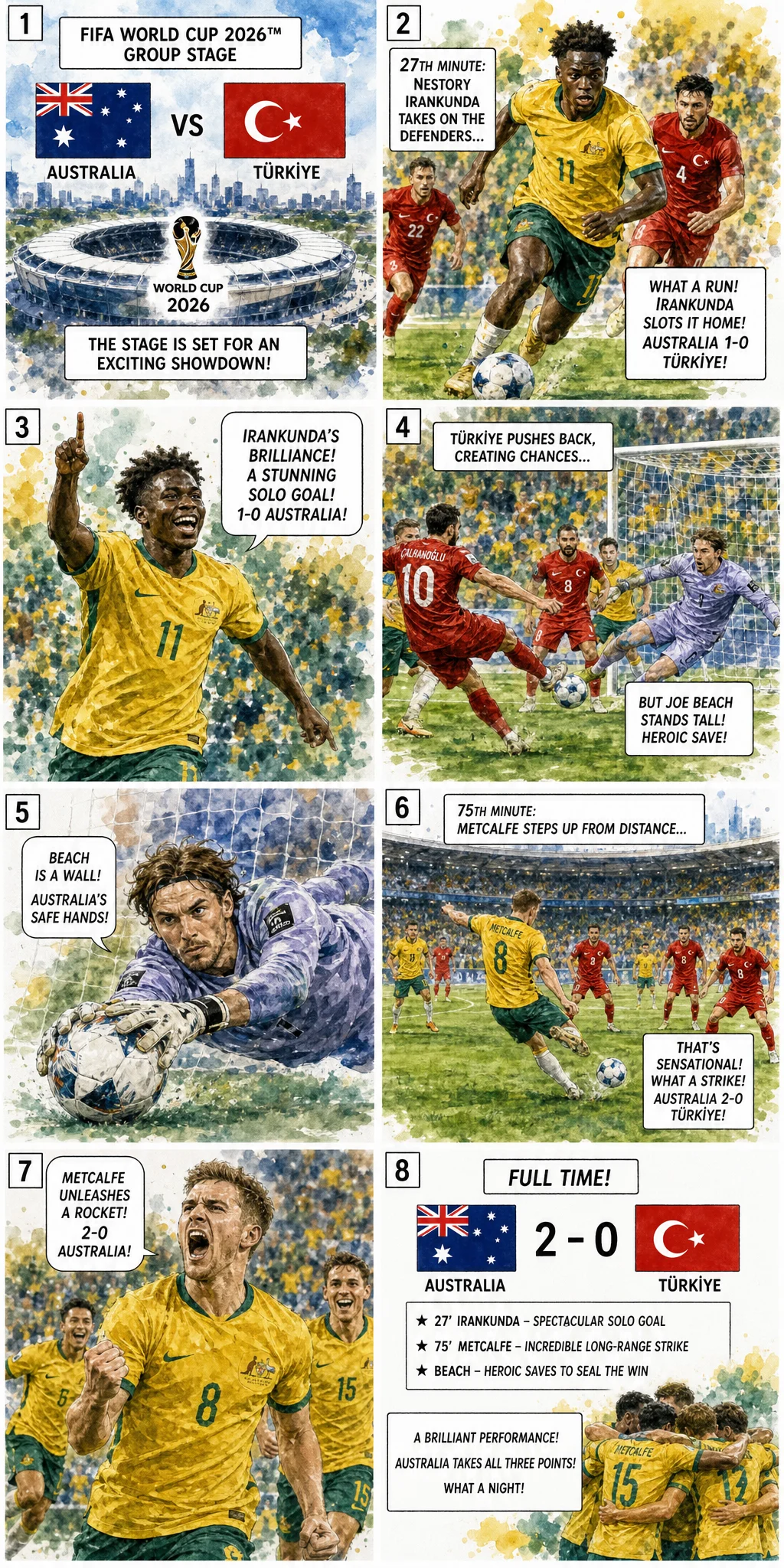
Comic content and match statistics are for entertainment purposes only and may contain inaccuracies. For Accurate Data, please refer to the reference's official website.
Australia 2-0 Türkiye: Irankunda's Arrival and the Socceroos' Blueprint
The most revealing statistic from BC Place was not the 30 shots Türkiye fired, nor the 30,000 Turkish supporters who transformed Vancouver into a distant suburb of Istanbul. It was this: Australia completed 13 tackles in their own defensive third — more than any team in the tournament so far — and converted their two clear chances with the cold efficiency of a side that had long accepted they would not see much of the ball. The Socceroos did not outplay Türkiye. They out-waited them.
Graham Arnold's tactical plan was, in its broad strokes, the same blueprint that carried Australia to the round of sixteen in Qatar four years earlier: a compact 4-4-2 mid-block that conceded possession, denied central penetration, and sprang forward through the pace of Nestory Irankunda on the break. Against a Türkiye side managed by Vincenzo Montella — whose attacking talent, headlined by Arda Güler and Hakan Çalhanoğlu, is among the most technically gifted in the tournament — the plan was a calculated gamble. It paid with compound interest.
The Mid-Block That Swallowed Istanbul
Australia's defensive shape without the ball was a 4-4-2 that functioned as a 4-5-1 in practice, with Riley McGree tucking inside from the left to form a tertiary midfield line alongside Jackson Irvine and Connor Metcalfe. The objective was not to press Türkiye's centre-backs — Montella's side are too technically proficient to be troubled by an Australian high press — but to deny Güler and Çalhanoğlu the half-spaces where they are most dangerous.
The execution was close to flawless. Güler, the Real Madrid playmaker whose left foot is among the most valuable commodities in world football, received the ball 47 times in the first half — but only four of those receptions occurred between the lines in the final third. Australia's midfield three of Irvine, Metcalfe, and the disciplined McGree formed a shifting screen that funnelled Türkiye's possession wide, where Australia's full-backs — Aziz Behich and Nathaniel Atkinson — were positioned to engage.
Montella's response was to push his full-backs — Ferdi Kadıoğlu and Zeki Çelik — higher, creating a 2-3-5 shape in possession that overloaded Australia's defensive line. The pressure was immense. Türkiye amassed 1.8 expected goals from 30 shots. But the quality of those chances, when examined individually, tells a more nuanced story. Of the 30 attempts, 14 came from outside the penalty area. Eight were blocked before reaching Patrick Beach. The underlying numbers reflected a defence that, while conceding territory, was conceding precisely the kinds of shots it was designed to concede.
Irankunda: The Counter-Attack as Art Form
The goal that gave Australia the lead in the 27th minute was a counter-attack so pure in its geometry that it could serve as a coaching manual diagram. A Çalhanoğlu free-kick from 25 yards struck the Australian wall. The rebound fell to Metcalfe, who played a first-time pass down the right channel. Irankunda, starting from his own half, gathered the ball at full stride, cut inside past Çelik — who had pushed high and was caught in transition — and drove toward the penalty area.
What happened next was not a pass. It was a statement. Irankunda shaped to shoot, drew three Turkish defenders toward him, and kept running. By the time he released the ball past Uğurcan Çakır and into the far corner, he had carried it 60 metres, beaten four defenders, and delivered Australia's first shot on target of the match. The goal was worth 0.24 xG — a low-probability chance converted through individual brilliance and the structural disorganisation that Türkiye's high line creates when possession is lost in central areas.
Irankunda, the 19-year-old Bayern Munich winger who chose Australia over his birth nation of Burundi, had arrived on the World Cup stage with the kind of moment that defines careers. Arnold had gambled on starting him ahead of the more experienced Craig Goodwin. The goal was the justification.
Metcalfe and the Visible Hand of Structure
Australia's second goal, in the 75th minute, was structurally instructive in a different way. It began not with a transition but with a period of sustained possession — a rarity for Australia on this night — that lasted 14 passes and drew Türkiye's defensive block higher up the pitch. When the ball was worked to Metcalfe on the edge of the area, the St. Pauli midfielder had time to look up, set himself, and strike.
The shot, from 22 yards, was struck with the instep and bent away from Çakır's dive into the top corner. It was worth 0.04 xG — a goal that, by the numbers, should happen once in every 25 attempts. But the quality of the chance was not in the shot alone. It was in the sequence that preceded it: Australia's patience, the rotation of Irvine and McGree to create the passing lane, the discipline of the back four holding their line. This was not a counter-attack. This was construction — and it was, in its own way, as significant as the Irankunda goal.
The Implications for Group D
Australia's victory, combined with the United States' 4-1 dismantling of Paraguay in their opener, reshapes the arithmetic of Group D in a way few predicted. The Socceroos and the host nation sit joint top with three points and favourable goal differences, while Türkiye — the group's second-ranked side — and Paraguay occupy the bottom two positions.
For Australia, the path to the knockout stage is now mathematically straightforward: a draw against the United States in their second group match would leave them needing only a point from their final fixture against Paraguay. Arnold's side have given themselves the luxury of a buffer, and in a tournament format where third-place qualification introduces layers of strategic complexity, the value of securing points early cannot be overstated.
For Türkiye, this result is a tactical warning dressed as a statistical anomaly. Thirty shots, 1.8 xG, and no goals represents the kind of finishing variance that analytics departments file under "low-probability negative outcomes." But the deeper concern is structural: Montella's high defensive line was repeatedly exposed by Irankunda's pace, and the full-backs' attacking positioning left gaps that a more clinical side than Australia might have exploited even more ruthlessly. Türkiye face Paraguay next in a match that has, after this result, taken on the quality of a must-win.
The night at BC Place belonged to Australia. Not because they were the better side. By almost every measure other than the scoreboard, they were not. But Arnold's Socceroos have perfected the art of winning while being outplayed — a skill that is undervalued in tactical analysis and invaluable in tournament football.