

Czechia 1-1 South Africa: Sadilek Strike, Mokoena Penalty, Both Alive
Czechia 1-1 South Africa. Michal Sadilek scored in the 6th minute before Teboho Mokoena converted an 83rd-minute penalty after a Pavel Sulc handball. Both teams earned their first Group A point after opening defeats.
Published: June 18, 2026
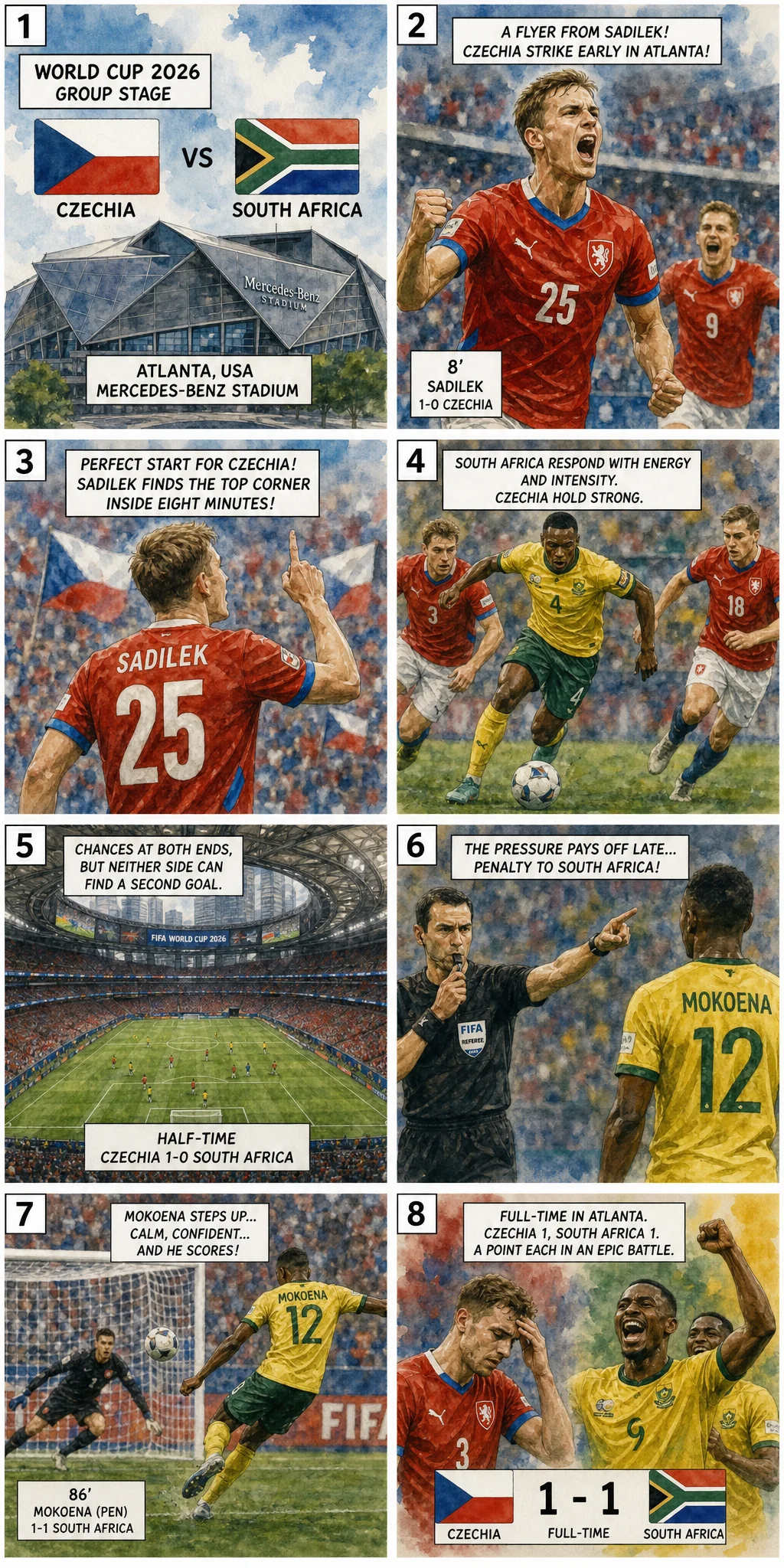
Comic content and match statistics are for entertainment purposes only and may contain inaccuracies. For Accurate Data, please refer to the reference's official website.
# Czechia 1-1 South Africa: Sadílek's Bright Start, Mokoena's Late Penalty, and Two Teams That Refused to Lose
Mercedes-Benz Stadium, Atlanta. A venue built for the choreographed violence of American football, transformed for one humid June evening into a stage upon which two nations attempted to salvage their World Cups. Czechia arrived having lost their opening match to South Korea. South Africa had opened this tournament against Mexico and lost. Both teams understood the stakes without needing to articulate them: defeat meant elimination, a draw meant survival, victory meant resurrection. The score at the final whistle was Czechia 1, South Africa 1. It was a result that satisfied no one and kept everyone alive — the particular cruelty and mercy of tournament football.
The match began with a goal of startling directness. In the sixth minute — the kind of early strike that rearranges tactical plans before they have had time to settle — Czechia took the lead through Michal Sadílek. A long throw-in from the right flank, the kind of weapon that is too often dismissed as unsophisticated by people who have never had to defend against one, was flicked on at the near post. The ball dropped into the six-yard box, and Sadílek — the 27-year-old Twente midfielder whose name is not yet known in every household — arrived to finish with a smart volley past Ronwen Williams. 1-0 Czechia. The goal was Sadílek's first at a World Cup. It felt, even in the moment, like the kind of moment that changes the trajectory of a tournament — and of a career.
For seventy-seven minutes after that goal, Czechia controlled the match in the manner that Ivan Hašek's teams tend to control matches: with possession figures that hovered around sixty percent, with passing sequences that seemed designed to lull the opponent into a state of tactical hypnosis, with a geometry of triangles that was technically proficient and, at times, genuinely difficult to disrupt. Tomáš Souček, the West Ham captain whose running, tackling, and sheer willpower underpinned the entire Czech performance, was immense in central midfield. Patrik Schick, the Bayer Leverkusen striker who had scored in the defeat to South Korea, dropped deep to receive and spun into the penalty area with movements that troubled Williams without ever quite producing the second goal that would have settled the match.
That second goal never arrived. And in tournament football, a 1-0 lead that is not extended is a 1-0 lead that is waiting to be erased.
The equaliser arrived in the eighty-third minute, and it arrived with the particular cruelty that defines sport at this level. A Czech defensive header — intended to clear, executed imperfectly — dropped toward the edge of the penalty area. Pavel Šulc, the Viktoria Plzeň midfielder who had been one of Czechia's most composed performers throughout the first half, raised his arm as he challenged for the loose ball. The contact was minimal. The consequence was maximal. The referee, Tori Penso of the United States, pointed to the spot without hesitation. VAR reviewed. The decision stood. And Teboho Mokoena — the twenty-nine-year-old Mamelodi Sundowns midfielder whose set-piece delivery had been South Africa's most reliable creative outlet throughout the tournament — placed the ball on the penalty spot with the quiet authority of a man who had decided, unequivocally, that he was going to score.
The penalty was struck low and hard to Kovář's left. The goalkeeper dived correctly. The ball was past him before he reached the ground. 1-1. The South African bench emptied onto the touchline with the particular joy of a team that had been staring at elimination and had just been handed a reprieve. The South African supporters behind the goal — a pocket of yellow and green in the vastness of the Mercedes-Benz Stadium — erupted with a sound that contained within it every moment of doubt that had preceded Mokoena's run-up.
The final minutes plus stoppage time produced no winner. Czechia pushed forward with the desperate energy of a team that understood a draw was not enough. South Africa defended with the grim determination of a team that understood a draw was everything. Williams made a save from Schick in the eighty-ninth minute — a sprawling, instinctive stop that preserved the point. The final whistle blew moments later, and both sets of players collapsed onto the grass with the particular exhaustion of men who had given everything and received, in return, precisely one point each.
For Czechia, the result is a point that keeps them alive in Group A ahead of a defining match against Mexico. For South Africa, the result is their first point of the tournament — a foothold in a competition that had seemed to be slipping away. The mathematics of group qualification remain complex for both nations. But mathematics is for later. Tonight, in Atlanta, the story belonged to Sadílek's bright start and Mokoena's late intervention — two midfielders, two moments, two teams that refused to lose.