

Brazil 3-0 Haiti: History rewritten in first-half masterclass
PHILADELPHIA — At Lincoln Financial Field, Brazil did not merely defeat Haiti 3-0 on Thursday night. They rewrote a century of World Cup history, becoming the tournament’s all-time leading scorers…
Published: June 20, 2026
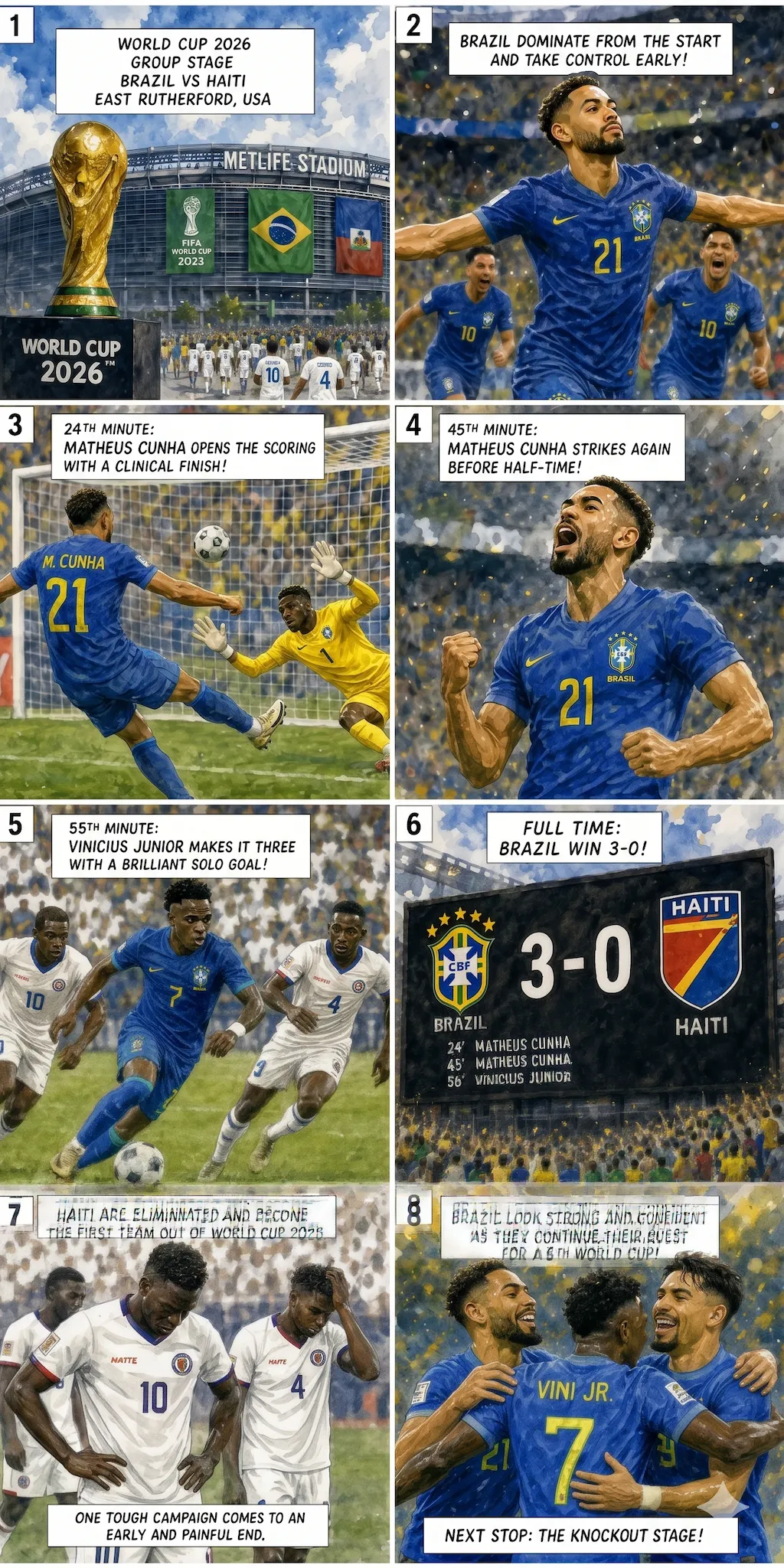
Comic content and match statistics are for entertainment purposes only and may contain inaccuracies. For Accurate Data, please refer to the reference's official website.
# Brazil 3-0 Haiti: History rewritten in first-half masterclass
PHILADELPHIA — At Lincoln Financial Field, Brazil did not merely defeat Haiti 3-0 on Thursday night. They rewrote a century of World Cup history, becoming the tournament’s all-time leading scorers with a first-half masterclass that simultaneously extinguished Haiti’s faint hopes of progression. The 241st goal in Brazil’s storied World Cup career, scored by Vinícius Júnior deep into first-half stoppage time, pushed them past Germany’s previous record of 240, a milestone that felt both inevitable and, given the opposition, somewhat ceremonial. Yet the manner in which it was achieved—three goals inside 30 first-half minutes, two disallowed for offside, and a performance of relentless, suffocating pressure—spoke to a team that treats history as a byproduct of its present ambition.
The match was effectively decided inside the opening 36 minutes, and the architect was Matheus Cunha. The forward, often a supporting cast member in a squad overflowing with galacticos, delivered a performance that will be remembered long after the record books are updated. His first goal, in the 23rd minute, was a study in predatory instinct. Vinícius Júnior, cutting in from the left flank, unleashed a low, driven shot that seemed destined for the far corner. Haiti’s goalkeeper, Johny Placide, got a strong hand to it, parrying the ball into a dangerous central area. Where others might have hesitated, Cunha read the trajectory instantly, arriving ahead of a static Haitian defense to slot the rebound into an empty net from six yards. It was a goal born of movement and anticipation, not power. The Lincoln Financial Field crowd, a sea of yellow and green, erupted—not just for the lead, but for the sense that this was merely the opening act.
Twelve minutes later, the script repeated with a twist. This time, Vinícius Júnior turned provider. Picking up the ball on the left touchline, he drove at Haiti’s right-back, Carlens Arcus, with a feint that left the defender unbalanced. Instead of shooting, Vinícius slid a perfectly weighted pass across the face of the penalty area, finding Cunha in stride. The forward’s first touch was heavy enough to take him away from the nearest defender, but his second was clinical: a left-footed finish that rifled past Placide at the near post. The 36th-minute strike made it 2-0, and it was already clear that Haiti, brave and organized in patches, lacked the defensive structure to contain Brazil’s fluid front line. Cunha’s double was his first World Cup goals, a breakthrough that felt overdue for a player who has often been a bench option behind the likes of Richarlison and Gabriel Jesus.
Brazil’s dominance was not without its frustrations. Raphinha, deployed on the right wing, had two goals disallowed for offside in the first half, both marginal calls that left the Barcelona winger shaking his head. The first, in the 28th minute, came after a sweeping move that saw Lucas Paquetá clip a ball over the top; Raphinha controlled and finished with composure, but the assistant’s flag was raised immediately. The second, just before the half-hour mark, was even tighter—a cross from Danilo that Raphinha headed home, only for VAR to confirm his shoulder was beyond the last defender. On another night, these decisions might have frayed Brazil’s composure. Here, they merely delayed the inevitable.
The third goal arrived in the third minute of first-half stoppage time, and it was the one that will occupy the history books. Paquetá, drifting into the left channel, received a pass from Bruno Guimarães and, with a quick glance up, threaded a through ball into the path of Vinícius Júnior. The Real Madrid forward, who had been Haiti’s tormentor all half, took a touch to steady himself before curling a right-footed shot past Placide and into the far corner. The goal made it 3-0, but its significance extended beyond the scoreline. As the ball crossed the line, Brazil’s all-time World Cup goal tally reached 241, surpassing Germany’s 240. The milestone was announced on the stadium’s big screen, and the Brazilian bench rose as one, acknowledging a record that spans 22 tournaments and includes the exploits of Pelé, Ronaldo, Romário, and Garrincha. For a team that measures its success in titles, this was a statistical coronation.
Haiti, to their credit, did not capitulate. Under the guidance of coach Gabriel Calderón, they had entered the tournament with a clear defensive plan: absorb pressure and hit on the counter. For the first 20 minutes, it worked. They defended deep, with a compact 4-4-1-1 shape, and forced Brazil to work for openings. Midfielder Bryan Alcéus, in particular, was tireless in breaking up play, while forward Duckens Nazon offered a sporadic outlet on the break. But Haiti’s limitations were exposed by the sheer quality of Brazil’s individual actions. Vinícius Júnior’s dribbling, Paquetá’s vision, and Cunha’s finishing were simply too much for a side ranked 86th in the world. The final score, while emphatic, could have been worse: Brazil had 18 shots to Haiti’s three, and only Placide’s reflexes kept the margin from growing.
The second half was a formality. Brazil, content with their three-goal lead and the record, eased off the gas. Manager Tite withdrew Cunha and Vinícius Júnior early in the second period, introducing Gabriel Martinelli and Rodrygo, but the tempo dropped noticeably. Haiti enjoyed their best spell of the match between the 55th and 70th minutes, with Nazon forcing a save from Alisson Becker from 20 yards—the Brazilian goalkeeper’s first meaningful involvement. Yet they never truly threatened a comeback. Brazil’s defense, marshaled by Marquinhos and Éder Militão, remained untroubled, and the midfield trio of Paquetá, Guimarães, and Casemiro controlled possession with surgical precision. The second half was a victory lap, a chance for the Philadelphia crowd to savor the history they had witnessed.
For Haiti, the defeat was not just a setback—it was an elimination. With zero points from two group matches (they lost their opener 2-1 to Portugal), they became the first team mathematically eliminated from the 2026 tournament. It is a harsh reality for a nation that qualified for only its second World Cup, but the statistics tell a story of a team out of its depth at this level. They have now conceded five goals in two matches and scored just once. Their remaining group game against South Korea will be a battle for pride, not progression. “We knew the challenge was massive, but the players gave everything,” Calderón said afterward. “Brazil is a different level. We have to learn from this and grow.”
The narrative, however, belongs to Brazil. Surpassing Germany’s goal record is a testament to the sustained brilliance of a footballing superpower. Germany’s 240 goals came across 20 tournaments; Brazil reached 241 in their 22nd appearance, a rate of nearly 11 goals per tournament. The names that contributed to that tally span generations: Pelé (12 goals), Ronaldo (15), Garrincha (5), Zico (5), Romário (5), and now Vinícius Júnior and Matheus Cunha. The current squad may not yet carry the same aura as the 1970 or 2002 teams, but they are writing their own chapter. With two wins from two in Group H, they have already secured a place in the round of 16, and their attacking fluidity—11 goals in two matches—suggests they are peaking at the right time.
Tite, typically measured, was quick to deflect individual praise. “The record is for all Brazilians, not just this team,” he said. “We are proud to carry on the legacy of those who came before. But we have not won anything yet. The objective is July 19.” The reference to the final date was deliberate: Brazil’s focus is on a seventh World Cup, not a footnote in the record books. Yet the milestone matters. In a tournament where traditional powers like Germany and Argentina have stumbled, Brazil’s efficiency in front of goal—three goals from six shots on target against Haiti—is a warning to the rest of the field.
The match at Lincoln Financial Field will not be remembered as a classic. It was one-sided, clinical, and, for long stretches, predictable. But it contained moments of individual brilliance and a collective achievement that will endure. Matheus Cunha, a player who arrived in Philadelphia with two international goals to his name, left with a brace and a place in history. Vinícius Júnior, the heir to Brazil’s attacking throne, scored the record-breaking goal and assisted two others. And Haiti, the tournament’s first eliminated side, departed with dignity, having conceded only to a team that now stands alone as the most prolific in World Cup history.
The final whistle prompted a subdued celebration from the Brazilian players—a handshake here, a pat on the back there. They know the real work lies ahead. But for a few minutes, as the scoreboard flashed “BRA 3-0 HAI” and the crowd chanted “Brasil, Brasil,” the moment belonged to them. They had come to Philadelphia, scored three goals, and left with a record that may stand for decades. For Haiti, the journey ends here. For Brazil, it is only just beginning.