

Turkiye 0-1 Paraguay: Ten-man Paraguay stuns Turkiye early
SANTA CLARA, Calif. — The 2026 FIFA World Cup will remember Matias Galarza for 65 seconds of brilliance and Miguel Almiron for a moment of madness, as Paraguay held on with 10 men for more than 45…
Published: June 20, 2026
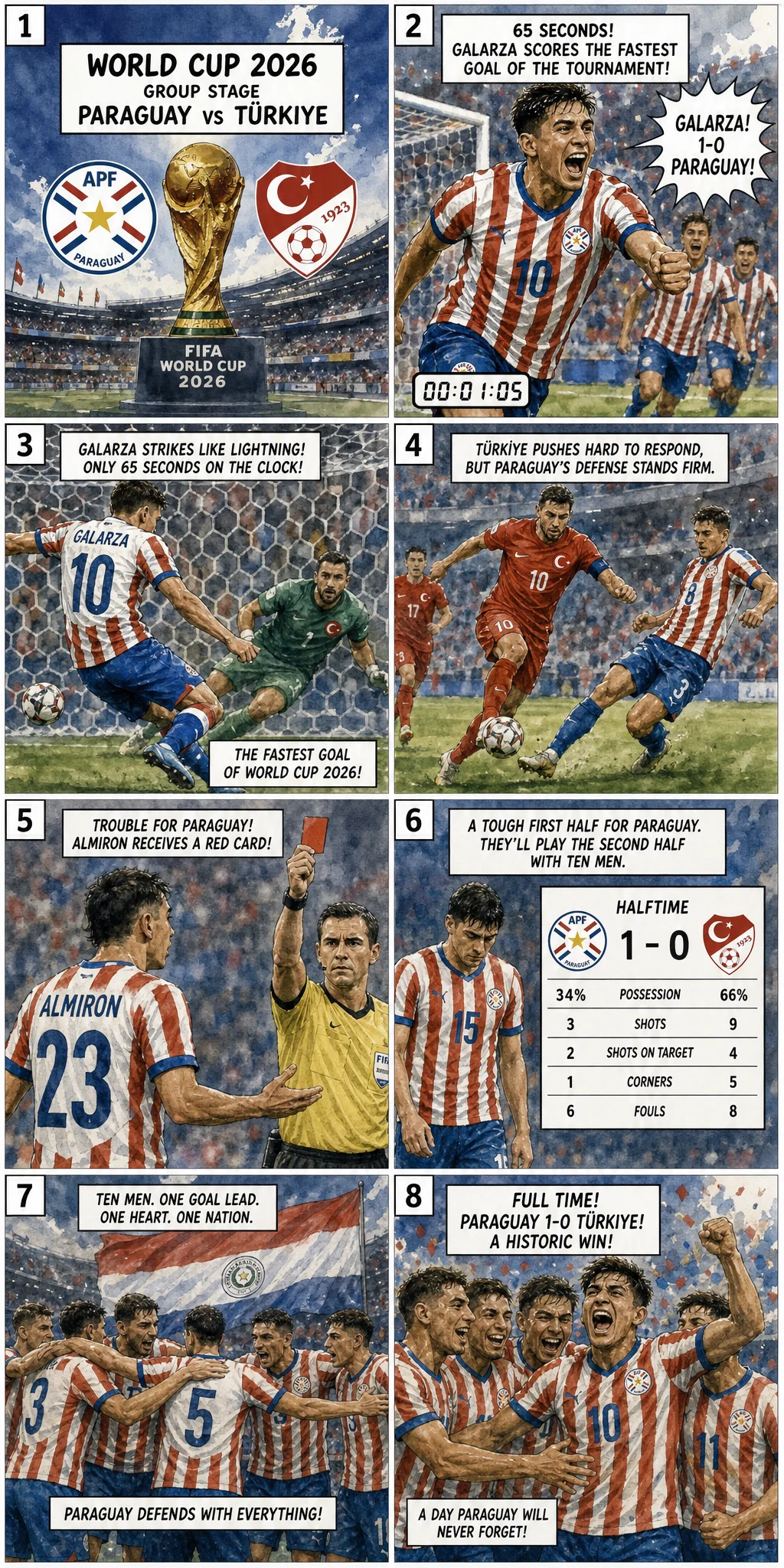
Comic content and match statistics are for entertainment purposes only and may contain inaccuracies. For Accurate Data, please refer to the reference's official website.
# Turkiye 0-1 Paraguay: Ten-man Paraguay stuns Turkiye early
SANTA CLARA, Calif. — The 2026 FIFA World Cup will remember Matias Galarza for 65 seconds of brilliance and Miguel Almiron for a moment of madness, as Paraguay held on with 10 men for more than 45 minutes to eliminate Turkiye 1-0 at Levi’s Stadium on Thursday night. The result sent Turkiye crashing out of the tournament as the second team eliminated, having failed to score in 180 minutes of football, while Paraguay kept their knockout-stage hopes alive with a performance defined by discipline, desperation, and one of the most bizarre red cards in World Cup history.
The match began with a jolt that silenced the majority of the pro-Turkiye crowd inside the cavernous Silicon Valley venue. Just 65 seconds had elapsed when Julio Enciso, Paraguay’s creative fulcrum, collected the ball in midfield and spotted Galarza making a diagonal run from the right flank. Enciso’s pass was precise, weighted perfectly into Galarza’s stride about 20 yards from goal. The 22-year-old midfielder took one touch to steady himself and, with his left foot, struck a low, skimming drive that arrowed past Ugurcan Cakir’s despairing dive and nestled inside the far post. It was the fastest goal of the tournament so far, a clinical finish that stunned a Turkish side that had spent the opening minutes trying to impose themselves. Galarza sprinted to the corner flag, arms outstretched, as his teammates mobbed him. Paraguay had not planned to defend a lead for 88 minutes, but that is exactly what they would be forced to do.
Turkiye responded with the urgency of a side that knew their World Cup was on the line. They had already lost their opening group match without scoring, and another blank would likely spell the end. The first half became a siege. Turkiye’s midfield, led by the creative spark of Arda Guler, began to find pockets of space between Paraguay’s compact lines. Hakan Calhanoglu pulled the strings from deep, spraying passes wide to overlapping full-backs. The chances came in waves. A header from a corner flashed just over the bar. A curling effort from the edge of the box forced Paraguay goalkeeper Orlando Gill into his first save, a routine catch that belied the pressure building. Guler, the 21-year-old playmaker carrying the weight of a nation’s expectations, had two clear opportunities before the interval. The first came after a clever one-two with a striker freed him inside the box, but his left-footed shot lacked conviction and Gill saved with his legs. The second was even more glaring: a cutback from the byline found Guler unmarked 12 yards out, but he hurried his finish and dragged it wide of the post. Each miss was met with groans from the Turkish supporters, who sensed their team’s dominance was not translating into goals.
Then, in first-half stoppage time, the game turned on a decision that will be debated for years. Miguel Almiron, Paraguay’s most experienced attacking player, had been involved in a running battle with Turkish left-back Mert Muldur. The two had clashed several times, with Almiron complaining to the referee about Muldur’s physical approach. In the 45+3 minute, after a tangle near the touchline, the pair squared up. Almiron, his face flushed with frustration, raised his hand to his mouth and appeared to shout something in Muldur’s direction. Under a newly implemented IFAB rule introduced for the 2026 World Cup, covering the mouth during confrontations with opponents or match officials is a straight red-card offense, designed to prevent players from hiding insults or inflammatory language. The referee, after consulting with the fourth official, reached for his back pocket. The red card was shown to Almiron, who stood in disbelief as his teammates surrounded the official. Replays showed his hand had indeed covered his mouth as he spoke to Muldur. It was the first-ever dismissal under this rule in a World Cup match. Paraguay would play the entire second half with 10 men.
The halftime whistle blew moments later, and the Paraguayan coaching staff huddled frantically. They had a lead, but they had lost their most dangerous attacker. The second half was a test of survival. Turkiye, now facing a numerically inferior opponent, threw everything forward. Coach Vincenzo Montella made attacking substitutions, introducing fresh forwards and pushing his full-backs high. The pattern was relentless: Turkiye possessed the ball, probed for openings, and peppered Paraguay’s penalty area with crosses and shots. But Paraguay, under the guidance of coach Daniel Garnero, dropped into a deep 4-4-1 formation, with only a lone striker left upfield. The central defenders, Gustavo Gomez and Junior Alonso, threw their bodies at everything. The midfielders tracked runners with desperate energy.
Orlando Gill, the 24-year-old goalkeeper, became the hero. He made five crucial saves in the second half, each one more vital than the last. The first came early, when a deflected shot from outside the box looped toward the top corner. Gill adjusted his feet and palmed it over the bar. The second was a reaction stop from point-blank range after a Turkish forward had peeled away from his marker at a corner. Gill’s reflexes were sharp, his positioning impeccable. The third save was the pick of the bunch: a powerful, swerving effort from 25 yards that seemed destined for the bottom corner. Gill dove low to his left, got a strong hand to the ball, and pushed it around the post. The Turkish players looked to the sky in frustration. The fourth and fifth saves came in the final 15 minutes, as Turkiye’s desperation grew. A header from a free kick was clawed away from the goal line; a stinging volley was beaten away with two fists. Gill’s performance was a masterclass in concentration and courage.
Turkiye finished the match with 27 shots, a statistic that would normally guarantee goals. But football is not played on spreadsheets. Their finishing was wayward, their decision-making rushed. Guler, who had missed those two first-half chances, grew increasingly frustrated. He dropped deeper to demand the ball, but his final passes often went astray. The Turkish midfield became predictable, recycling possession without incision. Paraguay’s defense, marshaled by the experienced Gomez, read the play superbly. They blocked shots, intercepted crosses, and cleared their lines with a desperation born of necessity. The crowd, initially roaring for Turkiye, grew quieter as the minutes ticked by, the tension palpable.
As the match entered stoppage time, Turkiye launched one final assault. A long ball forward was flicked on, and a Turkish striker spun and shot on the turn. Gill was again equal to it, diving low to his right. The rebound fell to a Turkish midfielder, but his follow-up was blocked by a sliding defender. The ball bounced around the box like a pinball, but Paraguay’s bodies were always in the way. The referee blew the final whistle, and the Paraguayan players collapsed to the turf in exhaustion and joy. They had held on. They had survived.
For Turkiye, the defeat was a crushing end to a campaign that promised so little and delivered even less. They became the second team eliminated from the 2026 World Cup, joining the ignominious list of sides who failed to score a single goal in two group matches. Zero goals in 180 minutes. Two defeats. A plane home. The statistics were brutal: 27 shots, no goals. Five saves from a goalkeeper who had not been a household name before this night. The Turkish players trudged around the pitch in a daze, some falling to their knees, others staring blankly at the stands. Their World Cup was over before the knockout stage had even begun.
Paraguay’s players, meanwhile, formed a huddle near the center circle. Almiron, banished to the dressing room, would later emerge to embrace his teammates on the pitch. His red card could have been a disaster, but his teammates refused to let it define them. Galarza, the goalscorer, was named man of the match, though Gill’s performance was arguably more decisive. The victory was gritty, ugly, and entirely effective. Paraguay had shown that even with 10 men, they could defend a lead with discipline and heart.
The broader implications for the group are now clear. Paraguay, with three points, have given themselves a fighting chance of advancing. Turkiye, with zero points and a goal difference already in the red, are packing their bags. The tournament moves on, but this match will be remembered as a strange, compelling chapter in World Cup history: a goal inside the first minute, a red card under a controversial new rule, and a heroic defensive stand that defied logic. In Santa Clara, under the lights of Levi’s Stadium, Paraguay wrote a story of survival. Turkiye wrote one of what might have been.