

Netherlands 5-1 Sweden: Dutch depth demolishes Sweden
HOUSTON — The Netherlands delivered a statement of intent at the NRG Stadium on Tuesday night, dismantling Sweden 5-1 in a World Cup group-stage performance that blended ruthless efficiency with…
Published: June 20, 2026
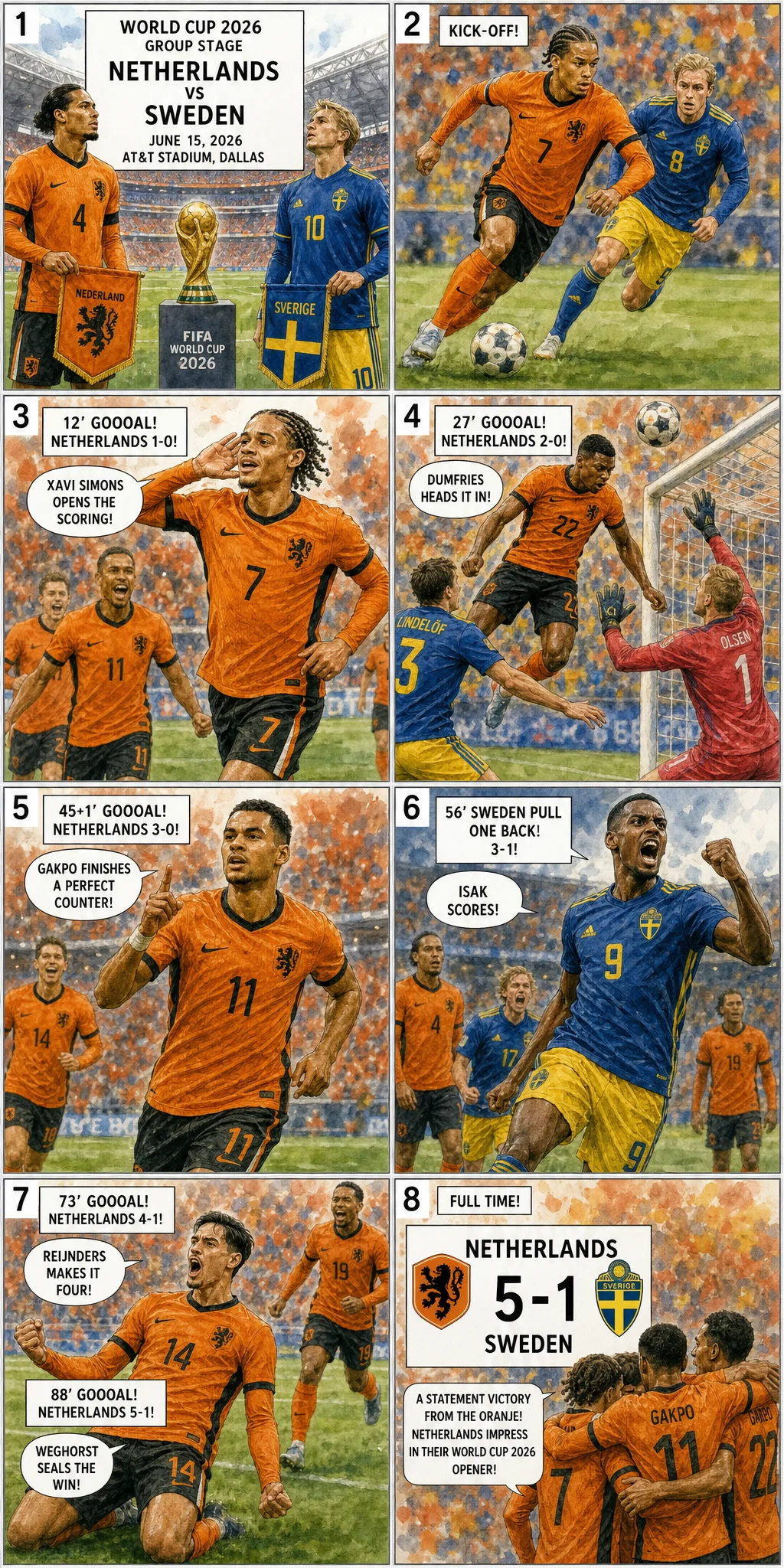
Comic content and match statistics are for entertainment purposes only and may contain inaccuracies. For Accurate Data, please refer to the reference's official website.
# Netherlands 5-1 Sweden: Dutch depth demolishes Sweden
HOUSTON — The Netherlands delivered a statement of intent at the NRG Stadium on Tuesday night, dismantling Sweden 5-1 in a World Cup group-stage performance that blended ruthless efficiency with moments of individual brilliance. Ronald Koeman’s side, buoyed by a first-half brace from Brian Brobbey and a second-half double from Cody Gakpo, never allowed Sweden to settle, turning a potentially tricky fixture into a rout that underscored the depth of talent in the Dutch squad.
The tone was set inside the opening five minutes. From the first whistle, the Netherlands pressed high, forcing Sweden into hurried clearances. It was from one such turnover that the opening goal arrived. Gakpo, stationed on the left flank, collected a pass and drove toward the byline. His cross, whipped with pace and precision, found Brobbey unmarked at the near post. The Ajax striker’s finish was clinical—a firm, low header that arrowed past Swedish goalkeeper Robin Olsen before he could react. The stadium erupted, and the Netherlands had the lead they craved.
Sweden, to their credit, attempted to respond. Viktor Gyökeres tried to hold the ball up and bring midfield runners into play, but the Dutch backline, marshaled by Virgil van Dijk, remained compact. The real damage, however, came in the 17th minute. Denzel Dumfries, marauding down the right, exchanged passes with Frenkie de Jong before delivering a cross that was almost a carbon copy of Gakpo’s earlier delivery. Brobbey, again the target, peeled away from his marker and guided another header past Olsen. It was a textbook set-piece routine from open play, and the Dutch had doubled their advantage with barely a quarter of an hour played.
Sweden’s best chance of the first half came from a set piece of their own. Gustav Lagerbielke, the towering center-back, rose highest to meet a corner from the right, powering a header toward the bottom corner. The ball nestled in the net, but the linesman’s flag was already raised. Referee Michael Oliver consulted with his assistant, and the goal was correctly ruled out for offside. Replays showed Lagerbielke had strayed a fraction ahead of the last defender. It was a let-off for the Netherlands, but one they would not need to rue.
The remainder of the first half saw the Netherlands control possession without creating further clear chances. Sweden, coached by Jon Dahl Tomasson, struggled to find rhythm. Their midfield, anchored by the experienced Albin Ekdal, was overrun by the energy of Tijjani Reijnders and the creativity of Xavi Simons. Isak, isolated up front, cut a frustrated figure as he watched crosses sail over his head or be intercepted by Van Dijk.
If the first half was about control, the second half was about demolition. The Netherlands emerged from the tunnel with renewed intent, and within two minutes of the restart, they had effectively ended the contest. A routine pass from the Swedish defense was cut out by Gakpo, who had drifted into a central position. He drove forward, exchanged a quick one-two with Brobbey, and then rifled a shot from the edge of the area. The ball took a slight deflection off a Swedish defender, wrong-footing Olsen, and nestled into the corner. It was Gakpo’s first of the night, and the scoreboard now read 3-0.
Sweden’s hopes of a comeback were extinguished seven minutes later. Alexander Isak, who had been starved of service, received the ball on the halfway line and attempted to turn his marker. He was dispossessed by Nathan Aké, who instantly fed the ball forward to Gakpo. The winger surged down the left, cut inside, and, with the Swedish defense retreating, unleashed a low drive that beat Olsen at his near post. It was a rapid counter-attack that exposed Sweden’s lack of defensive cover, and Gakpo’s second goal of the match made it 4-0. The Dutch fans, who had traveled in considerable numbers, were now in full voice, chanting and waving flags in the humid Houston air.
To their immense credit, Sweden did not fold entirely. In the 59th minute, they finally found a route back into the game. Isak, who had endured a difficult evening, picked up the ball just inside the Dutch half. This time, instead of trying to dribble, he spotted the run of Anthony Elanga, who had peeled away from his marker on the left. The through-ball was perfectly weighted, splitting the center-backs and allowing Elanga to race through on goal. The Manchester United winger kept his composure, slotting the ball past the advancing Bart Verbruggen to make it 4-1. It was a moment of quality from a player who had been quiet until that point, and it briefly silenced the Dutch faithful.
The goal injected a semblance of life into the Swedish performance. For the next 20 minutes, they pressed with greater urgency, forcing the Netherlands to defend deeper. Gyökeres had a snapshot from the edge of the box that flew just wide, and a dangerous cross from Emil Krafth was cleared by Van Dijk under pressure. But the Dutch, to their credit, absorbed the pressure without panic. Koeman made a series of substitutions, introducing fresh legs in midfield and defense, and the rhythm of the game began to tilt back in the Netherlands’ favor.
The final blow came in the 89th minute. Sweden, pushing for a second goal that might have set up a nervy finish, committed men forward from a corner. The ball was cleared to the edge of the box, where Crysencio Summerville had positioned himself. The Leeds United winger, who had come on as a substitute, took a touch to set himself and then struck a low, driven shot that skipped through a crowd of players and past Olsen. It was a finish from the edge of the box that completed the rout, and Summerville’s celebrations were muted—professional, almost, as if he knew the result had long been decided.
The final whistle confirmed a 5-1 victory that will resonate beyond the confines of this group. For the Netherlands, it was a performance that showcased their attacking versatility: Brobbey’s poacher’s instincts, Gakpo’s ability to drift and finish, and Summerville’s impact from the bench. Defensively, they were tested only sporadically, and the offside call against Lagerbielke was the closest Sweden came to a meaningful threat in the first half. Van Dijk’s leadership at the back, combined with the tireless running of Dumfries and Aké, provided a solid platform.
For Sweden, the result will sting. They arrived in Houston with hopes of springing an upset, but they were outclassed in almost every department. Isak’s assist for Elanga was a bright spot, but his overall performance was marred by the loss of possession that led to Gakpo’s second goal. The midfield, too, struggled to impose itself, and the defense was repeatedly caught out by the movement of the Dutch forwards. Tomasson will have questions to answer, particularly about his side’s inability to cope with the pace and directness of the Netherlands’ counter-attacks.
The match also served as a reminder of the Netherlands’ credentials as contenders for the tournament. In a group that also features Senegal and Ecuador, this result sends a clear message: Koeman’s side can score goals, and they can do so against a team that, on paper, was expected to be a stubborn opponent. The 5-1 scoreline was not flattering—it was a fair reflection of a game in which the Dutch created the better chances and converted them with ruthless efficiency.
As the players left the field, the Dutch fans lingered, chanting and applauding. The NRG Stadium, which had hosted a World Cup match for the first time, had witnessed a performance that blended the old and new Netherlands: the total football principles of pressing and movement, combined with a modern edge of clinical finishing and defensive solidity. For Sweden, the road ahead looks steeper, but they will take heart from Elanga’s goal and the brief period of pressure they exerted. For now, though, the night belonged to the Oranje, and to a performance that will be remembered as one of the standout displays of the tournament’s opening week.