

Germany 2-1 Cote d'Ivoire: Undav's Late Double Rescues Germany
BMO Field in Toronto has rarely heard a sound quite like the one that greeted the final whistle. It was a sound of pure, unadulterated relief, a thunderous exhalation from the German contingent that…
Published: June 20, 2026
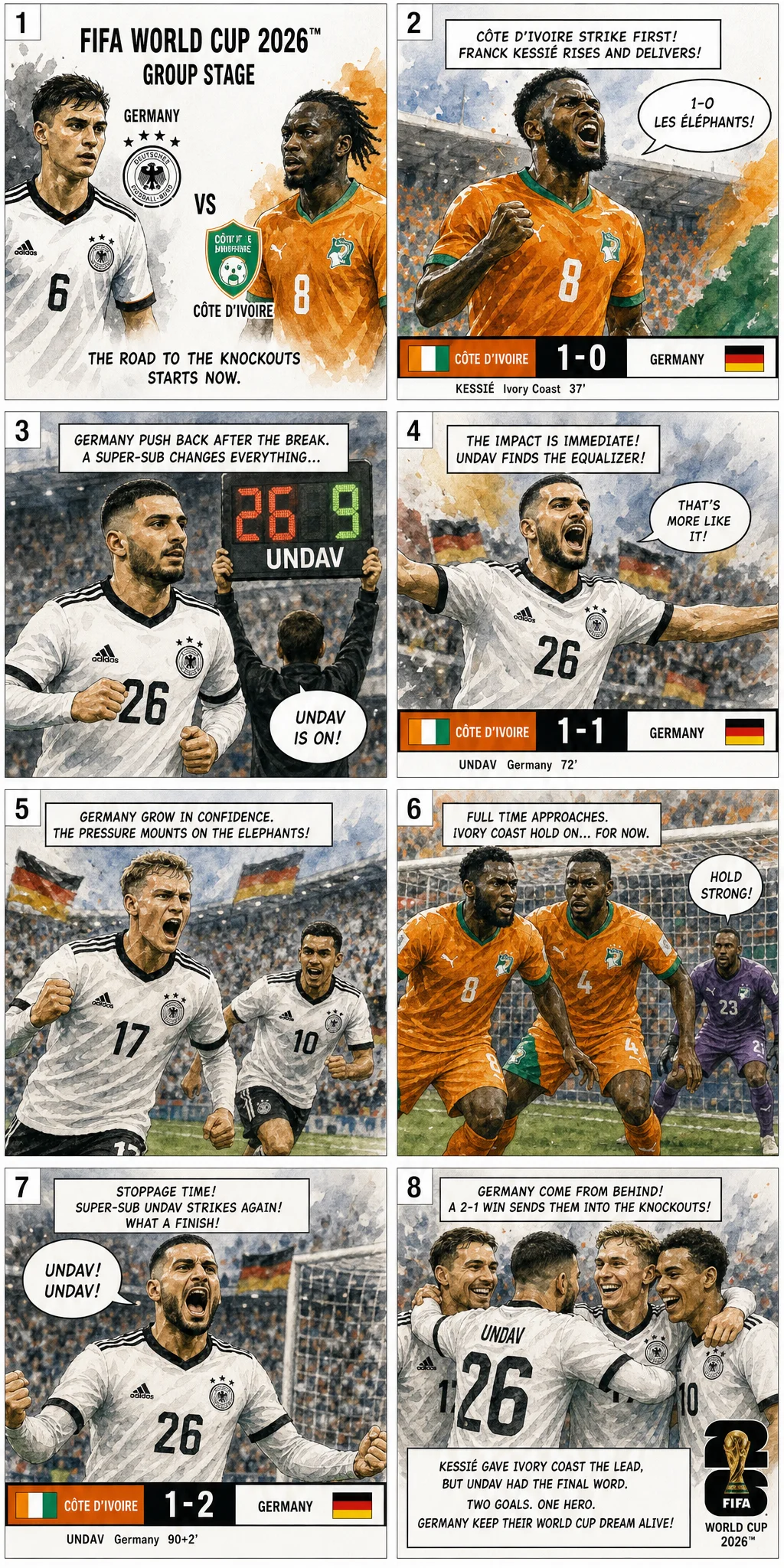
Comic content and match statistics are for entertainment purposes only and may contain inaccuracies. For Accurate Data, please refer to the reference's official website.
# Germany 2-1 Cote d'Ivoire: Undav's Late Double Rescues Germany
BMO Field in Toronto has rarely heard a sound quite like the one that greeted the final whistle. It was a sound of pure, unadulterated relief, a thunderous exhalation from the German contingent that had spent the previous 94 minutes watching their World Cup campaign teeter on the edge of a catastrophic miscalculation. For 68 minutes, Germany were not just losing to a vibrant and disciplined Côte d'Ivoire side; they were being systematically dismantled in a way that suggested their 11-match winning streak was a fragile illusion. Then, in a blur of late drama that defined this tournament’s opening round, Deniz Undav transformed from a frustrated figure into a national hero, scoring twice—including a stoppage-time winner—to snatch a 2-1 victory and secure Germany’s place in the knockout stage with six points.
The narrative of this match was never supposed to be this tense. Germany arrived in Toronto having dispatched their first group opponent with the kind of clinical efficiency that had made them pre-tournament favorites. But football, particularly at a World Cup, has a short memory for past glories. Côte d'Ivoire, needing a result to keep their own hopes alive, had no intention of playing the role of obliging sparring partners. From the first whistle, they pressed high, snapped into tackles, and targeted the spaces behind a German backline that looked unsettled by the Ivorian pace.
The opening half-hour was a masterclass in Ivorian game management. They absorbed the early German pressure—a speculative long-range effort from Aleksandar Pavlovic that sailed over the bar, a Kai Havertz header that lacked power—and then struck with brutal efficiency. The goal, when it came in the 30th minute, was a lesson in the value of persistence. Amad Diallo, the Ivorian winger who had been a constant menace on the flank, received the ball in the box and shifted it onto his right foot. His shot was low and aimed for the far corner, but Nathaniel Brown, the German left-back, threw himself into a desperate block. The ball looped up and fell kindly into the six-yard box. Franck Kessie, the veteran midfielder, had not stopped his run. He arrived before any German defender could react, stabbing the rebound past the stranded goalkeeper. BMO Field erupted, a sea of orange and green celebrating a goal that felt both deserved and seismic.
The goal injected a palpable anxiety into the German performance. Their passing, usually crisp and purposeful, became hesitant. Their movement off the ball, a hallmark of their style, stagnated. They were chasing the game against a team that was growing in confidence with every successful tackle and every cleared corner. The frustration boiled over in the moments before halftime. A slick German move ended with the ball in the Ivorian net, only for the referee’s flag to cut short the celebration. Aleksandar Pavlovic had timed his run a fraction too early. The goal was disallowed, and the German players surrounded the official in protest, but the decision stood. The half-time whistle was met with a mixture of Ivorian jubilation and German introspection. They had dominated possession, yet they trailed. They had created chances, yet they had nothing to show for it.
The second half began with a renewed sense of urgency from the Germans. Julian Nagelsmann, the German coach, had clearly delivered a pointed message in the dressing room. They pushed higher, they moved the ball faster, and they forced the Ivorians deeper into their own half. Yet the pattern of the match stubbornly refused to change. Germany would build patiently, work an opening, and then find a wall of orange shirts. Havertz, dropping deep to collect the ball, twisted and turned before unleashing a curling shot that seemed destined for the top corner. The Ivorian goalkeeper, however, was equal to it, tipping the ball over the bar. From the resulting corner, the ball fell to Havertz again. This time, his finish was precise and low, nestling into the corner of the net. The German bench erupted. The fans behind the goal celebrated. But again, the referee’s arm was raised. A foul in the buildup—a subtle push on an Ivorian defender—was enough to wipe the goal from the scoresheet. Havertz’s shoulders slumped. The sense of injustice among the German contingent was palpable. Two goals disallowed, a one-goal deficit, and the clock ticking mercilessly toward an outcome that would leave their World Cup hopes hanging by a thread.
The turning point came in the 68th minute, and it came from a source that had been relatively quiet. Nadiem Amiri, introduced as a substitute to inject creativity, received the ball on the left flank. He had space, a rare luxury in this congested match. He looked up, measured his run, and delivered a cross that was a thing of beauty—curving away from the goalkeeper and dropping perfectly into the path of Deniz Undav. The striker, who had been starved of service for most of the evening, did not need a second invitation. He adjusted his body, let the ball drop over his shoulder, and met it with a sweetly struck left-footed volley. The connection was pure, the trajectory unstoppable. The ball flew past the Ivorian goalkeeper and nestled into the far corner of the net. 1-1. The relief in the stadium was almost audible. Undav, who had been a peripheral figure for much of the match, had announced his arrival with a moment of genuine quality.
The equalizer did not calm the game; it inflamed it. Côte d'Ivoire, knowing that a draw was not enough to guarantee their progression, pushed forward with renewed vigor. The final 20 minutes were a chaotic, end-to-end affair that tested the nerve and fitness of every player on the pitch. Germany had chances to take the lead—a header from a corner that flashed wide, a driven shot from distance that the Ivorian goalkeeper parried away. But the Ivorians also carved out opportunities, their counter-attacks stretching the German defense to its limits. The game felt destined for a draw, a result that would have left Germany needing results elsewhere to advance, and the Ivorians with a fighting chance.
Then came the 94th minute. The fourth official had signaled five minutes of added time. Germany had one last chance to avoid the anxiety of a nervy wait. Felix Nmecha, who had been industrious in midfield, picked up the ball just inside the Ivorian half. He drove forward, drawing defenders toward him, and then, with a vision that belied his age, slipped a perfectly weighted pass into the path of Deniz Undav. The striker had made a subtle, intelligent run, peeling away from his marker and into the space between the center-backs and the goalkeeper. The pass was precise, arriving at his feet with the goal at his mercy. There was no time for a touch, no time for deliberation. Undav, with the composure of a man who has scored nine goals in his last 11 international appearances, shifted the ball onto his left foot and unleashed a powerful, venomous shot. The ball flew past the goalkeeper’s desperate dive and into the roof of the net. 2-1. BMO Field fell silent for a split second, a moment of collective disbelief, before the German supporters erupted in a cacophony of joy.
The final whistle, blown moments after the restart, confirmed the result. Germany had done it the hard way, the ugly way, the way that tests the character of a team. The 11th consecutive win was secured, but this one felt different. It was not a statement of dominance but a testament to resilience. Undav, with his brace, now has nine goals in 11 appearances for his country, a rate of scoring that places him among the most dangerous forwards in the tournament. Germany advanced to the knockout stage with six points, but the performance in Toronto raised more questions than it answered. The defensive fragilities that were exposed by the Ivorian counter-attacks will need to be addressed. The profligacy in front of goal—the two disallowed goals, the missed chances—will need to be refined. But for now, none of that matters. They are through. They are alive. And in Deniz Undav, they have a striker who can produce decisive moments when it matters most. For Côte d'Ivoire, there was only heartbreak. They had pushed a world power to the absolute limit, had executed their game plan with near-perfection for 68 minutes, and had been undone by two moments of individual brilliance from a player who simply refused to let his team lose. The Ivorian players collapsed to the turf, their World Cup dreams extinguished in the cruelest possible fashion. They left Toronto with their heads high, but with the bitter taste of what might have been.