

Ecuador 0-0 Curacao: Eloy Room denies Ecuadorian onslaught
ARROWHEAD STADIUM, KANSAS CITY — For 90 minutes, Ecuador did everything except the one thing that matters most in football.
Published: June 21, 2026
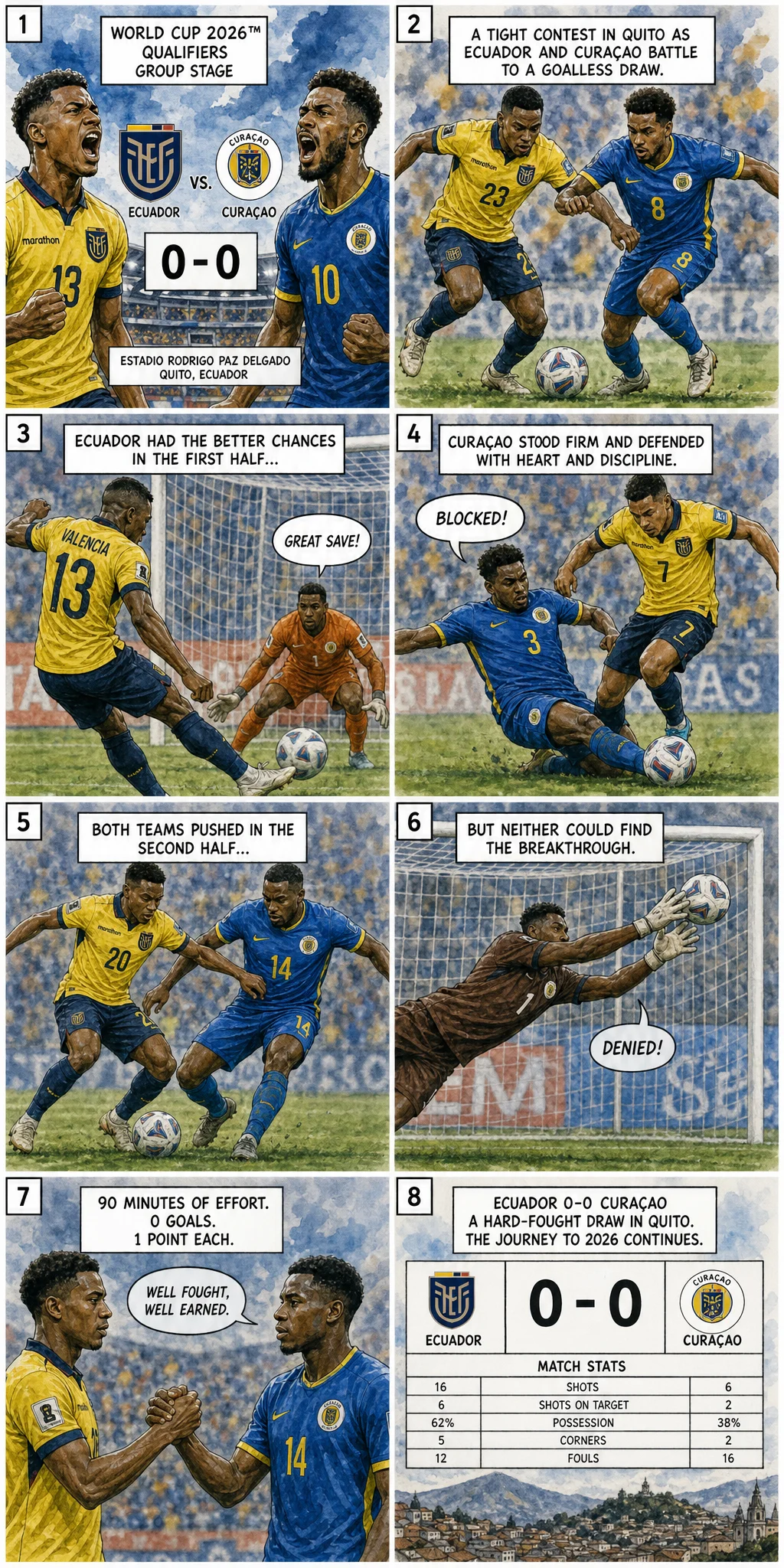
Comic content and match statistics are for entertainment purposes only and may contain inaccuracies. For Accurate Data, please refer to the reference's official website.
# Ecuador 0-0 Curacao: Eloy Room denies Ecuadorian onslaught
ARROWHEAD STADIUM, KANSAS CITY — For 90 minutes, Ecuador did everything except the one thing that matters most in football. They commanded possession, they battered the crossbar, they accumulated an expected goals tally that typically signals a comfortable victory. But they could not beat Eloy Room. And because they could not beat the 37-year-old goalkeeper from Miami FC, Curacao — a nation of roughly 158,000 people, ranked 81st in the world — walked off the field with the first World Cup point in their history, a 0-0 draw that will be remembered as one of the great defensive rearguard actions in the tournament’s modern era.
The final whistle from referee Ma Ning of China sent a ripple of disbelief through the 68,598 spectators packed into this vast NFL venue, many of whom had come expecting a straightforward Group B victory for the South Americans. Instead, they witnessed something far more improbable: a clean sheet for Curacao, their first at a World Cup, secured by a performance from Room that rewrote the record books. The veteran shot-stopper made 15 saves across the 90 minutes — the most by any goalkeeper in a single World Cup match since detailed records began in 1966. It was not merely a case of routine stops; Room was forced into a series of reflex interventions, point-blank denials, and aerial claims that left Ecuador’s forwards shaking their heads in mounting frustration.
From the opening exchanges, the pattern was established. Ecuador, playing in their vivid yellow, pressed high and moved the ball with purpose. They enjoyed 75% possession, a figure that reflected their complete control of the midfield zones. Curacao, in their blue and white, sat deep in a compact 4-4-2 shape, inviting pressure and trusting that Room would be equal to whatever came his way. The first significant chance arrived inside ten minutes when Ecuador worked a short corner routine, only for a goal-bound header to be clawed away by Room at full stretch. It was a sign of things to come.
The onslaught continued through the first half. Ecuador registered 27 shots in total, a volume that suggests not just dominance but profligacy. Yet to label it merely wasteful would be to undersell Room’s contribution. He was positioned impeccably, his footwork sharp, his decision-making unerring. When Ecuador did find a way past him, the woodwork intervened. Multiple times, the sound of ball striking frame echoed around Arrowhead. A curling effort from the edge of the area beat Room’s dive but kissed the outside of the post. A powerful drive from a tight angle cannoned back off the crossbar. A looping header from a deep cross seemed destined for the top corner until it rattled the underside of the bar and bounced down, tantalisingly, on the wrong side of the line. Each near-miss drew groans from the Ecuadorian supporters and a collective intake of breath from the neutrals.
Curacao’s game plan was simple: absorb, defend, and hope for a moment of counter-attacking inspiration that never truly materialised. They managed only a handful of forays into Ecuador’s half, none of which seriously threatened the opposition goal. Their discipline, however, was absolute. The back four, marshalled by a central defensive partnership that refused to be drawn out of position, held their shape even as Ecuador’s attackers interchanged positions and attempted to find gaps between the lines. The midfield worked tirelessly to close down space, forcing Ecuador into speculative efforts from distance that Room dealt with comfortably.
As the second half wore on, the tension ratcheted. Ma Ning, the Chinese referee, had already brandished five yellow cards to Curacao players by the hour mark, a reflection of the desperate, last-ditch tackles required to keep Ecuador at bay. The fouls were tactical, often committed high up the pitch to prevent dangerous transitions, but they carried an increasing risk of a red card that would have shattered the defensive structure. Curacao’s players walked a tightrope, yet they never lost their composure.
Ecuador’s expected goals (xG) reached 3.05, a figure that in the vast majority of matches results in at least two or three actual goals. The statistic measures the quality of chances created, and by that metric, Ecuador produced a glut of high-probability opportunities. A close-range header from a corner, saved by Room’s outstretched leg. A one-on-one after a defensive slip, snuffed out by a rapid advance from the goalkeeper. A volley from eight yards, tipped over the bar. The xG tells the story of a team that did everything right in the build-up but found a man in the form of his life standing between them and the net.
The most contentious moment arrived deep into stoppage time. With the clock ticking past the 90th minute, Ecuador launched one final attack. A cross from the right wing appeared to strike the arm of a Curacao defender as he turned to block the ball. The Ecuadorian bench erupted, demanding a penalty. Players surrounded Ma Ning, gesturing towards the spot. The referee, who had been firm throughout, waved the appeals away. Replays suggested the arm was in a natural position, close to the body, but in the heat of the moment, the decision felt like a hammer blow to Ecuador’s hopes. The game resumed, and within seconds, Room was again called into action, making his 15th and final save — a low, diving stop to his left to keep out a driven shot that seemed destined for the corner.
When the final whistle blew, the contrast in emotions was stark. Ecuador’s players collapsed to the turf, some with their heads in their hands, others staring blankly at the Kansas City sky. They had dominated every statistical category except the only one that matters. For Curacao, the reaction was one of unbridled joy. Players hugged Room, who was named man of the match by common acclaim. They embraced each other, a group of players representing a tiny Caribbean island that had just achieved something no Curacao side had ever managed before: a point at the World Cup finals.
The significance of the result extends beyond this single match. For a nation with a population roughly equivalent to a medium-sized English town, earning a point on the global stage is a monumental achievement. It validates years of development within the Curacao football federation, a system that has produced players scattered across lower leagues in Europe and the Americas, many of whom have Dutch passports and experience in the Eredivisie. Room, the veteran of the group, plays his club football in the USL Championship for Miami FC — a second-tier American league — yet here he produced a performance that will be studied by goalkeeping coaches for years.
For Ecuador, the draw is a setback, but not a fatal one. They remain a strong side, capable of progressing from the group, but the failure to convert such overwhelming dominance into goals will raise questions about their cutting edge. The xG of 3.05 suggests the chances were there; the finishing was not. They will point to the woodwork, to Room’s brilliance, to the penalty decision, but the cold reality is that they dropped two points against a team they were expected to beat comfortably.
The atmosphere at Arrowhead, known for its deafening noise during Kansas City Chiefs NFL games, was subdued at full time. The neutral crowd, which had grown to admire Curacao’s defiance, offered a standing ovation to the underdogs as they made their way around the pitch. Room raised his arms, acknowledging the applause. He had earned it. Fifteen saves, a clean sheet, a historic point. In a tournament defined by moments of individual brilliance, this was a masterclass in the art of goalkeeping.
Curacao’s next challenge will be to build on this result, to prove that the point was not a one-off fluke but a foundation for further progress. Their defensive organisation was exemplary, but they will need to offer more in attack if they are to advance. For now, however, they can savour the achievement. They came to Kansas City as rank outsiders, ranked 81 places below their opponents in the FIFA rankings. They leave with a clean sheet, a point, and a goalkeeper whose name will be etched into World Cup folklore.
Ecuador, meanwhile, must regroup. The possession statistics, the shot count, the expected goals — all of it will be forgotten if they fail to advance. Football has a cruel habit of punishing the profligate, and this 0-0 draw will serve as a stark reminder that dominance on the pitch means nothing without the final touch. They hit the woodwork multiple times, they saw a penalty appeal rejected, and they faced a goalkeeper who produced the finest performance of his career. Sometimes, the game simply refuses to bend to your will.
As the teams departed Arrowhead Stadium, the Curacao players lingered on the pitch, taking photos with the backdrop of the stands. They knew what they had done. For a nation of 158,000, a first World Cup point is not just a statistic. It is a story to tell for generations. And at its heart is Eloy Room, the 37-year-old who made 15 saves, who refused to be beaten, who turned a night of Ecuadorian dominance into a night of Curacaoan history.