

Japan 4-0 Tunisia: Ruthless efficiency marks historic milestone
MONTERREY, Mexico — The Estadio BBVA, a steel-and-glass colossus perched on the edge of this northern industrial city, played host to a piece of World Cup history on Saturday that felt less like a…
Published: June 21, 2026
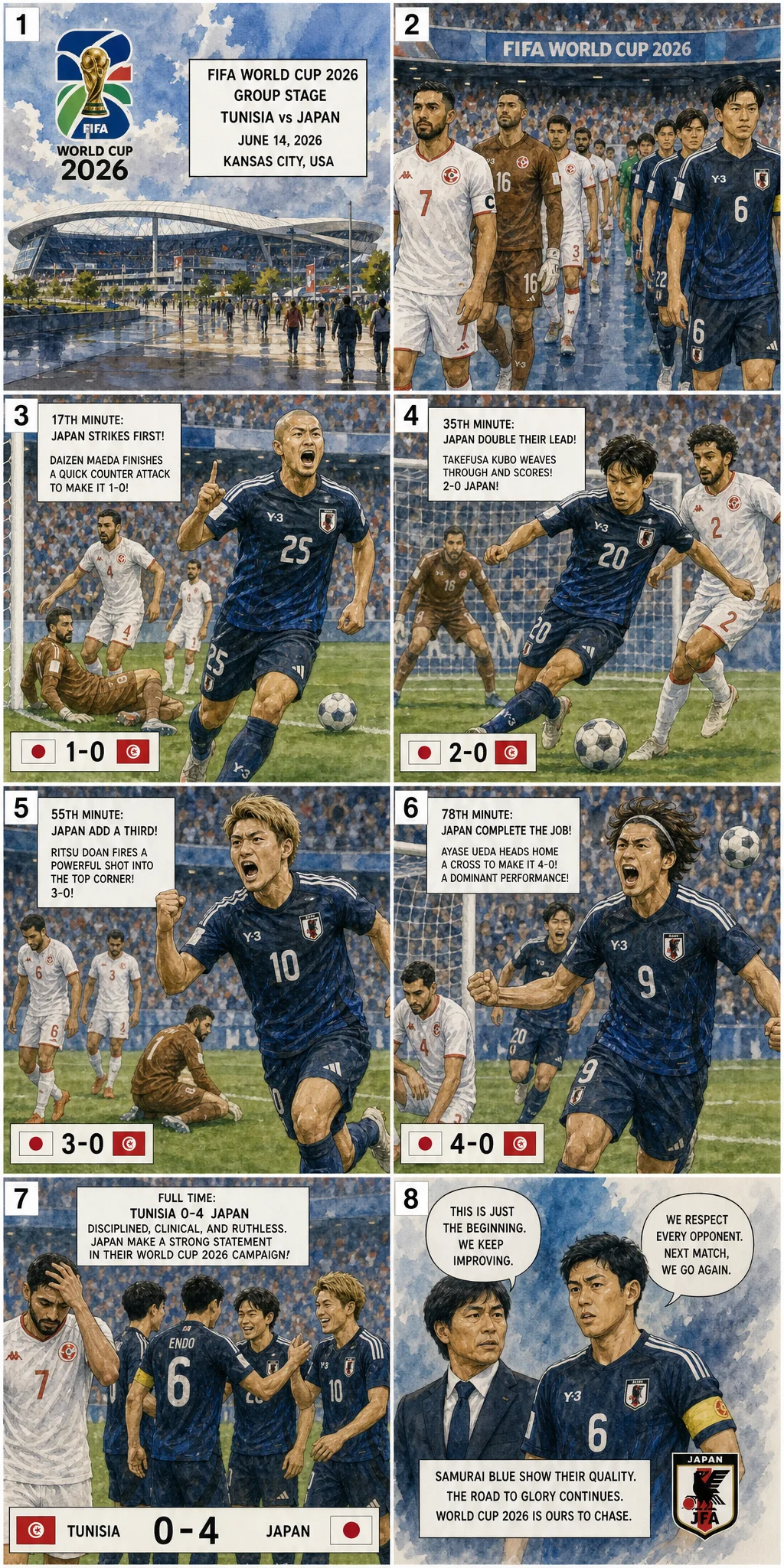
Comic content and match statistics are for entertainment purposes only and may contain inaccuracies. For Accurate Data, please refer to the reference's official website.
# Japan 4-0 Tunisia: Ruthless efficiency marks historic milestone
MONTERREY, Mexico — The Estadio BBVA, a steel-and-glass colossus perched on the edge of this northern industrial city, played host to a piece of World Cup history on Saturday that felt less like a seismic shock and more like a cold, precise surgical strike. Japan, a nation that has built its footballing reputation on resilience and late drama, chose a different script for the 1,000th match in the history of the men’s FIFA World Cup finals. They dismantled Tunisia 4-0 with a performance of ruthless efficiency, securing not only their largest-ever World Cup victory but also ensuring that an Asian team scored four goals in a single World Cup match for the first time.
The milestone match number was a ceremonial curiosity before kick-off, a statistic to be mentioned in pre-match broadcasts and match programmes. By the fourth minute, it had become a footnote. Japan’s start was not merely fast; it was historically instantaneous. From the first whistle, the Samurai Blue pressed high, forcing Tunisia’s backline into a series of panicked clearances. The move that broke the deadlock was a microcosm of their entire approach: quick, direct, and devastatingly simple. Left winger Keito Nakamura, given space to measure his run on the flank, delivered a low, driven cross that skimmed across the six-yard box. It bypassed the outstretched leg of a Tunisian defender and found Daichi Kamada, who had ghosted in unmarked at the far post. Kamada’s finish was a simple tap-in, the kind of goal that looks easy on replay but requires perfect timing and movement to create. The clock read 3 minutes and 47 seconds. It was the fastest goal Japan had ever scored in a World Cup, a statement of intent that left the Tunisian players and their considerable support in the stands stunned before the game had truly settled.
For the next 25 minutes, Tunisia attempted to regain their composure. Their midfield, anchored by the experienced Ellyes Skhiri, tried to slow the tempo, but Japan’s pressing was relentless. The Tunisian defence, which had been organised but passive in the opening stages, was repeatedly caught square. Every second ball seemed to fall to a blue shirt. The warning signs were there before the second goal arrived. Japan’s full-backs, instructed to push high, were creating overloads in wide areas, and Tunisia’s wingers were failing to track back with sufficient urgency.
The second goal, when it came in the 31st minute, was a moment of individual brilliance that broke the game’s back. Ayase Ueda, who had been a persistent nuisance with his hold-up play, received the ball with his back to goal about 25 yards out. What followed was not a hopeful punt but a calculated decision. Ueda swivelled, creating a yard of space, and unleashed a ferocious, dipping angled shot from outside the box. The ball arrowed towards the far corner, leaving Tunisian goalkeeper Aymen Dahmen with no chance. It was not a speculative effort; it was a finish of supreme confidence from a striker in peak form. The goal doubled the lead and effectively ended Tunisia’s hopes of mounting a sustained challenge. The first half ended with Japan in total control, their passing crisp and their defensive shape impenetrable. Tunisia had managed only a single speculative shot from distance, which sailed harmlessly over the bar.
The second half began with Tunisia forced to chase the game, a situation that played directly into Japan’s hands. Their manager, likely having demanded more aggression, saw his team push forward but leave gaping spaces behind. Japan, rather than sitting on their lead, continued to hunt for more goals. The pattern was set: Tunisia would win the ball in midfield, attempt a quick forward pass, lose possession to a Japanese interception, and then scramble back as the blue wave broke again.
The third goal arrived in the 69th minute and was a masterclass in counter-attacking efficiency. It began with a Tunisian corner that was cleared with authority by Japan’s central defence. The ball was quickly worked to Ueda, who had dropped deep to receive. With his back to goal, he laid it off first-time to the onrushing Junya Ito. Ito, known for his direct running and composure in one-on-one situations, took one touch to control and another to set himself. From the edge of the area, he drilled a low, precise shot that beat Dahmen at his near post. The goalkeeper may have been unsighted, but the power and placement left him with little argument. It was a goal that highlighted the synergy between Ueda, the provider, and Ito, the finisher. The 3-0 scoreline was a fair reflection of the game’s balance, but Japan were not finished.
The fourth goal, in the 83rd minute, was the most aesthetically pleasing of the afternoon. It came from a set-piece situation that Japan had clearly rehearsed. A free kick was awarded on the right flank. Kaishu Sano, who had been introduced as a substitute to add energy to the midfield, stepped up to deliver the cross. His ball was a looping, inviting delivery that arced towards the far post. Ueda, who had already scored one of the goals of the match, now showed his aerial prowess. He rose above his marker, timing his jump perfectly, and guided a looping header back across the goal and into the far corner. It was a textbook centre-forward’s finish, a demonstration of strength and technique. The brace was a fitting reward for a performance that had combined a striker’s instinct with a midfielder’s work rate. Ueda had been the focal point of everything good about Japan’s attack.
For Tunisia, the final whistle brought not just a heavy defeat but a mathematical certainty. With two losses from two group games, they became the first team eliminated from Group F. Their World Cup campaign, which had begun with cautious optimism, ended in a single afternoon in Monterrey. The statistics told a grim story: they had failed to create a single clear-cut chance, their midfield had been overrun, and their defensive structure had been carved open with alarming ease. The Carthage Eagles, a team that had reached the knockout stages in 2018 and pushed France to the brink in 2022, looked a shadow of those sides. The heat of the Mexican afternoon, combined with Japan’s relentless pressing, seemed to sap their spirit as much as their legs.
Japan’s victory was not just about the goals. It was about the manner in which they controlled the game from the first minute to the last. Their pressing was coordinated, their transitions were sharp, and their decision-making in the final third was clinical. Coach Hajime Moriyasu had clearly identified Tunisia’s vulnerability to quick, vertical attacks and had instructed his players to exploit it without hesitation. The result was a performance that did not rely on luck or a single moment of magic but on a coherent, repeatable system. The 4-0 scoreline was not a fluke; it was the logical outcome of a team that executed its game plan to perfection.
The record books will note that this was Japan’s largest-ever World Cup win, surpassing their 2-0 victory over Colombia in 2018 and their 2-1 win over Germany in 2022. More significantly, it marked the first time an Asian nation had scored four goals in a single World Cup match, a milestone that speaks to the growing tactical sophistication and attacking firepower of Asian football. Japan, already a perennial knockout-stage contender, have now added a ruthless streak to their identity.
For the neutrals in the Estadio BBVA, the match was a spectacle of controlled aggression. The venue, famous for its intense atmosphere and proximity to the pitch, provided a fitting backdrop for a game that ended any lingering doubt about Japan’s credentials in this tournament. The stands, a mix of Japanese flags, Tunisian red, and local Mexican fans who had come to see a good game, were treated to a performance that was as disciplined as it was entertaining.
As the players trudged off the pitch, the contrast was stark. The Tunisian players, heads bowed, faced the reality of an early flight home. Their tournament was over after just two matches, a harsh outcome in a group that still had everything to play for. Japan, meanwhile, celebrated with their supporters, a controlled celebration that suggested they knew this was just the beginning. They had made history in the 1,000th World Cup match, but their focus would already be shifting to the next challenge. In a tournament where margins are fine, Japan had delivered a statement performance that was impossible to ignore. The Samurai Blue had arrived in Monterrey, played their part in a historic occasion, and left with a victory that will be remembered long after the final whistle of this World Cup.