

Spain 4-0 Saudi Arabia: Tiki-taka evolves into ruthless dominance
ATLANTA — The Mercedes-Benz Stadium, a cathedral of American sport known for hosting Super Bowls and college football championships, bore witness to a distinctly Spanish footballing sermon on Tuesday…
Published: June 21, 2026
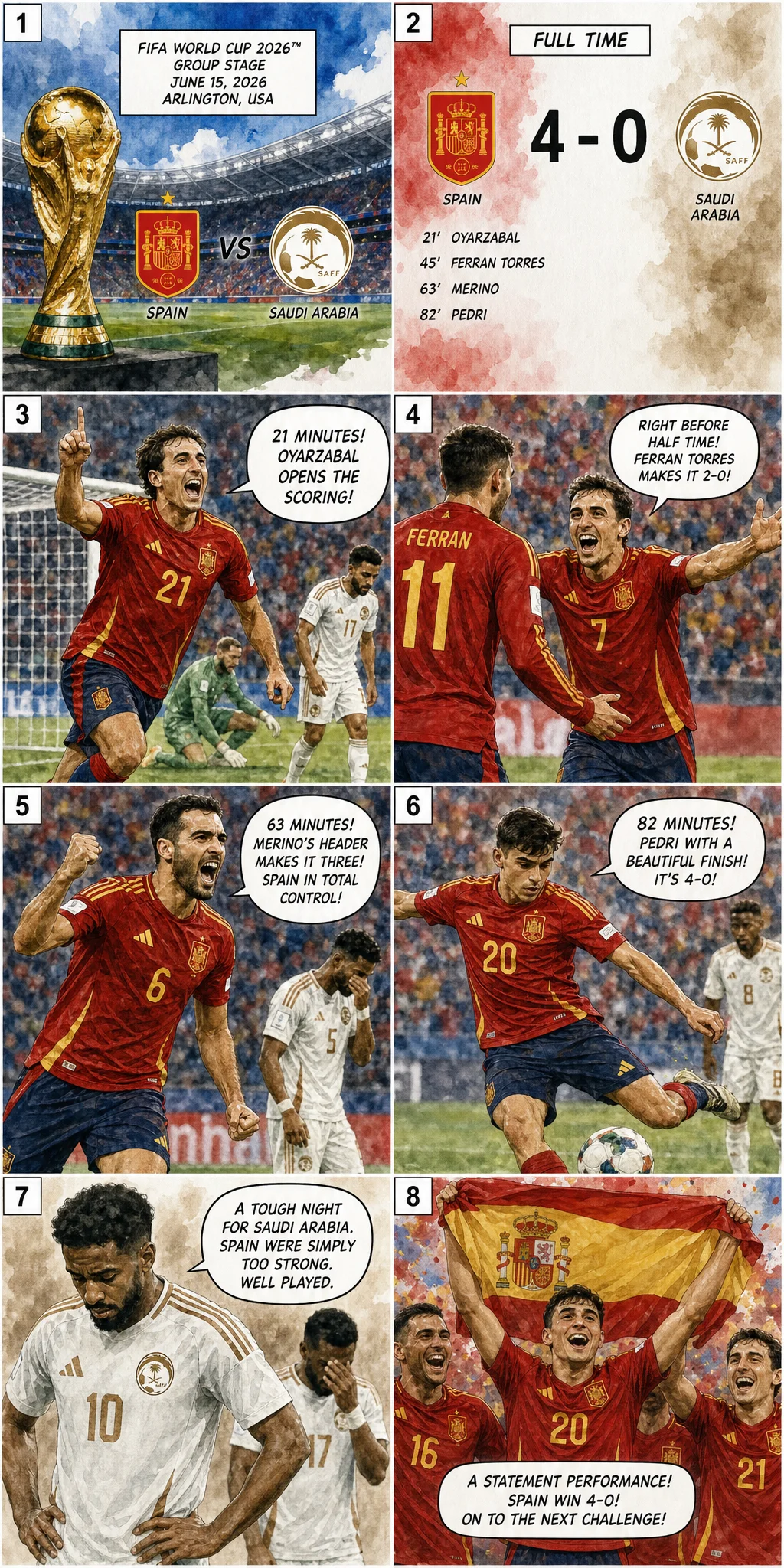
Comic content and match statistics are for entertainment purposes only and may contain inaccuracies. For Accurate Data, please refer to the reference's official website.
# Spain 4-0 Saudi Arabia: Tiki-taka evolves into ruthless dominance
ATLANTA — The Mercedes-Benz Stadium, a cathedral of American sport known for hosting Super Bowls and college football championships, bore witness to a distinctly Spanish footballing sermon on Tuesday night. Spain dismantled Saudi Arabia 4-0 in their opening group-stage match of the 2026 FIFA World Cup, a performance so complete in its dominance that the final scoreline felt almost charitable. With 70% possession, three goals in a devastating first-half burst, and a fourth shortly after the interval, La Roja sent an unequivocal statement to the rest of the tournament: the tiki-taka tradition is not merely alive; it is evolving into something more ruthless.
The first goal arrived in the 10th minute, and it bore the hallmark of a generational talent announcing himself on the grandest stage. Lamine Yamal, the teenage winger who has already shattered precocity records at club level, scored his first World Cup goal. It was a moment of instinctive, predatory movement. Mikel Oyarzabal, stationed on the left flank, received the ball in space and lofted a searching cross toward the far post. Yamal, having drifted off the shoulder of his marker, timed his run perfectly, sliding in to meet the ball with his right foot and steer it past the Saudi goalkeeper. The stadium erupted, and a piece of trivia was etched into World Cup lore: Yamal became the seventh player in the history of the competition to score before his 19th birthday. For a Saudi defense that had prepared for Spain’s patient buildup, the speed of the attack was a shock to the system.
If the first goal was a flash of teenage brilliance, the second was a lesson in set-piece efficiency. In the 21st minute, Spain won a corner on the right. The delivery, swung in with precision, found the head of Aymeric Laporte. The center-back, a towering presence in both boxes, directed his header goalward. It was not a clean finish—the ball bounced awkwardly in the six-yard box—but Oyarzabal, alert and opportunistic, bundled it over the line from close range. It was the kind of scrappy goal that often eludes possession-dominant teams, but it underscored a crucial evolution in Spain’s game: they are no longer solely reliant on threading passes through crowded defenses. They can hurt you from dead balls, too. For Oyarzabal, it was his second goal involvement of the night, and he was far from finished.
Just three minutes later, in the 24th minute, Spain delivered a knockout blow. The move began with Pedro Porro, the right-back, who overlapped and fired a cross into the box. The ball was headed on by Dani Olmo, whose deft touch redirected it into the path of Oyarzabal. The Real Sociedad forward, showing the composure of a man in the form of his life, met the ball on the volley. The strike was crisp, low, and accurate, nestling into the far corner. It was 3-0, and the game, for all intents and purposes, was over inside 24 minutes. Oyarzabal was now on a hat-trick, and the Saudi players looked shell-shocked, unable to cope with the relentless movement and technical superiority of their opponents.
The first half continued with Spain in complete control. Oyarzabal, sensing history, came within inches of completing his hat-trick before the interval. A flowing move, characteristic of Spain’s best work, carved open the Saudi defense once more. The ball found its way to Oyarzabal on the edge of the area, and he struck it sweetly, only to see his effort crash against the crossbar. It was a cruel moment for the forward, but it did little to diminish his impact. The statistic that followed him onto the pitch at halftime was staggering: Oyarzabal has now scored 14 goals in his last 13 appearances for Spain. That kind of ratio, for a player who is not always the first name on the teamsheet, is the hallmark of a man who has found a vein of form at precisely the right time. The Saudi defense, meanwhile, retreated to the dressing room with the look of a side that had been hit by a hurricane and was simply trying to survive the storm.
The second half offered no respite. Spain, to their credit, did not take their foot off the gas. They continued to circulate the ball with purpose, probing for openings, and in the 49th minute, they found their fourth goal. It came from a familiar source of pressure: a cross from the left. Marc Cucurella, the left-back who had been marauding forward all night, connected with a volley that was struck with power and dip. The Saudi goalkeeper, forced into action, managed to parry the ball, but only as far as his own defender, Hassan Al Tambakti. Under pressure from the onrushing Spanish forwards, Al Tambakti could only turn the rebound into his own net. It was a cruel own goal, the kind that will haunt a defender, but it was a fitting reward for Spain’s relentless pressure. The score was 4-0, and the match had become an exhibition of control.
From that point on, the game settled into a rhythm of Spanish possession and Saudi damage limitation. The 70% possession statistic told a story of total control, but it was not sterile possession. Spain continued to create chances, with Yamal and Olmo tormenting the flanks and Oyarzabal dropping deep to link play. The Saudi side, to their credit, did not capitulate entirely. They defended with a desperate pride, throwing bodies in front of shots and clearing their lines whenever Spain threatened to add a fifth. But they rarely threatened at the other end. Spain’s defense, marshaled by Laporte and his center-back partner, was rarely tested, and the midfield trio of Rodri, Pedri, and Olmo ensured that the ball rarely stayed in the Spanish half for more than a few seconds.
The attendance, announced at approximately 68,000, created a vibrant atmosphere in the cavernous Mercedes-Benz Stadium. The crowd, a mix of neutral American fans, the sizable Spanish diaspora, and a passionate Saudi contingent, witnessed a performance that was both clinical and artistic. For the Spanish fans, it was a night of vindication. The team that had been knocked out on penalties in the quarterfinals of the previous World Cup, and had struggled for consistency in the intervening years, looked reborn. The blend of youth and experience was evident: Yamal’s fearless dribbling, Pedri’s hypnotic passing, and the sheer ruthlessness of Oyarzabal in front of goal.
For Saudi Arabia, the reality is sobering. They came into the tournament with hopes of replicating their famous upset against Argentina in 2022, but they were simply outclassed from the first whistle. The speed of Spain’s passing, the movement off the ball, and the physicality in the air were all levels above what they could handle. The own goal by Al Tambakti was emblematic of a night where everything went wrong. They will need to regroup quickly if they are to have any hope of advancing from the group stage.
The narrative of this match, however, belongs to Oyarzabal. His near-hat-trick, his cross for Yamal’s historic goal, and his relentless work rate epitomized Spain’s approach. He is not the flashiest player in this squad, but he has become its most potent weapon. With 14 goals in his last 13 international appearances, he is in the form of his life, and he is the focal point of an attack that looks capable of dismantling any defense in this tournament. The crossbar denied him a perfect first half, but his performance was still a masterclass in forward play.
As the final whistle blew, the Spanish players gathered in a huddle, acknowledging the 68,000 fans who had cheered them on. The scoreline was emphatic, but the performance was even more so. Spain had not just beaten Saudi Arabia; they had dismantled them with a brand of football that was both beautiful and brutal. The tiki-taka has added a cutting edge, and the rest of the World Cup has been put on notice. In the heart of Atlanta, under the retractable roof of the Mercedes-Benz Stadium, Spain delivered a statement of intent. The road to the final is long, but on this evidence, La Roja have the tools to go all the way. For Oyarzabal, for Yamal, and for a team that seems to have rediscovered its identity, the journey has begun in spectacular fashion.