

Belgium 0-0 Iran: Red card, disallowed goal, miraculous saves
INGLEWOOD, Calif. — The 2026 FIFA World Cup will be remembered for many things, but not for what happened inside SoFi Stadium on this occasion.
Published: June 21, 2026
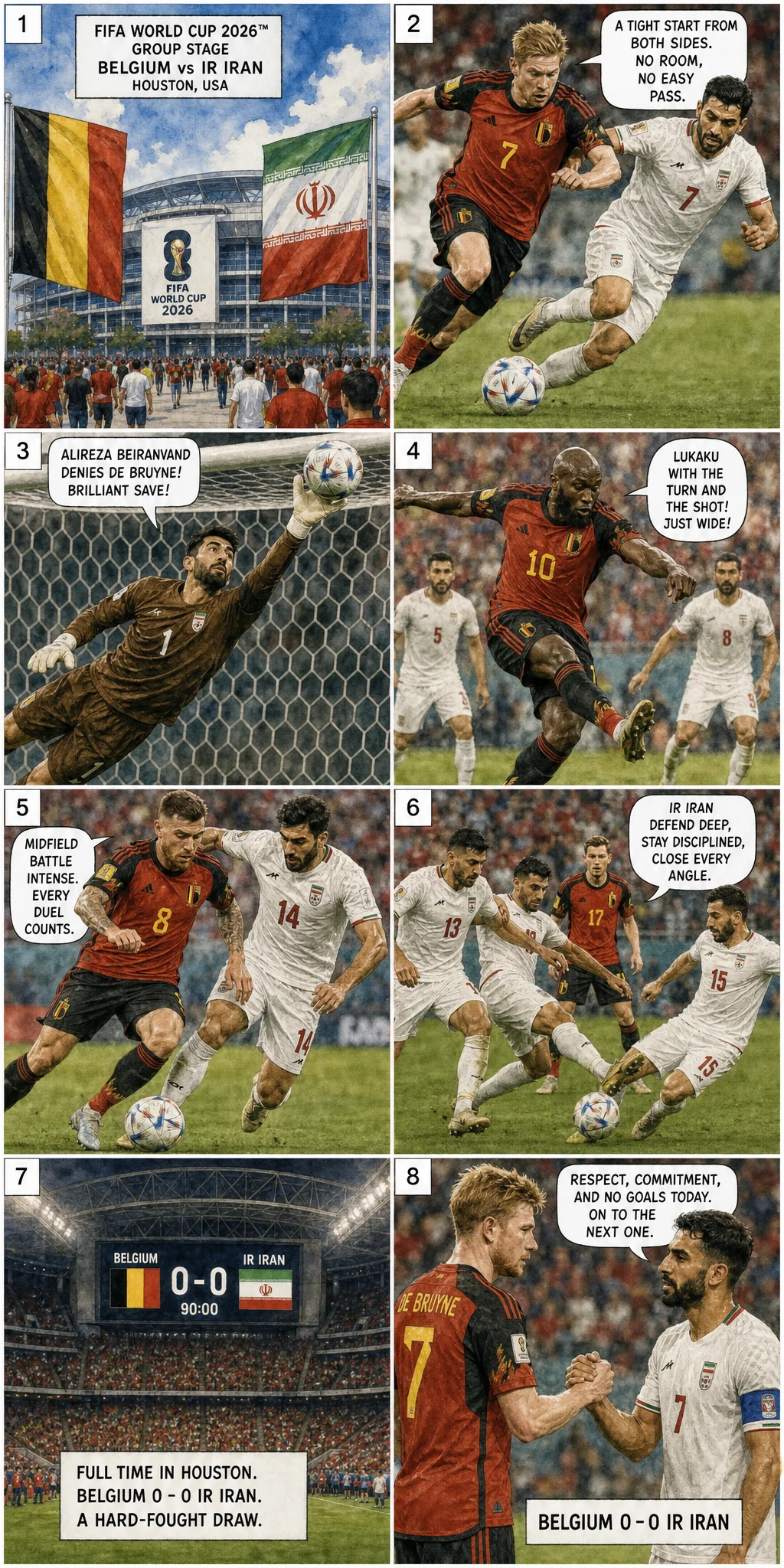
Comic content and match statistics are for entertainment purposes only and may contain inaccuracies. For Accurate Data, please refer to the reference's official website.
# Belgium 0-0 Iran: Red card, disallowed goal, miraculous saves
INGLEWOOD, Calif. — The 2026 FIFA World Cup will be remembered for many things, but not for what happened inside SoFi Stadium on this occasion. Belgium and Iran played out a goalless draw that was as tense as it was frustrating, a match defined by a disallowed goal, a red card, and a performance from Iran’s goalkeeper that bordered on the miraculous. The final scoreline of 0-0 belied the drama that unfolded over 90 minutes, but it was a result that left both sides with mixed feelings: Belgium wondering how they failed to score with 11 men, and Iran celebrating a point earned through sheer defiance.
From the opening whistle, Belgium asserted their dominance in a manner that suggested an early breakthrough was inevitable. The Red Devils, fielding a side packed with technical quality, pinned Iran back into their own half with relentless waves of possession. At times, the statistics were staggering: Belgium enjoyed nearly 80% of the ball in the first half, a figure that would have been even higher had Iran not occasionally cleared their lines. The midfield trio of Youri Tielemans, Amadou Onana, and Kevin De Bruyne orchestrated the tempo with precision, recycling possession and probing for gaps in Iran’s compact 4-4-2 defensive block. Shots rained in from all angles—11 in total before the interval—but each attempt was either blocked, skewed wide, or, most crucially, repelled by the man who would become the match’s defining figure.
That man was Alireza Beiranvand. The Iranian goalkeeper, already a veteran of three World Cups, delivered a performance that will be etched into tournament lore. His first significant intervention came in the 12th minute, when a curling effort from Jeremy Doku seemed destined for the top corner. Beiranvand, reading the flight of the ball early, launched himself to his right and tipped it over the bar with a strong wrist. The save was good, but it was merely a prelude. As the half wore on, Belgium’s pressure intensified. Romelu Lukaku, the focal point of the attack, saw a close-range header clawed away by Beiranvand’s outstretched palm. De Bruyne, orchestrating from deep, fired a low drive that the goalkeeper smothered at the second attempt. The Iranian backline, marshaled by the experienced Morteza Pouraliganji, held firm, but the cracks were showing.
The defining moment of the first half arrived in the 25th minute, and it was a moment of high technology and high controversy. Iran, having weathered the storm, launched a rare counter-attack. A long ball over the top found Mehdi Taremi, the Porto striker, who had timed his run to perfection. As the ball dropped, Taremi controlled it on his chest, took a touch, and slotted a composed finish past Thibaut Courtois. The Iranian bench erupted, and the traveling fans in the SoFi Stadium stands roared. But the celebration was short-lived. The assistant referee’s flag remained down, but the video assistant referee (VAR) was already reviewing the play. After a lengthy check, the decision came back: offside. The margin was minuscule—a shoulder width, according to the official broadcast. Taremi’s left shoulder, the one closest to the goal, had been fractionally ahead of the last Belgian defender, Nathan Ngoy. The goal was disallowed, and Iran’s hopes of a shock lead were dashed. The decision was correct by the letter of the law, but it left a bitter taste for those who love the flow of the game. For Belgium, it was a reprieve, but it also served as a warning: Iran were not here merely to defend.
The second half began with Belgium again on the front foot, but the pattern of the first half repeated itself. Shots were fired, chances were created, but Beiranvand was a wall. In the 58th minute, he produced the save of the match—an incredible one-handed stop from a thunderous volley by Maxim De Cuyper. The Belgian left-back, overlapping from his wing-back position, had connected cleanly with a cross that arced toward the far post. The ball was traveling with pace and dip, and it looked destined for the top corner. Beiranvand, reacting in a split second, threw himself to his right and somehow got a hand to it, deflecting it over the bar. The stadium gasped. Even the Belgian players paused, shaking their heads in disbelief. It was the kind of save that defines tournaments, the kind that makes a goalkeeper a national hero.
But the match’s complexion changed irrevocably in the 66th minute. Iran, again on the break, played a perfectly weighted through ball that split the Belgian defense. Taremi, once more, was the beneficiary. He galloped onto the pass, clear of the last defender, with only Courtois to beat. Nathan Ngoy, the young Belgian center-back, was caught out of position and desperate. He lunged, grabbing Taremi’s shoulder and pulling him to the ground. The referee, positioned well, immediately blew his whistle and reached for his back pocket. It was a straight red card—the eighth of the tournament, a statistic that underscored the physicality and high stakes of this World Cup. Ngoy’s face fell as he trudged off the pitch. Belgium, already frustrated by their inability to score, were now down to 10 men for the final 24 minutes plus stoppage time.
The decision forced Belgium manager Domenico Tedesco into an immediate tactical reshuffle. He sacrificed Romelu Lukaku, the team’s most potent attacking threat, in the 73rd minute, replacing him with defender Arthur Theate. The move was pragmatic but painful. Lukaku, who had been a focal point of the first-half dominance, had not scored, but his presence had occupied the Iranian center-backs. Without him, Belgium’s shape shifted to a 4-4-1, with De Bruyne pushed higher as a lone forward, but the attacking impetus was gone. The team that had dominated possession for 66 minutes was now reduced to counter-attacking on the break, hoping to catch Iran off guard.
Iran, sensing blood, pushed forward with renewed vigor. Taremi, still fuming from the disallowed goal, became a constant nuisance, dropping deep to link play and drawing fouls. Sardar Azmoun, his strike partner, tested Courtois with a low drive that the Belgian goalkeeper saved comfortably. But Iran’s best chance came in the 82nd minute, when a corner was flicked on at the near post and fell to Pouraliganji, whose header was goal-bound until Courtois, showing his class, acrobatically tipped it over. The Belgian goalkeeper, making his 17th World Cup appearance, had equalled Enzo Scifo’s all-time Belgian record. It was a milestone worth noting, but Courtois would have traded it for a win.
The final minutes were a frantic, disjointed affair. Belgium, with 10 men, defended deep, their midfielders tracking back with desperation. De Bruyne, usually the conductor, was now a passenger, isolated and frustrated. Iran threw bodies forward, but their final ball lacked precision. The referee added five minutes of stoppage time, and in that period, Iran had one last chance. A free kick from the edge of the box was swung in, and the ball ricocheted around the penalty area before falling to a substitute, whose shot was blocked by a sliding Theate. The final whistle blew, and the scoreboard read 0-0.
For Belgium, the result felt like a defeat. They had dominated the first half, created 11 shots, and controlled possession, yet they left with a single point. The red card to Ngoy was a disaster, but the failure to score with 11 men was the deeper concern. Lukaku’s sacrifice for Theate was a tactical necessity, but it highlighted the fragility of their squad depth. Courtois’s record-equaling appearance was a footnote in a night of frustration. The team will need to regroup quickly, as their path to the knockout stages now looks more precarious.
For Iran, this was a point earned through grit and a world-class goalkeeping display. Beiranvand’s performance—the one-handed stop from De Cuyper, the numerous saves from close range—was the stuff of legend. He was named FIFA Man of the Match, and the decision was unanimous. His teammates, particularly Taremi, who had his goal wrongly (or rightly, depending on perspective) disallowed, will feel aggrieved but also proud. They had held one of the tournament’s favorites to a draw, and they did so with discipline and resilience.
The match at SoFi Stadium was not a classic. It was a game of fine margins, of a shoulder width, of a red card, of a goalkeeper at his absolute peak. It was a reminder that football, at its highest level, is often about what doesn’t happen as much as what does. Belgium will look back at the first half and wonder how they didn’t score. Iran will look back at the 25th minute and wonder what might have been. In the end, the 0-0 scoreline was a fair reflection of a match that had everything except a goal.