

Colombia 1-0 DR Congo: Muñoz Strike Sends Colombia Through
GUADALAJARA, Mexico — For 75 minutes at Estadio Akron, Colombia looked like a team carrying the weight of a nation’s expectations on its shoulders, tentative and uncharacteristically cautious against…
Published: June 24, 2026
Comic content and match statistics are for entertainment purposes only and may contain inaccuracies. For Accurate Data, please refer to the reference's official website.
# Colombia 1-0 DR Congo: Muñoz Strike Sends Colombia Through
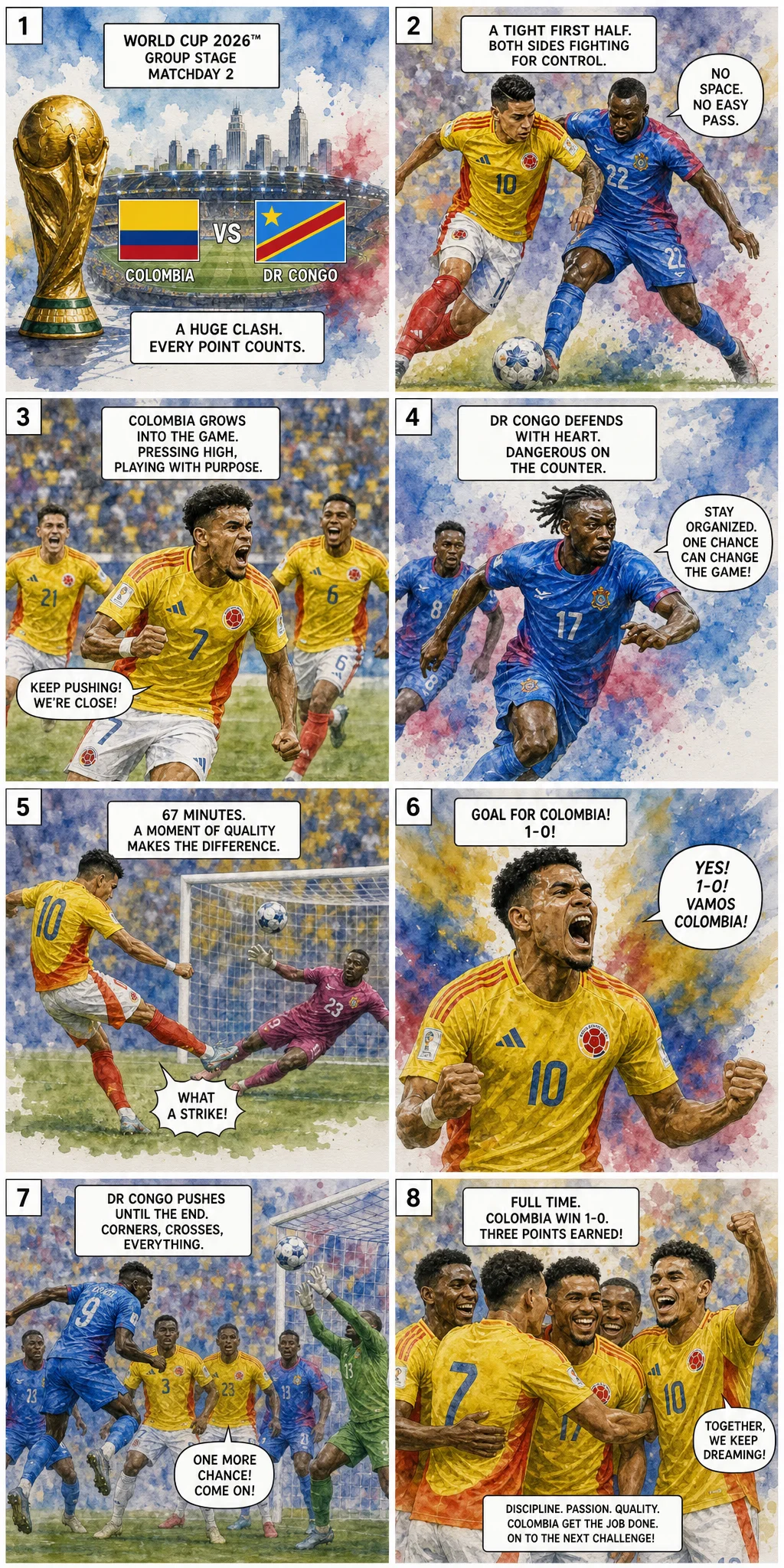
GUADALAJARA, Mexico — For 75 minutes at Estadio Akron, Colombia looked like a team carrying the weight of a nation’s expectations on its shoulders, tentative and uncharacteristically cautious against a DR Congo side playing with nothing to lose. Then Daniel Muñoz struck, a moment of precision from an unlikely source that not only broke the deadlock but sent Colombia soaring into the knockout stage of the 2026 FIFA World Cup. The 1-0 victory in this Group K encounter was far from the flowing, attacking football that Colombia’s supporters had hoped for, but in the cauldron of a World Cup group stage, style points matter less than the final scoreline. And the final scoreline, delivered by Muñoz’s left foot in the 76th minute, was enough to secure Colombia’s place in the Round of 32.
The match began with Colombia asserting control of possession, as expected, but the rhythm was labored. DR Congo, appearing in only their second World Cup finals after a long absence from the global stage, set up with a compact defensive block, content to absorb pressure and hit on the break. The African side had already made history in this tournament—Yoane Wissa had scored DR Congo’s first-ever World Cup finals goal in a previous match—and they carried that belief into this contest. Their organization was disciplined, their transitions sharp, and they forced Colombia into a series of half-chances rather than clear-cut opportunities. The first half passed without a goal, a testament to DR Congo’s resilience and Colombia’s inability to find the final pass or the incisive run to unlock a well-drilled defense.
Colombia’s midfield, typically the engine room of their creativity, struggled to impose itself. Jhon Arias, starting on the right side of midfield, was lively but often isolated, his crosses either blocked or claimed confidently by the DR Congo goalkeeper. The expected goals (xG) statistic, which measures the quality of chances created, told a revealing story: Colombia generated just 1.03 xG over the entire match, while DR Congo managed only 0.39. Those numbers reflect a contest that was tight, tactical, and often frustrating for the side carrying the greater burden of expectation. Colombia’s best chance of the first half came from a corner that was headed wide, but it was the kind of chance that felt more hopeful than dangerous.
As the second half wore on, the tension inside Estadio Akron grew palpable. Colombia’s manager made a key substitution, bringing on Richard Ríos to replace Jhon Arias in the 62nd minute. Ríos, a dynamic midfielder, injected energy and directness into Colombia’s play. His arrival seemed to shift the momentum, giving Colombia a more aggressive shape and forcing DR Congo to retreat deeper. The Leopards, as DR Congo are known, had defended valiantly for over an hour, but the constant pressure began to take its toll. Their midfield, which had been so effective at closing spaces, started to tire, and the gaps that Colombia had been searching for finally began to appear.
The decisive moment arrived in the 76th minute. The exact minute is recorded differently by various outlets—some sources note the 76th, others the 77th—but the action itself was unmistakable. A sequence of passes on the right side of the pitch created space for Muñoz, the right-back who had pushed forward with intent. The ball found him on the right side of the box, and with DR Congo’s defense scrambling to close him down, Muñoz took a touch to set himself before unleashing a left-footed shot that arrowed toward the bottom right corner. The goalkeeper, who had been solid throughout, could only watch as the ball nestled into the net. It was not a thunderous strike, but a precise one—placed with enough curl and pace to beat the outstretched hand. The goal sparked a roar from the Colombian contingent in the stands, a release of tension that had been building for more than an hour.
The assist provider for Muñoz’s goal is not recorded in the available match data, a detail that remains unknown. What is known is that the goal was Muñoz’s first of the tournament, and it came at the most crucial moment. For a full-back, scoring a goal of such importance in a World Cup group stage is the stuff of dreams. Muñoz’s celebration was brief but emotional, a reminder of how much this meant to a Colombian side that had struggled to break down a stubborn opponent.
After the goal, DR Congo pushed forward in search of an equalizer, but their efforts were disjointed. The xG of 0.39 tells the story of their attacking limitations: they created few high-quality chances, and Colombia’s defense, marshaled by its experienced center-backs, held firm. The Leopards’ best opportunity came from a set piece that was headed over the bar, but it was a half-chance at best. Colombia, for their part, could have added a second on the counterattack, but they were content to manage the game, keeping possession and running down the clock. The final whistle confirmed a 1-0 victory, and with it, Colombia’s progression to the knockout stage.
This was the first-ever meeting between Colombia and DR Congo at any level, a historical note that adds context to the match. The two nations had never crossed paths before, and the game reflected the unfamiliarity. Colombia, with their rich footballing heritage and a generation of players who have competed at the highest level in Europe, were expected to dominate. DR Congo, meanwhile, were making their mark on the world stage, and despite the defeat, they can take pride in a performance that pushed a World Cup contender to the limit. Their fans, who had traveled in numbers to Guadalajara, sang throughout the match, a testament to the pride they feel in their team’s first World Cup appearance in decades.
The significance of this result for Colombia cannot be overstated. By securing their place in the Round of 32, they have achieved the minimum objective for a team of their caliber, but the manner of the victory raises questions. Colombia struggled to create clear chances against a disciplined defense, and their reliance on a moment of individual brilliance from a full-back will not be sustainable against stronger opponents. The midfield, so often the heartbeat of Colombian football, lacked the incisiveness that has characterized their best performances. Richard Ríos’ introduction provided a spark, but the team’s overall fluidity was inconsistent. The xG of 1.03 suggests that Colombia created chances worth roughly one goal, and they scored exactly one—a narrow margin that could have gone the other way.
DR Congo, meanwhile, exit the World Cup with their heads held high. They have scored their first-ever finals goal, courtesy of Yoane Wissa, and they have shown that they can compete with top-tier opposition. Their defensive organization was excellent for 75 minutes, and they will rue the lapse that allowed Muñoz to find space on the edge of the box. But in a tournament where experience and composure often decide tight games, DR Congo lacked the cutting edge to punish Colombia’s mistakes. Their future is bright, however, and this campaign will serve as a foundation for the next generation.
For Colombia, the focus now shifts to the Round of 32, where they will face an opponent yet to be determined. The knockout stage is a different beast, a single-elimination format that rewards ruthlessness and efficiency. Colombia have shown they can grind out a result, but they will need to find more creativity and sharper finishing if they are to advance deep into the tournament. The Estadio Akron, a venue that has hosted its share of dramatic World Cup moments, witnessed a game that was not beautiful but was undeniably tense. In the end, Daniel Muñoz’s left foot made the difference, and Colombia march on.